 QuietFlame
Why Do I Feel Anxious the Moment I Lie Down in Bed?
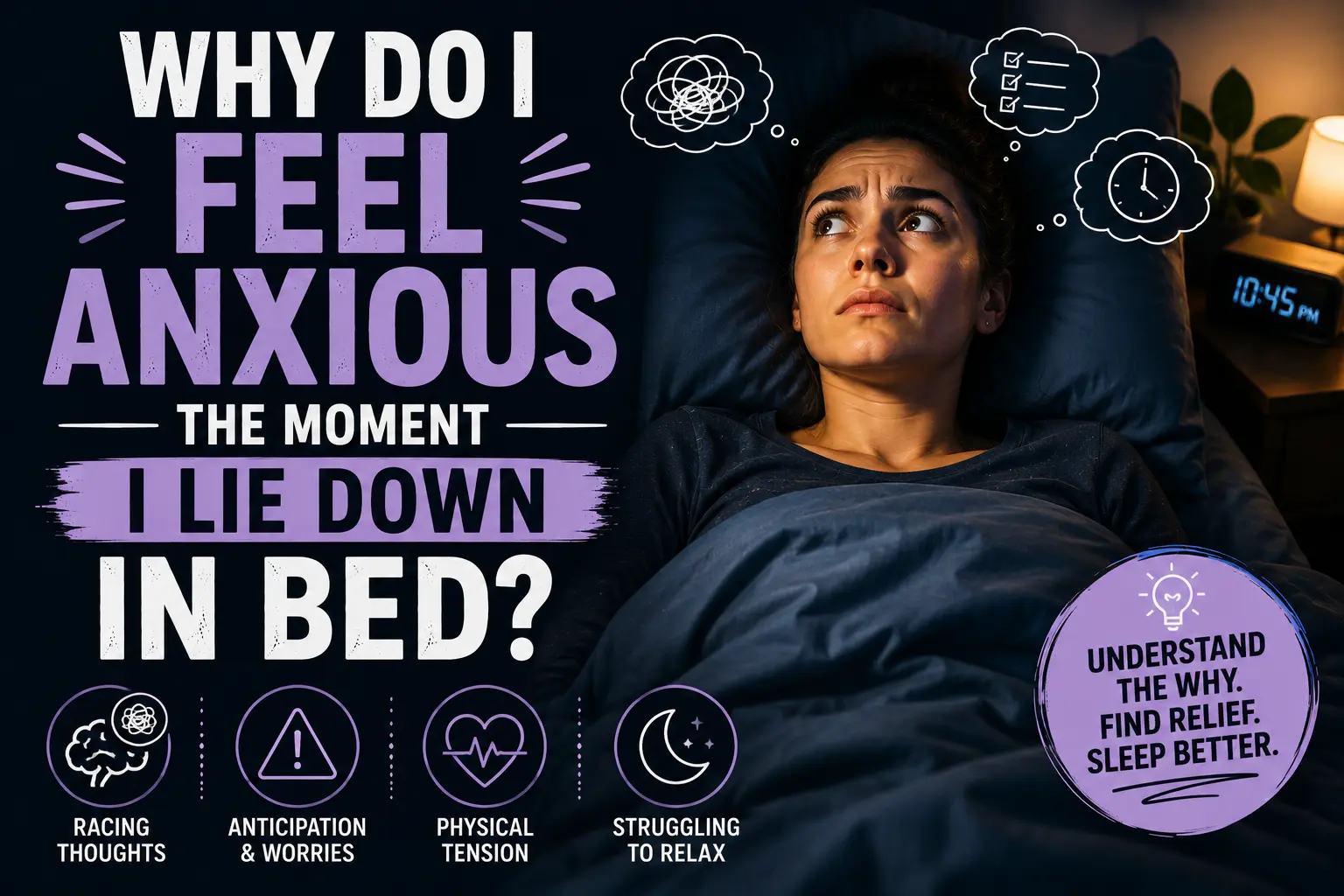
Bedtime anxiety is common and often misunderstood. Here is why it shows up when the lights go off, what is happening in your body, and what actually helps before sleep.
You feel anxious when you lie down because the day’s distractions stop while your nervous system is still running “daytime mode.” The bed is not causing the anxiety so much as revealing it. When external noise drops, unfinished thoughts and leftover physical arousal have nowhere to hide. That does not mean something is uniquely wrong with you. It means your body never got a clear signal that the day was over.
This article explains why that surge happens, what makes it worse, and what to do in the minutes before sleep - including a simple breathing approach that works better before you are already spiraling. For a focused technique walkthrough, see the best breathing exercise for anxiety before bed. For a short nightly reset habit, see the 5-minute breathing reset before bed.
What bedtime anxiety actually feels like
People describe it in different ways, but the pattern is familiar:
- A wave of dread as soon as the lights go off
- Heart rate that suddenly feels noticeable
- Chest tightness or a shallow breath you cannot “fix”
- A mind that opens every unresolved tab at once
- A fear of not sleeping that then becomes the main reason you cannot sleep
Sometimes there is a clear trigger - tomorrow’s meeting, a conflict, money, health. Sometimes there is not. The absence of a story does not make the body sensation less real. Anxiety at bedtime is often more physiological than philosophical: alertness without a task.
It also tends to have a schedule. During the day, meetings, messages, movement, and noise compete for attention. At night, those competitors leave. What remains is the residue of stress plus the quiet that makes residue feel enormous.
There is a second pattern that confuses people: you can feel fine while brushing your teeth or reading on the couch, then feel a sharp rise the second you lie flat. That timing is not random. Standing and light activity still give your brain something to organize. Horizontal stillness removes the last bit of structure. If your system is still carrying unfinished arousal, that is often when it announces itself.
Why lying down makes it louder
1. Your nervous system does not flip off with the light switch
Stress and focus keep the sympathetic system engaged - useful for getting through a day, inconvenient at 11 p.m. Closing the laptop is not the same as completing a downshift. If you go from stimulation to horizontal stillness with no transition, your body can still be prepared to respond while your mind expects rest. That mismatch feels like anxiety.
2. Silence removes distraction, not activation
Scrolling, TV, chores, and conversation can mask tension. They do not resolve it. When you lie down, the masking ends. The activation remains. So it feels like bed “gives” you anxiety, when bed mostly stops covering it.
3. Sleep pressure and threat detection collide
Your brain is supposed to become less vigilant as sleep approaches. If part of you is still scanning for problems - tomorrow’s list, something you said, a bodily sensation - vigilance stays high. Horizontal posture and darkness can even amplify body awareness: you notice your heartbeat because there is less else to notice.
4. Anticipatory fear of sleeplessness feeds itself
After a few hard nights, lying down can become a conditioned cue: this is where it gets bad. The fear of anxiety becomes a second layer of arousal. That layer is treatable with routine and downshift practice, but it rarely disappears by arguing with yourself to “just relax.”
5. Daytime coping can be nighttime liability
Many people manage anxiety during the day with motion, caffeine, productivity, or constant input. Those strategies work until they do not. At night they stop being available - or they become counterproductive if you try to keep them going in bed. The skill gap shows up at lights-out: you know how to push through a workday, but you have not practiced ending a day.
6. The body keeps score of unfinished stress
A tense jaw, raised shoulders, shallow breathing, and a stomach that never fully settled are not dramatic enough to stop your day. They are dramatic enough to keep sleep at bay. Lying down does not invent those signals. It finally lets you feel them without interruption.
What makes bedtime anxiety worse
Bright screens until the last second. Light and stimulating content keep alertness high, then you demand an instant off-switch.
Caffeine late in the day. Even “I still fall asleep” caffeine can leave a restless body underneath.
No wind-down at all. Jumping from work brain to pillow is a common setup for a surge.
Trying to force a blank mind. Fighting thoughts raises effort. Effort raises arousal. For looping thoughts specifically, breathing exercises to stop overthinking at night focus on interrupting the loop rather than erasing thinking.
Deep, forced “calming” breaths. Big heaving inhales can increase lightheadedness or panic-like sensations. Gentle longer exhales are usually safer at night.
Checking the clock. Each glance adds a progress report your nervous system did not need.
Alcohol as a sleep aid. It can make you drowsy, then fragment the second half of the night and leave you more reactive the next evening. If bedtime anxiety is already high, that rebound can feel like proof that “nothing works.”
Rehashing the day as a wind-down. Review can be useful earlier in the evening. In bed, it usually turns into rumination. Dump the loops on paper before you lie down, then stop the analysis.
What helps in the moment (and just before)
Start before you lie down
The highest-leverage move is a short practice before you expect sleep - sitting on the edge of the bed or in a chair for three to five minutes. Arriving in bed already slightly softer beats trying to invent calm after the surge has started.
Use a longer-exhale breath
A reliable pattern:
- Inhale through your nose for four seconds - quiet, modest volume
- Exhale slowly for six to eight seconds
- Skip long holds if you feel anxious
- Repeat for about five minutes
The long exhale is the active ingredient for downshifting. Perfect counts are optional. Comfort is not.
If classic techniques with long holds feel activating, skip the holds. You can still use structured methods like 4-7-8 breathing in a modified form: keep the longer exhale, drop anything that feels like pressure.
Box breathing (equal counts) can also work for some people earlier in the evening, but when anxiety is already climbing at lights-out, a longer exhale is usually the safer first choice. Comparisons like box breathing vs 4-7-8 for sleep matter less than this rule: if a pattern increases pressure in your chest, soften it.
Do a two-minute open-loop dump
Before the breathing, write two or three lines: what is unfinished, and the next tiny step for tomorrow. This is not journaling for insight. It is externalizing the loops so your brain stops rehearsing them to “not forget.”
Lower the sensory load
One lamp instead of overhead light. Phone face-down. Cooler room if you can. Anxiety and overheating often travel together at night.
If you are already in bed and spiraling
Stay with the longer exhale. Soften the inhale. Put a hand on your belly if that helps you feel the breath without forcing it. If twenty minutes pass and agitation is climbing, sit up in low light, breathe for a few minutes, then return. Avoid turning this into a bright-screen break.
A useful cue: you are not trying to fall asleep on command. You are trying to become a little less activated than five minutes ago. Sleep follows a softer body more often than a forced blank mind.
What “better” looks like on a hard night
Success is not always unconsciousness in ten minutes. On hard nights it can mean the dread peaks sooner, the breath stops feeling like a fight, you check the clock less, or you stay in bed without a full spiral. Track those wins, or you will only notice the nights that still feel bad.
A simple pre-bed sequence you can repeat
- Hard stop on stimulating input
- Two-minute dump of open loops
- Five minutes of 4-in / 6–8-out breathing while sitting
- Get into bed
- If thoughts spike, return to the exhale - not to problem-solving
This is short enough to survive weeknights and specific enough to become a cue. Cues matter because bedtime anxiety is partly learned. A repeated sequence teaches your system: this is how evening ends.
If five minutes feels impossible on the worst nights, start with two. Consistency beats ambition. A tiny ritual you actually do will outperform an ideal routine you abandon after three days.
Why “just relax” fails - and breathing does better
Relaxation as a command asks your mind to produce a state it does not currently have. Breathing changes inputs your body understands: pace, exhale length, muscle release. You are not persuading yourself. You are giving physiology a different signal.
That is also why counting alone can fail when anxiety is high. Counting is still cognitive work. On the worst nights, a guided session with a calming background scene and sound can carry the pace so you are not managing a metronome in your head. QuietFlame is built for short sessions like that - goals such as Sleep or Relax, each with a breathing pattern, scene, and sound - so the downshift has somewhere to live without becoming another performance.
Use it before lights-out when you can: one short pre-bed session, then phone away. The point is not to scroll yourself calm. The point is to borrow an external pace long enough for your body to follow.
Daytime habits that make night easier
Bedtime anxiety is not only a night problem. A few daytime choices reduce how much residue you bring to the pillow:
- Finish hard conversations earlier when possible. Emotional activation late in the evening has a long half-life.
- Move your body earlier. A walk or light activity during the day often helps more than late intense exercise right before bed.
- Protect a caffeine cutoff. Many people need six to eight hours between the last coffee and sleep.
- Take one real break. Continuous stimulation all day makes the sudden quiet of bed feel like a cliff.
These do not replace a night routine. They lower how much residue you bring to bed.
What to expect over the first two weeks
Night one: maybe a small softening, maybe mostly “I did the steps.” Both count.
Week one: the surge may still appear, but it often peaks lower or ends sooner on practice nights.
Week two: lying down can start to feel less like an ambush because the routine has begun associating bed with a known transition.
Some nights will still be hard. That does not cancel the habit. Bedtime anxiety improves more from consistency than from perfect nights.
When to take it more seriously
Self-guided wind-down and breathing help many people. Consider professional support if:
- Panic symptoms are intense or frequent
- Anxiety at night is paired with daytime impairment that is getting worse
- You avoid bed entirely or dread nightfall for weeks
- Breath practices consistently increase panic rather than ease it
This is educational, not a diagnosis. Persistent anxiety deserves real care, not only blog advice.
Common mistakes
Waiting until peak panic to start a technique. Practice earlier, while you still have some spare capacity.
Breathing harder when you feel scared. Softer and longer on the exhale usually works better.
Using the phone as both wind-down and stimulation. If you use it for a guided session, stop when the session ends.
Treating one bad night as proof nothing works. Nervous systems learn slowly. Give a simple plan two weeks.
Trying five techniques in one night. Pick one breathing pattern and one dump ritual. Repeat them.
Assuming anxiety means you are “bad at sleep.” Plenty of solid sleepers have anxious nights in stressful seasons. The skill is having a response, not being immune.
Bedtime anxiety vs related problems
It helps to name what you are dealing with:
- Bedtime anxiety: a surge of dread or alertness when you lie down or turn out the light
- Nighttime overthinking: mental loops that keep replaying; breathing can interrupt the loop, but the content may still need a daytime plan
- Insomnia: ongoing difficulty falling or staying asleep across nights, not only an emotional spike
- Panic at night: intense physical fear symptoms; keep breath gentle and seek clinical support if this is frequent
These can overlap. Treating them as the same thing leads to the wrong tool. If your main issue is a sudden body surge at lights-out, longer-exhale breathing and a pre-bed transition are usually the right first layer. If your main issue is hours of rumination, pair breathing with a dump ritual and the overthinking-focused practices linked above.
Try this tonight
- Dim the lights twenty minutes before bed.
- Write three open loops on paper or a notes app.
- Sit and breathe: inhale four, exhale six to eight, for five minutes.
- Get into bed.
- If anxiety rises, return to the exhale. Do not reopen the whole day.
You are not trying to become a person who never feels anxious at night. You are becoming a person who has a reliable response when the surge arrives - and, over time, a body that expects evening to include a downshift.
This article is educational, not medical advice. If you have a respiratory or cardiac condition, or anxiety that escalates with breathwork, keep the breath gentle, avoid long holds, and speak with a clinician if needed. Stop if you feel unwell. Comfort comes first.
FAQ
Why do I get anxious when I lie down?
Distractions stop and your nervous system may still be activated from the day, so physical tension and worry feel louder. Lying down removes the busyness that was masking that state.
Is bedtime anxiety the same as insomnia?
Not always. Bedtime anxiety is the surge of dread or alertness at lights-out. Insomnia is ongoing difficulty falling or staying asleep. They often overlap, but they are not identical.
What helps anxiety the moment I get into bed?
A short longer-exhale breathing session before you lie down, lower light, and a brief brain dump of open loops. Avoid starting the practice only after you are already spiraling.
Should I get out of bed if I feel anxious?
If you are agitated after about twenty minutes, it can help to sit up in low light and do a few minutes of slow breathing, then return when you feel slightly softer. Avoid bright screens.