 QuietFlame
Best Breathing Exercise for Anxiety Before Bed (No App Experience Needed)
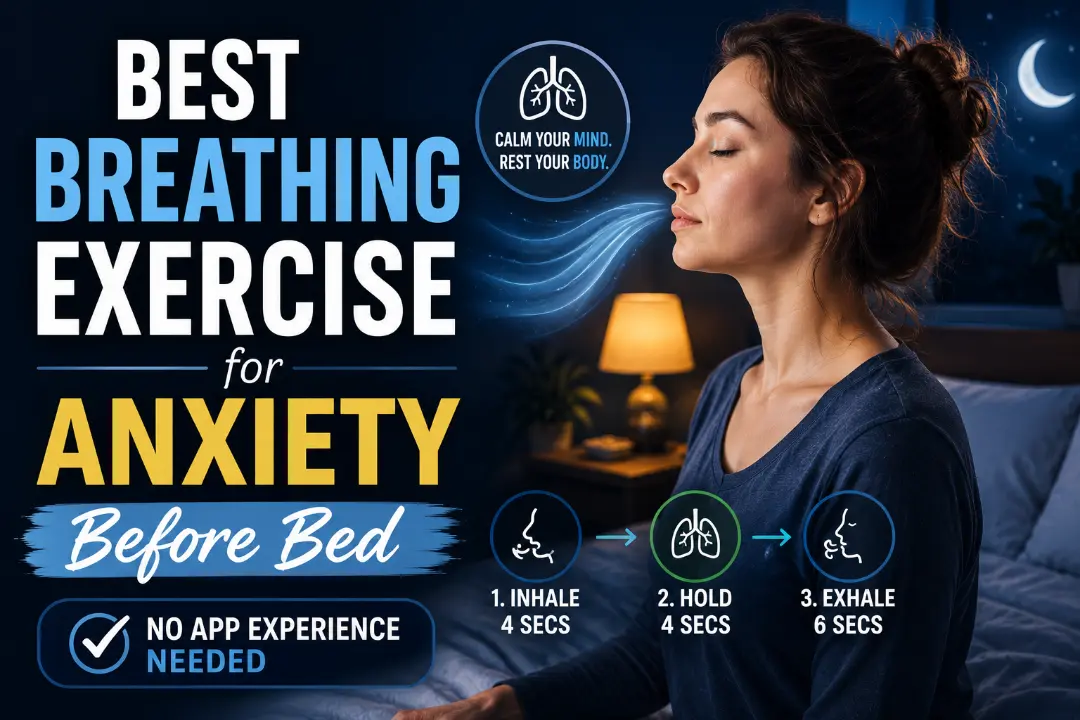
If anxiety shows up the moment your head hits the pillow, here is a simple breathing exercise that works without any apps, equipment, or prior experience - and why it helps specifically with anxiety.
For a lot of people, anxiety has a schedule. It is manageable during the day - busy enough to keep it at bay - and then arrives reliably the moment the lights go off and the distractions stop. If rumination is the bigger problem, breathing exercises to stop overthinking at night address that loop directly. Tight chest, racing heart, a sense of dread that has no obvious cause, or a very obvious cause that suddenly feels unbearable now that there is nothing else competing for attention.
The good news is that one of the most effective tools for this specific moment requires nothing you do not already have. No app, no subscription, no equipment, no prior breathing experience. Just you, your breath, and a few minutes before sleep — the same basic pattern used in paced breathing for sleep.
This article explains the single best breathing exercise for anxiety before bed, why it works specifically for anxiety rather than just general stress, how to do it correctly the first time, and what to expect if anxiety has been a regular nighttime visitor for a while.
Why anxiety gets louder at night specifically
Anxiety is not just a thought. It is a physiological state - your body preparing for a threat, whether or not a threat actually exists. Elevated heart rate, shallow and rapid breathing, muscle tension, a heightened sense of alertness. During the day, this state often goes unnoticed because you are moving, working, talking, and the physical sensations blend into the general busyness of being awake.
At night, everything that was masking the sensations disappears. You are lying still, the room is quiet, and suddenly your heart rate feels loud, your chest feels tight, and your mind starts looking for a reason why. Often it finds one - a worry that was perfectly manageable at 2pm becomes the center of the universe at 11pm. Sometimes it does not find a specific reason at all, which can feel even more unsettling, because free-floating anxiety with no clear target is harder to reason with.
There is also a feedback loop specific to anxiety that does not apply to ordinary stress in the same way. Anxiety often involves breathing pattern itself becoming part of the problem. When anxious, breathing tends to become shallow, fast, and centered in the upper chest rather than the diaphragm. This kind of breathing - sometimes called thoracic breathing - is itself a physiological signal of alarm. Your body interprets your own breathing pattern as confirmation that something is wrong, which can intensify the anxious feeling, which further affects the breath. The loop feeds itself.
This is important because it means the breathing pattern is not just a symptom of nighttime anxiety - it is part of the mechanism that sustains it. Which also means it is one of the most direct points of intervention available.
Why breathing specifically (and not just "calming down")
Telling someone with anxiety to calm down is famously unhelpful, and for good reason - calm is not something you can choose directly. You cannot decide to lower your heart rate, decide to stop your chest from feeling tight, or decide your thoughts to be less alarming. These are not under direct voluntary control.
Breathing is different. It is one of the few autonomic functions - functions normally run automatically by the nervous system - that you can also control voluntarily. This dual control is what makes it such a powerful entry point. When you deliberately slow and deepen your breath, you are not asking your nervous system to "feel calmer." You are directly changing one of the physiological signals your nervous system uses to determine whether you are safe or in danger.
Specifically, a slow, deep breath with a long exhale - breathing low into the belly rather than high in the chest - sends a signal through the vagus nerve that activates the parasympathetic nervous system, the branch responsible for rest and recovery. Heart rate slows. Blood pressure eases slightly. The sense of urgency that anxiety creates begins to soften, not because you decided to feel different, but because the underlying physiological conditions for anxiety became less present.
This is also why breathing exercises tend to be one of the few interventions that work in the moment, while anxiety is actively happening, rather than only as a long-term practice. You do not need to have been doing it for weeks to feel some effect tonight. The mechanism is immediate, even if the depth of the effect grows with consistency.
The best breathing exercise for nighttime anxiety: extended exhale belly breathing
There are many breathing techniques, and several of them appear regularly on lists of anxiety tools - box breathing, 4-7-8, alternate nostril breathing, and others. For anxiety specifically, at night, in bed, the most consistently effective and the easiest to do correctly without guidance is a simple combination of two elements: breathing low into the belly, with an exhale that is noticeably longer than the inhale.
Here is exactly how to do it.
Place one hand on your belly, just below your ribs. This is optional but genuinely useful, especially the first few times. It gives you immediate feedback about whether you are breathing into your belly or your chest.
Inhale slowly through your nose, and let your belly rise. Your hand should move outward as you breathe in. Your chest and shoulders should stay relatively still - most of the movement happens at your belly. This is the opposite of how anxious breathing typically works, where the chest and shoulders do most of the moving and the belly stays tense and still. Aim for a count of around four seconds, though the exact number matters less than the feeling of the breath going low rather than high.
Pause very briefly at the top - one second, no more. You are not holding your breath in any forced way. Just a small, natural pause before the exhale begins.
Exhale slowly, through your nose or your mouth, for longer than the inhale. Aim for around six to eight seconds. Let your belly fall back down under your hand. The exhale should feel like a release - not forced out, but allowed to leave slowly, as if you are letting air drain out rather than pushing it out.
Repeat. Inhale low and slow for about four seconds, brief pause, exhale slow for six to eight seconds. Continue for at least five minutes, though there is no upper limit - if it is helping, continue for as long as feels right.
That is the entire exercise. No equipment, no app, no specific posture beyond lying or sitting in a way that lets your belly move freely - which usually means lying on your back or on your side, with anything tight around your waist loosened.
Why this version specifically, and not something more complex
Anxiety before bed is not the moment for a complicated technique. When anxiety is high, working memory and the capacity to follow multi-step instructions are both reduced - this is part of why anxiety can make even simple tasks feel overwhelming. A breathing exercise that requires remembering a sequence of holds, counts, and nostril positions adds cognitive load at exactly the moment you have the least capacity for it.
Belly breathing with a longer exhale has two enormous advantages for this specific situation. First, it is physically intuitive - once you have done it a few times with your hand on your belly, your body remembers the sensation even when your mind is too anxious to consciously direct each breath. Second, it directly targets the breathing pattern that anxiety itself produces - shallow, chest-based, rapid breathing - by replacing it with the opposite pattern. You are not adding a technique on top of anxious breathing. You are substituting a different breathing pattern for the one anxiety is currently running.
Box breathing and similar count-based techniques with holds on all four sides can be useful for general focus or daytime stress, but the holds tend to keep attention quite active, which is not always what is needed when the goal is to wind down toward sleep. The 4-7-8 technique, which involves a longer breath hold, can also feel uncomfortable or even slightly alarming for some people with anxiety - holding the breath can itself trigger a sense of restriction for someone whose anxiety already involves a feeling of tightness in the chest.
Belly breathing with an extended exhale avoids both of these issues. There is no hold to manage, no count that needs to be precise, and the physical sensation - belly rising and falling - is grounding in a literal sense. It gives your attention something to track that is not a number and not your thoughts.
What to expect in the first few minutes
It helps to know what is likely to happen, because anxiety often comes with a tendency to monitor very closely whether something is "working," which can itself become a source of frustration if the first thirty seconds do not feel transformative.
In the first minute, you may notice that breathing into your belly feels unfamiliar or even slightly awkward. This is completely normal, especially if your breathing has defaulted to the chest for a long time. It may take a few breaths before the movement starts to feel natural rather than effortful.
By the second or third minute, many people notice a subtle shift - perhaps the breath starts to feel slightly easier, or there is a small sense of the exhale "landing" more fully than it did at first. This is often the point where the parasympathetic response starts to become noticeable, even if it is mild.
Anxious thoughts will likely still be present. This exercise does not make anxious thoughts disappear, and expecting it to can itself become a source of disappointment. What tends to change is the intensity underneath the thoughts - the thoughts may continue, but the physical sense of alarm that was amplifying them starts to ease. A thought that felt unbearable at the start of the exercise may feel more like background noise by the end, even if its content has not changed.
It is normal for anxiety to spike briefly at the start. Turning attention toward the breath, and therefore toward the body, can initially bring physical sensations of anxiety - like a racing heart or tight chest - more clearly into awareness rather than less. This is not a sign that the exercise is making things worse. It is often a sign that you are simply noticing something that was already there. If this happens, continuing with the slow exhale tends to resolve it within a minute or two, as the physiological signal of the longer exhale begins to outweigh the initial spike in attention.
When counting feels impossible
Some nights, anxiety is intense enough that even a simple four-second count feels like too much to track. If this happens, here is a version that removes counting entirely.
Instead of counting seconds, breathe in until your belly feels comfortably full - not stretched, just gently full - and breathe out for longer than that, until your belly feels empty. The relative lengths matter more than the exact numbers. You can think of it as "in for a little, out for a bit more," without attaching specific numbers at all.
Another option that some people find easier when anxiety is high: make a soft sound on the exhale - a quiet sigh, or breathing out through slightly pursed lips so you can hear the air leaving. The sound itself becomes something to focus on instead of a count, and audibly slowing the exhale often makes it easier to actually slow it, rather than just intending to.
Both of these versions preserve the core mechanism - belly breathing, longer exhale - while removing the cognitive task of counting, which can be one extra thing an anxious mind does not need to manage.
A note on apps, and when they help
This exercise works completely on its own, without any technology. That is part of the point - on a night when you do not want to look at a screen, or your phone is charging in another room, or you simply do not have the energy to open anything, this is something you can do immediately, in the dark, with no setup.
That said, some people find that having something to gently anchor attention - particularly on nights when the mind is especially busy - makes the exercise easier to sustain for the full five minutes. This is where a visual pacer can help, not as a requirement, but as an option for nights when it would help.
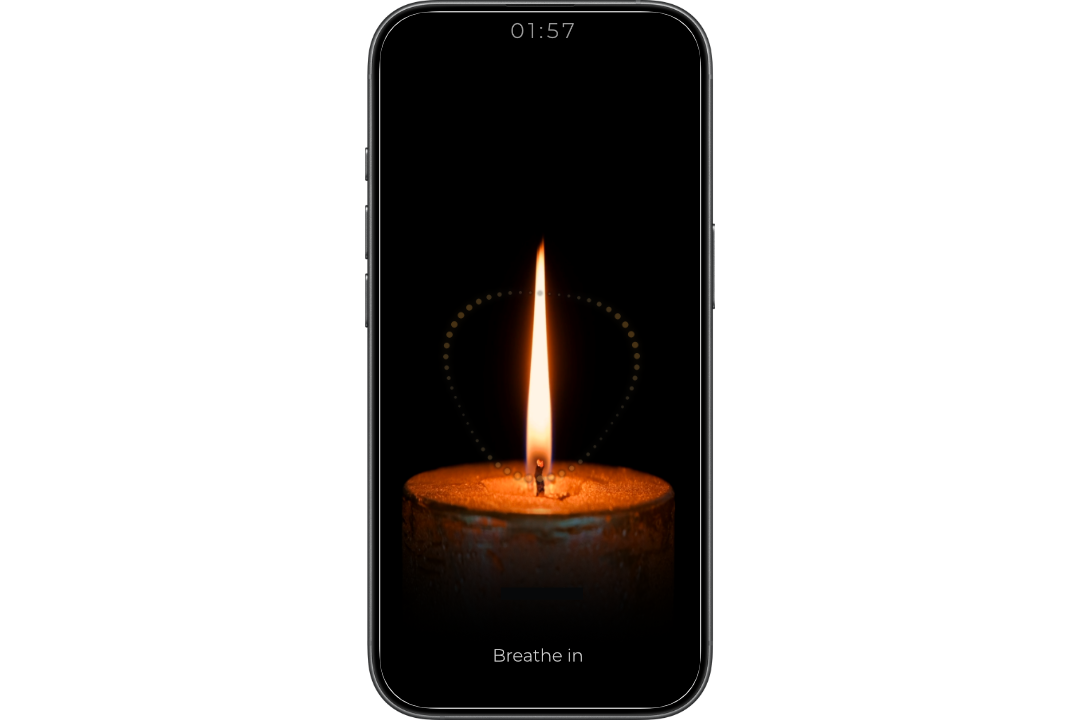
QuietFlame offers exactly this kind of option - a slow-moving flame that rises and settles at a gentle pace, giving your eyes and attention somewhere quiet to rest while your belly breathing happens underneath it. It is not necessary for the exercise to work. But on nights when anxiety makes five minutes feel very long, having something soft to follow can make those minutes pass more easily, without adding any complexity to the breathing itself.
The exercise above is the foundation. The app, if you choose to use it, is simply a quiet companion for nights when that foundation needs a little extra support.
If anxiety before bed is a frequent pattern
A breathing exercise like this is genuinely effective for the in-the-moment experience of anxiety before sleep, and for many people, used consistently, it can meaningfully reduce how often that anxiety reaches an intense level in the first place. Practiced nightly - not just on anxious nights, but as a regular part of winding down - it can lower the baseline level of physiological arousal your body carries into the evening, which often means anxiety has less to build on when it does arise.
That said, it is worth being honest about its limits. If anxiety before bed is a near-nightly experience, significantly affects your ability to fall asleep over an extended period, or is accompanied by anxiety that feels unmanageable, persistent, or connected to a broader pattern of anxiety throughout your life, a breathing exercise is a genuinely helpful tool but not a substitute for support from a doctor or therapist. Anxiety that is frequent and intense enough to regularly disrupt sleep is something that responds well to professional support, often in combination with exactly the kind of tools described here.
For the much more common experience - anxiety that shows up occasionally or moderately before bed, the kind almost everyone experiences during stressful periods - this exercise is one of the most accessible and effective tools available, and it costs nothing to try tonight.
Tonight, right now
If anxiety is present as you read this, here is the exercise in its simplest form: lie down comfortably, place one hand on your belly, and breathe in slowly so your belly rises under your hand. Pause for a second. Then breathe out slowly - longer than the inhale - and let your belly fall. Repeat for at least five minutes.
No app is required. No prior practice is required. Just your breath, your hand, and a few minutes of letting the exhale do what it already knows how to do.
If you find it helpful to have something gentle to follow with your eyes while you breathe, QuietFlame offers a slow-moving flame designed for exactly this kind of evening - but the exercise itself works with nothing but you.
The anxiety may not disappear completely tonight. That is alright. The goal was never to make it vanish - just to give your body a different signal than the one it has been running on, and to let that signal do its quiet work while you rest.
FAQ
What is the best breathing exercise for bedtime anxiety?
Inhale through your nose for four seconds and exhale slowly for six to eight seconds, repeated for five minutes with comfortable, unforced breaths.
Why does anxiety get worse at night?
Distractions drop away and your nervous system may still be in an alert state, so physical anxiety symptoms and worry feel louder than during the day.
How quickly does breathing help anxiety?
Heart rate and subjective alertness often begin to ease within the first two to three minutes of slow, steady breathing with a longer exhale.
Can I do this lying in bed?
Yes, though doing a short session before getting into bed often works better because you arrive in bed already closer to a restful state.