 QuietFlame
Paced Breathing for Sleep: What It Is, How It Works, and How to Start Tonight
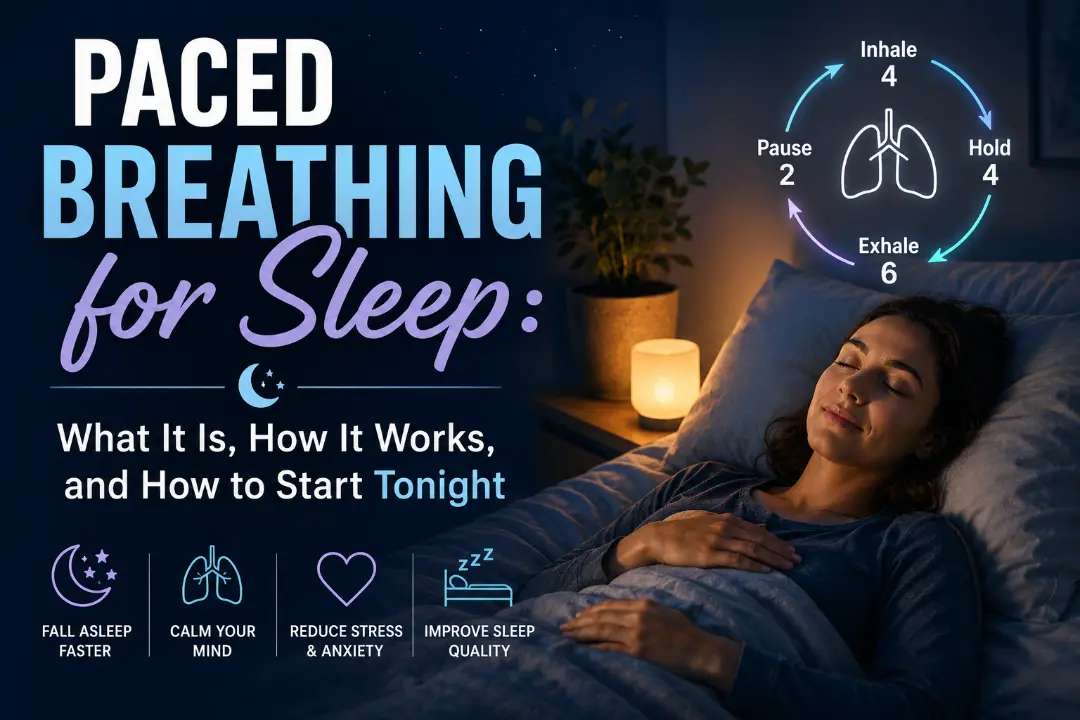
Paced breathing is one of the most effective and accessible tools for falling asleep faster. Here is what it actually is, what happens in your body when you do it, and how to start tonight.
Most sleep advice circles around the same familiar territory. No screens before bed. Keep the room cool. Go to sleep at the same time each night. Cut the caffeine. All of that is reasonable. None of it tells you what to actually do in the minutes before you close your eyes when your mind is still running.
Paced breathing fills that gap. It is not a meditation discipline or a wellness trend. It is a specific, physiologically grounded practice with a clear mechanism and a low barrier to entry. You can start tonight with no equipment, no experience, and no background in breathwork whatsoever.
This article explains what paced breathing is, why it works for sleep specifically, what the research behind it actually says, and how to practice it in a way that becomes a reliable part of your evening without requiring willpower or perfect conditions. If you are starting from scratch, a 5-minute breathing reset before bed is the simplest entry point. For the research angle, see can 5 minutes of slow breathing before bed improve your sleep quality.
What paced breathing actually is
Paced breathing means breathing at a deliberate, controlled rate - usually slower than your default resting pace - with a consistent rhythm of inhale and exhale. You are not trying to breathe as deeply as possible or perform any advanced technique. You are simply slowing down and steadying the tempo.
Most adults breathe somewhere between twelve and twenty times per minute at rest. Paced breathing for relaxation typically brings that down to around five to seven breaths per minute. That is roughly one breath every nine to twelve seconds. Slower than you would breathe without thinking about it, but not so slow that it feels effortful or uncomfortable.
The "pacing" part is the structure. Rather than breathing freely, you follow a set count: a fixed number of seconds for the inhale, a fixed number for the exhale, sometimes a brief pause between. The count gives your attention something specific to follow, which is part of what makes it effective at night when the mind tends to wander toward tomorrow's problems.
Paced breathing is sometimes called controlled breathing, slow breathing, or resonance breathing, depending on the context. The differences between these terms matter to researchers and clinicians. For someone who wants to fall asleep more easily, they are essentially describing the same core practice: slow down, find a rhythm, stay with it.
How it is different from other breathing techniques
Breathwork is a broad category. Box breathing, Wim Hof, alternate nostril breathing, holotropic breathing, the 4-7-8 method - all involve deliberate control of the breath, but they are designed for very different outcomes.
Some breathwork techniques are activating. Rapid breathing patterns, breath holds, and hyperventilation-adjacent practices can increase alertness, shift emotional state, or create unusual physiological sensations. These are not what you want before sleep.
Paced breathing for sleep sits at the calm, slow end of the spectrum. The goal is downregulation - reducing physiological arousal, slowing the heart rate, and shifting the nervous system toward the parasympathetic state associated with rest. The technique is quiet, gentle, and sustainable. You can do it lying in bed without disturbing a partner. You can do it without any sound. You can do it in complete darkness following nothing but an internal count or a simple visual guide.
That gentleness is not a limitation. It is exactly the right tool for the job.
What happens in your body when you pace your breath
This is the part that turns paced breathing from advice into something you can trust. The mechanism is real and relatively well understood.
Your heart rate follows your breath. When you inhale, your heart rate naturally speeds up slightly. When you exhale, it slows. This is called respiratory sinus arrhythmia, and it is a normal, healthy function. When you breathe quickly and shallowly, these fluctuations are small and rapid. When you breathe slowly and deliberately, you amplify them in a way that activates the vagus nerve and stimulates the parasympathetic nervous system.
The exhale is the active ingredient. When you extend your exhale beyond your inhale, you spend more of each breath cycle in the phase that slows the heart. This is why most sleep-oriented breathing patterns emphasize a longer out-breath. A four-second inhale followed by a six-second exhale is not arbitrary - the asymmetry is deliberate. The exhale does the calming work.
Your attention narrows. Following a breath count or a visual cue gives the mind a simple, repetitive task. This is not the same as clearing your mind, which is both difficult and unnecessary. It is more like giving a restless child something to hold. Anxious thoughts do not disappear, but they lose some of their urgency when attention is gently occupied elsewhere. The breath becomes a small, reliable focal point that interrupts the loop of planning and replaying.
Muscle tension releases. Most people carry evening tension they are not fully aware of - a clenched jaw, raised shoulders, a tightened abdomen. Slow breathing, especially with attention placed on the body at the start of a session, tends to release this tension naturally. The softening is subtle but cumulative. After five minutes of paced breathing, the body is measurably different from how it started.
Cortisol levels are influenced. Stress hormones do not disappear the moment work stops. Cortisol, which peaks in the morning and declines through the day, can stay elevated in the evening when the day's demands were intense. Slow, rhythmic breathing is one of the faster behavioral interventions for shifting the cortisol curve downward. This is not instant, but a consistent evening practice over weeks has a compounding effect on how the body manages that evening transition.
What the research actually says
Sleep research is complicated because sleep is personal, variable, and difficult to study under controlled conditions. That said, the evidence for slow, paced breathing as a relaxation and sleep-onset tool is more consistent than most wellness advice.
Studies on heart rate variability - a measure of the nervous system's flexibility and parasympathetic tone - consistently show increases following slow paced breathing sessions. Higher HRV is associated with better stress regulation, lower resting anxiety, and improved sleep quality. The resonance breathing literature, which focuses on breathing at around five to six breaths per minute, has shown particularly clear effects in this area.
Research on pre-sleep arousal - the state of being physiologically and cognitively "on" when you should be winding down - points to slow breathing as one of the more effective ways to reduce it. This matters because high pre-sleep arousal is one of the most common contributors to difficulty falling asleep, even in people who do not have clinical insomnia.
Cognitive behavioral therapy for insomnia, widely considered the gold-standard treatment for sleep difficulties, often includes relaxation techniques such as slow breathing as a component. The reason is practical: it works reliably enough across enough people to be worth including in a structured protocol.
None of this means paced breathing is a cure for serious sleep disorders. Sleep apnea, restless legs, and clinical insomnia with strong cognitive components all require more than a breathing practice. But for the large majority of people whose sleep suffers because they cannot switch off the day, the evidence base is solid.
The most useful patterns for sleep
Different ratios feel different in the body. Here are the most practical options, starting with the gentlest.
4-6 breathing (recommended starting point)
Inhale for four seconds, exhale for six. This is the most accessible place to begin. The longer exhale activates the calming mechanism without requiring any breath-holding or significant lung capacity. If this feels comfortable after a few minutes, stay here. There is no requirement to progress to anything more complex.
4-4 breathing (equal ratio)
Inhale for four seconds, exhale for four. Some people find the symmetry of equal counts easier to follow, particularly when they are very tired and counting feels like effort. The calming effect is slightly less pronounced than a longer exhale, but the simplicity is a real advantage. If you find yourself losing count, this is worth trying.
4-7-8 breathing
Inhale for four seconds, hold for seven, exhale for eight. This pattern, often associated with Dr. Andrew Weil, has become widely known and many people find it effective. The extended exhale is the longest of any common pattern, which tends to produce a strong calming response. The breath hold can feel uncomfortable for some people, particularly those who experience any chest anxiety. If it does, skip it and return to 4-6.
Box breathing (4-4-4-4)
Inhale for four, hold for four, exhale for four, hold for four. Box breathing is better known as a focus and stress-management tool than a sleep tool - the holds tend to keep attention active rather than settling it. Useful if your mind is particularly racing and you need something to grip onto at the start of a session, less ideal as the final pattern before sleep.
For most people building an evening practice for the first time, 4-6 is the right starting point. Simple, effective, and comfortable enough to sustain for five minutes without strain.
How long do you need to do it
Five minutes is enough to produce a measurable shift in physiological state. This is not a compromise - it is a genuine threshold. Most of the benefit from a paced breathing session comes in the first five minutes as the nervous system responds to the slower rhythm. Sessions beyond that have value, but the core effect does not require ten or twenty minutes.
Five minutes also survives real life. On a night when you are exhausted, behind on sleep, and tempted to skip everything, five minutes is completable. That reliability is worth more than a longer practice that only happens when conditions are ideal.
If you enjoy the practice and find yourself wanting to stay longer, ten minutes is a natural extension. Some people settle into a fifteen-minute rhythm over time. None of that is necessary. Start with five. Keep it at five for as long as it is working.
How to actually start tonight
Here is the complete practice, from nothing to asleep.
Set up your environment first. Dim or switch off overhead lights. Plug your phone somewhere it will not pull you back in. If you use a breathing app as a visual guide, open it before you dim the lights so it is ready without requiring a bright screen search.
Find a comfortable position. Sitting on the edge of the bed or in a chair with your back supported is often better than lying down to start, because lying flat can make the breath feel slightly more constrained and makes it easier to drift into distraction before the session is complete. After your session, move into your sleep position.
Begin with a thirty-second body scan. Before counting anything, take a few natural breaths and notice where you are holding tension. Jaw, shoulders, hands, belly. You are not trying to force relaxation - just noticing. This brief check-in turns attention inward and begins the transition before the structured breathing starts.
Start the count. Inhale through your nose for four seconds. Exhale through your nose or mouth for six. Do not force the breath to be large - breathe comfortably, at a depth that feels natural. The count is the structure; the breath follows.
When your mind wanders, return. It will wander. That is not failure. Noticing that it has wandered and returning to the next exhale is the practice. You do not need to count how many times this happens. You just need to keep returning.
End the session gently. When five minutes is up, take two or three natural breaths without counting. Notice how the body feels compared to when you started. Then move into your sleep position.
That is the complete practice. No special equipment, no prior experience, no perfect conditions required.
Why a visual guide makes the habit easier to keep
Counting is effective but cognitively active. When you are very tired, maintaining an accurate four-second count can feel like work - and work is the opposite of what you are trying to create. On nights when the count keeps slipping, you might find yourself checking the time, restarting, or giving up earlier than intended.
A visual guide removes that friction. When something on screen moves with your breath - expanding on the inhale, settling on the exhale - you follow it rather than counting. Your attention has somewhere to rest that requires almost no effort. The rhythm is externalized, and you simply track it.
This is why QuietFlame uses a flame as its central visual. The flame rises as you inhale and settles as you exhale, moving at the pace of a 4-6 pattern. There is no counting required, no timer to watch, no interface to navigate mid-session. You follow the flame for five minutes and the session is complete.
For people who have tried counting-based breathing and found it too effortful at night, a visual pacer is often what makes the habit finally stick. The practice becomes easier to do than to skip, which is exactly the threshold a habit needs to cross.
Building it into your evening reliably
A paced breathing practice works best when it lives in a consistent slot - not whenever you remember it, but attached to something you already do every night. This is how habits become automatic rather than dependent on motivation.
The most reliable anchor is directly after brushing your teeth. You brush your teeth every night regardless of how the day went. Attaching the breathing session to that existing behavior borrows its reliability. "After I brush my teeth, I sit down and do five minutes of breathing" is a complete habit design. No alarm required, no decision to make at a moment when your decision-making capacity is already depleted.
The second most reliable anchor is the moment you get into bed before reaching for your phone. If the phone is your last action before sleep, sliding the breathing session immediately before it - using the phone only as a visual guide, then putting it down - creates a boundary that gradually shifts the association. Bed starts to mean breath, not scroll.
Give any anchor two weeks of consistent use. After that, the sequence will begin to feel incomplete without it.
What you might notice in the first few weeks
The first night you try paced breathing before sleep, you might feel a notable shift. You might also feel nothing unusual - the practice works in the background of your physiology in ways that are not always consciously dramatic.
Over the first week, most people notice that the time between lying down and falling asleep shortens on the nights they practiced. Not always dramatically, but consistently enough to register.
After two weeks, the pre-sleep period tends to feel less combative. The lying-awake-with-racing-thoughts experience does not necessarily disappear, but it becomes less intense and shorter. The body has started to learn what the breathing signal means.
After a month, many people report that starting the practice itself feels calming - before the first full breath cycle is even complete. That is the habit doing its work. The cue alone has become associated with the state.
None of this is guaranteed on a specific timeline. Sleep varies. Stress varies. Some nights will still be hard. The goal of a consistent paced breathing practice is not to eliminate difficult nights but to raise the baseline - to make the average evening transition smoother and the average night's sleep slightly more restorative.
That is a modest claim. It is also an honest one, and it is achievable starting tonight.
Try it now
You do not need to wait for a better night or a less busy week. The practice is designed for exactly the nights when things are not ideal.
Sit somewhere quiet. Dim the light. Inhale for four seconds. Exhale for six. Repeat for five minutes.
If you want something to follow so the counting takes care of itself, QuietFlame is built for this exact moment. Open it, follow the flame, and let the session do the work.
Same time tomorrow. That is the whole practice.
FAQ
What is paced breathing for sleep?
Paced breathing is deliberately slowing and lengthening your breath, often with a longer exhale, to lower physiological arousal before sleep.
What breathing pattern works best for sleep?
A common pattern is inhaling for four seconds and exhaling for six to eight seconds, repeated for about five minutes without forcing large breaths.
How long before bed should I do paced breathing?
Five minutes in the ten to fifteen minutes before you get into bed works well. Anchor it to something you already do, like brushing your teeth.
Do I need an app for paced breathing?
No. You can count breaths manually. A visual guide like QuietFlame helps when counting feels like one more task at the end of the day.