 QuietFlame
Why a 5-Minute Breathing Reset Before Bed Is Important

Evening stress keeps your body on alert long after the day ends. Here is why a short breathing reset before bed matters - and how five minutes can help you unwind.
Most of us do not have a dramatic "end of work" moment anymore. The laptop closes, but the mind keeps going. You rehearse tomorrow's meeting, replay something you said at dinner, or scroll until your eyes ache. By the time you actually get into bed, your body is still running the day - not resting from it.
That is where a 5-minute breathing reset before bed can help. Not a full meditation course. Not a complicated routine. Just a short, deliberate pause that tells your nervous system the day is over.
This article explains why that small habit matters, what happens in your body when you breathe with intention at night, and how to practice it in a way you will actually stick with.
Your body does not flip from "on" to "off" instantly
During the day, stress is useful. Your heart rate rises, muscles tense, and attention narrows so you can handle what is in front of you. That is your sympathetic nervous system doing its job - often called fight-or-flight, though for most of us it is more like push-through-and-get-it-done.
The problem is not stress during the day. The problem is carrying it into the evening. When you go from answering emails to lying in bed without a transition, your body is still in go-mode. You may feel tired, but tired and relaxed are not the same thing.
Sleep researchers and clinicians often talk about the need for a wind-down period before bed. The idea is simple: give your physiology time to shift toward the parasympathetic side - rest, digest, recover - so sleep is deeper and easier to reach.
A breathing reset is one of the most practical wind-down tools because it is:
- Free and always available
- Short enough to do on a weeknight
- Physical - you are not trying to "think calm," you are doing calm with your breath
Five minutes is not magic. But it is long enough to matter and short enough that you will not talk yourself out of it.
Why breathing, specifically?
You breathe all day without thinking about it. So why focus on it at night?
Because breath is the one part of your autonomic nervous system you can consciously steer. You cannot will your heart rate down on command - but you can slow and lengthen your exhale, and your heart rate often follows.
Slower, steadier breathing can:
- Reduce arousal - less of the keyed-up feeling that keeps you staring at the ceiling
- Anchor attention - your mind has a simple rhythm to follow instead of another loop of worry
- Create a ritual boundary - the same cue every night: now we downshift
People sometimes assume relaxation means clearing the mind completely. That is unrealistic for most of us, especially at night. A breathing reset is more honest: you are not erasing thoughts; you are changing the background state so thoughts feel less urgent.
Why five minutes before bed is enough
If five minutes is enough, why do people promote twenty- or thirty-minute meditations?
Longer sessions can be wonderful - but they are also easy to skip. On a Thursday night when you are exhausted, "twenty minutes of mindfulness" often becomes zero minutes. Five minutes survives real life.
Here is what five steady minutes can realistically do:
- Interrupt the stress spiral. You step out of the loop of planning, replaying, and checking your phone - even briefly.
- Lower physical tension. Shoulders drop. Jaw unclenches. Breath deepens without forcing it.
- Pair bed with calm, not stimulation. Over time, the routine itself becomes a signal: bed means breathe, not browse.
You do not need to feel transformed when the timer ends. The win is showing up. Some nights you will feel noticeably softer. Other nights you will still be restless - and that is normal. The habit still trains your evening rhythm.
What sleep science says about winding down
You do not need a PhD to benefit from a breathing habit, but it helps to know the why behind wind-down advice. Sleep is not a switch; it is a process. Your brain and body move through stages of decreasing alertness. When you stay mentally engaged - work chat, heated news, bright screens - you delay that curve.
Evening relaxation practices, including slow breathing, are often studied as ways to lower physiological arousal before bed: heart rate, muscle tension, and the subjective sense of "still being on." Results vary by person and study design, but the pattern is consistent enough that clinicians routinely recommend a buffer between daytime stress and sleep.
A five-minute reset is not a guarantee of eight perfect hours. It is a practical way to respect the process - to stop demanding that your nervous system go from 100 to 0 in the second your head hits the pillow. Think of it as the first page of the sleep chapter, not the whole book.
What a 5-minute reset is (and what it is not)
It is:
- A short paced-breathing practice at the end of the day
- Usually done sitting on the edge of the bed, in a chair, or lying down once you are settled
- Focused on slow, regular inhales and exhales - not perfect technique
It is not:
- A substitute for medical care if you have serious insomnia or sleep apnea
- A performance you must ace
- A promise that you will fall asleep in five minutes every night
Think of it as hygiene for your nervous system, the way brushing teeth is hygiene for your mouth. Small, repeated, cumulative.
A simple 5-minute pattern to try tonight
This is a balanced pace many people find calming before sleep: a slightly longer exhale than inhale.
- Inhale through the nose for 4 seconds
- Exhale through the nose or mouth for 6 seconds
- Repeat until 5 minutes is up
Why longer exhale? For many people, extending the out-breath encourages the body to downshift. You are not forcing huge lungfuls of air - stay comfortable. If 4/6 feels strained, try 3 in / 5 out or 4 in / 4 out until it feels sustainable.
Optional body check (30 seconds at the start): notice feet, seat, or mattress; unclench hands; let the tongue rest away from the roof of the mouth. Then begin the pace.
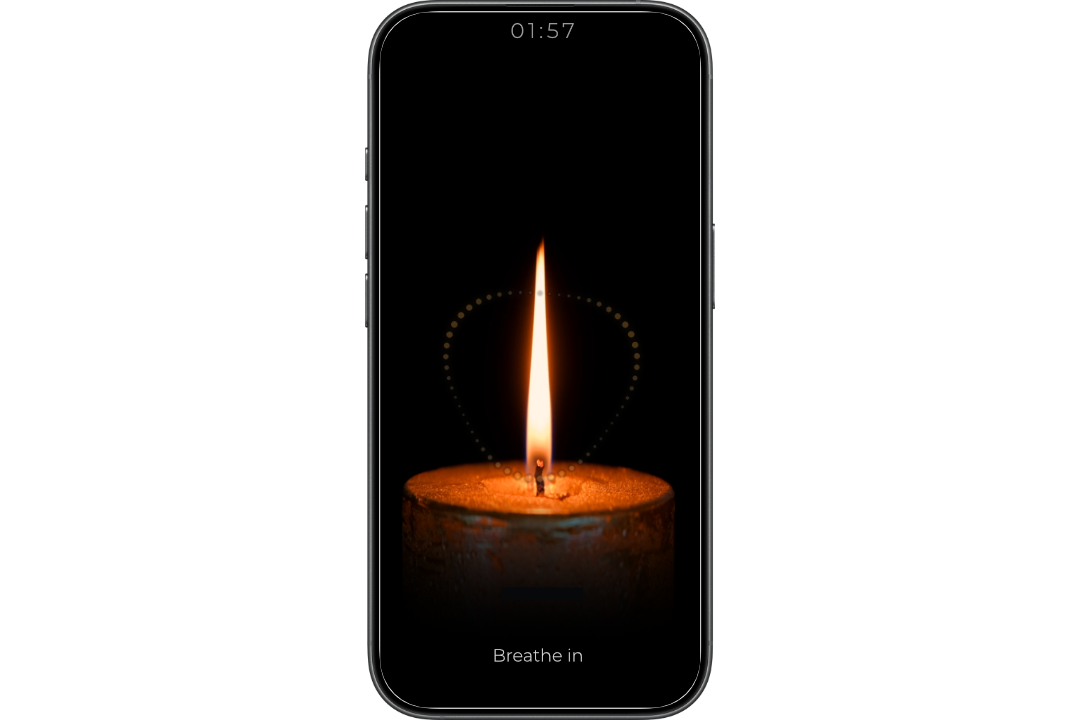
If counting feels like work, use a visual or haptic cue so you can follow the rhythm without staring at a clock. In QuietFlame, the on-screen flame moves with your breath and a timer keeps the session honest - helpful when you want structure without noise.
Another option: even counts (box-style)
Some people prefer equal inhale and exhale - for example, 4 seconds in and 4 seconds out. This "box" rhythm feels steady and neutral, like tracing a square with your breath. Try it for one or two minutes, then switch to a longer exhale if you want more of a downshift. There is no single correct pattern; the best one is the one you will repeat at night.
A sample weeknight routine with your reset built in
Habits stick when they are anchored, not heroic. Here is one way to slot five minutes of breathing into an ordinary evening:
- 9:00 p.m. - Dim main lights; stop work email and task lists
- 9:30 p.m. - Brush teeth, change clothes, plug phone in away from the bed
- 9:45 p.m. - Sit on the bed or a chair; start your 5-minute paced breathing
- 9:50 p.m. - Lights out; no "quick" scroll "just to relax"
You can shift the times. The important part is order: breathing comes after stimulation stops and before you expect sleep to arrive. After a week, your body starts to anticipate the cue. That anticipation is part of why the reset works.
Why doing this before bed matters
Timing matters because habits attach to context. A breathing reset works best when it sits in a reliable slot:
- After you plug in your phone across the room
- After you brush your teeth
- After you dim the lights
- Before you get under the covers - or the moment you lie down if that is when your mind races
The goal is to stop treating bed as another place to process the day. You are giving your brain a repeatable off-ramp.
If you only breathe when you are already frustrated at 2 a.m., the practice becomes linked to crisis. If you breathe at the same gentle time each night, it becomes linked to care.
Screens, light, and why they fight your reset
Even a perfect breathing pattern struggles if you flood your eyes with bright light right after. Screens are not evil - but they are stimulating. News, messages, and short-form video keep the mind in discovery mode: what's next?
You do not have to ban phones forever. A useful rule is finish breathing, then screens off - or use the phone only as a timer or guide for those five minutes, then put it down. Pairing dim light with slow breath sends a consistent signal: the day is closed.
If you read before bed, paper or an e-reader with warm, low light tends to interfere less than a glowing feed you can swipe forever.
Common obstacles (and honest answers)
"I try to breathe slowly and I feel more anxious."
That happens. Focusing on breath can surface sensation in the chest, which alarm bells sometimes misread as danger. Responses that help:
- Shorten the counts
- Breathe more quietly and shallowly at first, then deepen naturally
- Keep eyes open with a soft focal point until you settle
You are learning a skill, not failing a test.
"My mind will not stop talking."
Good. Minds talk. The point is not silence; it is returning to the next exhale when you notice wandering. That return - once, ten times, a hundred times - is the practice.
"I only remember when I am already in bed scrolling."
Put the reset before the phone goes to the nightstand, or use the phone for a five-minute guided session and then stop. Pair it with something you already do every night so you do not rely on memory.
"Five minutes feels pointless compared to a workout or a long walk."
Movement is great - but it is not the same signal. A walk can be stimulating; evening breathing is explicitly downregulating. They complement each other; one does not replace the other.
"I share a bed or a thin-walled apartment - is quiet breathing enough?"
Yes. This is not loud chanting or sharp breathwork. Soft nasal breathing rarely disturbs a partner. If you need silence to focus, exhale through pursed lips gently - still quiet, still slow. The reset is private by design.
What you might notice over a few weeks
Sleep is variable. Weather changes, stress spikes, caffeine happens. Still, people who keep a short evening breathing habit often report:
- Falling asleep a little faster on average
- Waking less wired from the day's residue
- Feeling more in control of the transition to bed
- Less doom-scrolling when a positive ritual fills the same slot
Track loosely if you like: a simple note on your phone - "did the five minutes, felt X." Patterns emerge without turning life into a spreadsheet.
After two or three weeks, ask yourself: Is getting into bed slightly less fraught? Even a small yes is meaningful. You are training a transition, not chasing a single perfect night.
How this fits a calmer evening overall
A breathing reset works better inside a soft environment:
- Lower light an hour before bed when you can
- Cooler, quiet space - or steady sound if silence feels sharp
- Same wake time when possible; regularity helps more than people expect
You do not need a perfect spa night. You need a repeatable minimum: five minutes of breath, most nights, same place in your routine.
Small additions help: herbal tea if you like it, a shower if that marks "done" for you, laying out clothes for morning so your brain drops one more open loop. None of that is required. The breathing reset is the core.
When to be cautious
Paced breathing is generally safe for healthy adults, but check with a clinician if you have asthma, COPD, heart conditions, panic disorder with severe hyperventilation, or if you feel dizzy or tingly every time you try structured breathwork. Comfort first. Ease the counts. Stop if something feels wrong.
This article is educational, not medical advice.
Building the habit without guilt
Miss a night? Resume tomorrow. The habit is identity, not streak perfection: I am someone who downshifts before sleep.
Start with three nights this week. If that sticks, add nights. If five minutes grows easy, you can stay there forever - there is no requirement to graduate to thirty.
Tell one person you live with, if that helps: "I'm taking five minutes before bed." Accountability can be gentle - a closed door and a dim light - not a performance.
The importance of a 5-minute breathing reset before bed is not in one transcendent session. It is in teaching your body that evening has an ending - and that you are the one who gets to call it.
Try it tonight
Sit or lie down. Set a five-minute timer or open a guided session. Inhale for four, exhale for six, and let the day be done for now.
If you want a calm visual pace and a simple timer on your phone, QuietFlame is built for exactly this: short breathing sessions, minimal screen, and a steady flame that keeps you on rhythm without extra clutter.
Five minutes. Same time tomorrow. See what changes when your nights stop starting in overdrive.
FAQ
How long should a breathing reset before bed take?
Five minutes is enough for most people. It is long enough to lower arousal and short enough that you will actually do it on busy nights.
Is five minutes enough to make a difference?
Yes. Five steady minutes can interrupt the stress spiral, reduce physical tension, and signal to your nervous system that the day is ending.
Do I need experience with breathwork?
No. A simple pattern like inhaling for four seconds and exhaling for six is enough. You are changing your background state, not performing perfect technique.
What if I miss a night?
Resume tomorrow. The habit is about consistency over time, not a perfect streak. Even three to four nights a week helps train your evening rhythm.