 QuietFlame
The Simplest Evening Habit for Stress Relief (Backed by Your Own Nervous System)
You do not need a complicated routine to feel less stressed at night. Your nervous system already has a built-in stress relief mechanism - here is how to use it in five minutes.
There is no shortage of advice about evening stress relief. Cold plunges, magnesium supplements, journaling prompts, elaborate wind-down routines, forty-five-minute yoga flows. Some of it is genuinely useful. Most of it asks more of you than you have left at the end of a hard day.
What if the simplest evening habit for stress relief was not something you had to buy, learn, or schedule into a calendar? What if it was something your body already knows how to do - and just needs a small, deliberate prompt to begin?
That is not a rhetorical setup. The mechanism is real, the practice is simple, and the barrier to entry is genuinely as low as sitting down and breathing slowly for five minutes - the same 5-minute breathing reset before bed that works as a reliable evening anchor. This article explains why that works, how your nervous system makes it possible, and how to turn it into the kind of habit that survives real evenings rather than just ideal ones.
Stress does not end when the day does
This is the starting point that most stress relief advice glosses over. Stress is not just a feeling. It is a physiological state - a coordinated response by your nervous system that involves your heart, your muscles, your hormones, and your brain simultaneously. When you close your laptop or leave the office, the feeling of stress might ease slightly. The physiological state does not reset automatically.
Your sympathetic nervous system - the branch responsible for mobilizing you to respond to demands - does not have a clock. It responds to signals, not schedules. As long as your environment keeps sending activation signals - bright lights, notification sounds, news headlines, unresolved mental loops - your body stays in a version of high alert. The specific threat is gone, but the readiness to respond remains.
This is why so many people describe feeling exhausted but unable to relax. Tired and activated are not opposites. You can be completely depleted and still running on a nervous system that has not received a clear signal to stand down.
Evening stress, left unaddressed, flows directly into sleep. Elevated heart rate, higher-than-ideal cortisol, tense muscles, and a mind still processing the day's inputs are all barriers to the deep, restorative sleep stages. And poor sleep feeds the next day's stress tolerance, which makes the following evening worse. The cycle is familiar to anyone who has spent a few weeks in a demanding stretch of work or life.
Breaking the cycle does not require a dramatic intervention. It requires a reliable, repeatable signal that tells your nervous system: the demands are over, you can stand down now. Your body already knows what to do with that signal. It just needs to receive it.
Your nervous system already has a stress relief system built in
The autonomic nervous system has two branches that most people have heard of but fewer understand in practical terms.
The sympathetic branch is the activating one. It mobilizes energy, raises heart rate, sharpens focus, and prepares the body to respond to demands. It is not the villain it is sometimes made out to be - without it, you could not get through a workday, a difficult conversation, or a flight that is running late.
The parasympathetic branch is the recovery one. It lowers heart rate, supports digestion, promotes tissue repair, and creates the physiological conditions for rest and sleep. It is sometimes called rest-and-digest, which captures its function reasonably well.
What most people do not realize is that you can deliberately activate the parasympathetic branch through your breath. This is not a metaphor or a wellness approximation. It is a direct physiological pathway.
The vagus nerve - the longest nerve in the autonomic nervous system, running from the brainstem down through the heart, lungs, and digestive organs - is the main channel of parasympathetic communication. It is activated by slow, rhythmic breathing, particularly by a long, steady exhale. When you extend your out-breath deliberately, you are directly stimulating the vagus nerve and triggering a measurable cascade of calming responses: heart rate slows, blood pressure eases, muscle tension releases, and the subjective sense of being wound-up begins to ease.
You did not build this system. It has been part of human physiology for a very long time. Slow, rhythmic breathing after a period of activation is how your body has always recovered from stress. The modern problem is that activation rarely stops long enough for that natural recovery to occur. The evening habit is simply giving the system the space it needs to do what it already knows how to do.
Why five minutes is the right dose
The phrase "just five minutes" is often a polite way of saying something is not very important. In this case it is the opposite - five minutes is the right dose for a specific physiological reason.
The parasympathetic response to slow breathing is not linear across a session. Most of the measurable change in heart rate variability, muscle tension, and subjective arousal happens in the early portion. The response curve rises steeply in the first few minutes and then levels off. A ten-minute session produces more benefit than a five-minute one, but the difference is smaller than the difference between five minutes and zero.
This means five minutes is not a compromise. It is the point at which the practice becomes genuinely effective rather than merely symbolic.
It also happens to be the length that survives the worst evenings. When you are behind, exhausted, and already in bed reaching for your phone, five minutes is possible in a way that twenty minutes is not. A habit that holds on bad nights is infinitely more valuable than a habit that only works when you already feel good.
The practical implication is simple: design your evening habit around five minutes and do not feel any pressure to graduate from it. Longer sessions are fine if they happen naturally, but they are not required. The compounding benefit of five consistent minutes every night is greater than the theoretical benefit of thirty inconsistent minutes.
The specific practice: slow breathing with a longer exhale
There is a version of this that works. It is not complicated, and it does not require any background in meditation, breathwork, or wellness practice.
Inhale through your nose for four seconds. Exhale through your nose or mouth for six seconds. Repeat for five minutes.
That is the complete practice. The asymmetry - a longer exhale than inhale - is the active element. By spending more of each breath cycle in the exhale phase, you maximize the vagal stimulation and the parasympathetic response. The four-second inhale is not magic; it is simply a comfortable pace that pairs naturally with a six-second exhale without creating strain.
Some variations worth knowing:
4-4 equal breathing is slightly less activating of the parasympathetic response but easier to follow when you are very tired and counting feels effortful. If you find yourself losing count with 4-6, try equal counts.
Box breathing (4-4-4-4) - inhale, hold, exhale, hold - is better for acute stress management during the day than for pre-sleep use. The holds keep attention active, which is useful in a high-stress moment but less ideal when you are trying to transition into rest.
4-7-8 breathing produces a strong calming effect due to the very long exhale but can feel uncomfortable for anyone who experiences chest tension or anxiety. If the breath hold feels fine, it is worth trying. If it creates any discomfort, 4-6 without a hold is the better choice.
For an evening stress relief habit, 4-6 is the recommended starting point. Do it sitting on the edge of the bed or in a chair rather than lying flat, where it is easier to drift into distraction before the session is complete.
Making it easier to follow
Counting to four and six while trying to relax is more cognitively demanding than it sounds. On tired evenings, the count slips, you lose track, you restart, and suddenly a practice that was supposed to feel like rest feels like effort.
This is where a visual guide changes the experience entirely. When something moves with your breath - expanding as you inhale, settling as you exhale - you follow rather than track. Attention can be soft and peripheral rather than sharp and effortful. The rhythm is externalized, and your only job is to match it.
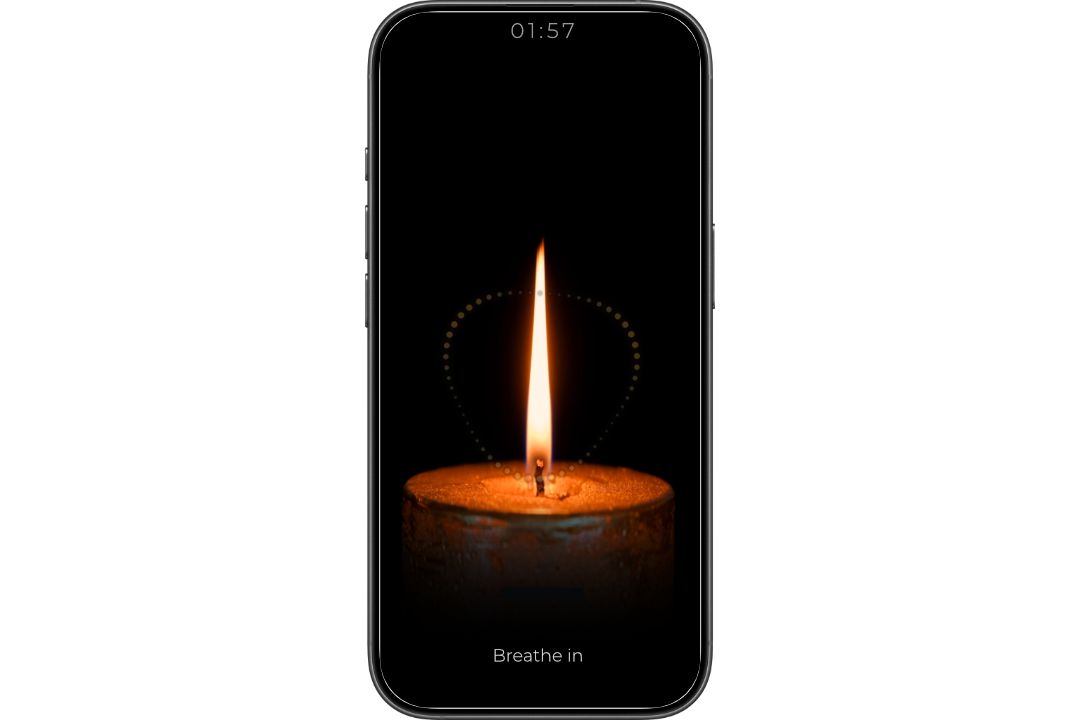
QuietFlame uses an animated flame for exactly this reason. The flame rises on your inhale and settles on your exhale, moving at a 4-6 pace without any counting required. There is no content library to navigate, no meditation course to begin, no discovery feed to pull you in. You open the app, the flame starts moving, and you follow it for five minutes. That is the entire experience.
For people who have tried counting-based breathing and found it too effortful to maintain at night, a visual pacer is often what makes the difference between a practice that sticks and one that does not. The session becomes easier to do than to skip, which is the threshold any habit needs to cross to become automatic.
Where to put it in your evening
The most common reason a good habit does not become automatic is that it floats - it exists in intention but not in a specific slot. "I will do some breathing before bed" fails because before bed is not a time. It is a vague zone that expands and contracts depending on the evening.
A habit sticks when it is attached to something that already happens reliably. This is called habit stacking, and it is one of the more robust findings in behavioral research on habit formation.
The most reliable anchor for an evening breathing practice is directly after brushing your teeth. Brushing happens almost every night regardless of how the day went. Attaching the breathing session to that existing behavior borrows its reliability. After two weeks, the sequence begins to feel incomplete without the breathing portion - which is the sign that the habit has taken hold.
A second reliable anchor is the moment you sit down on the bed before getting under the covers. If you are already in the habit of sitting for a moment before lying down, the breathing session slides naturally into that space.
What you want to avoid is placing the habit after a high-stimulation activity like scrolling your phone or watching something engaging. The breathing practice works best as a transition out of stimulation, not as something you do after your nervous system has already been re-activated by a screen. The order matters: stimulation stops, then breathing begins, then sleep follows.
The environment helps more than most people realize
The breathing practice is the core habit. But it works inside an environment, and that environment either supports or undermines it.
Light is the most underestimated variable. Bright overhead lighting in the evening tells your brain it is still daytime. Melatonin - the hormone that signals the body to begin the sleep transition - is suppressed by light intensity, particularly at the blue end of the spectrum that screens and modern LEDs emit. Switching to a dimmer, warmer light source an hour before bed does something physiologically real, even when the effect feels subtle. A single lamp in a corner costs almost nothing and signals something meaningful.
Thermal comfort matters. A slightly cooler room - most research suggests somewhere in the range of 65 to 68 degrees Fahrenheit, or 18 to 20 Celsius - supports the natural body temperature drop that precedes sleep. This does not require anything elaborate. A window cracked open, lighter bedding, or changing into cooler clothes can shift the environment enough to help.
Consistent sound conditions. Some people need silence. Others find that complete quiet amplifies restless thoughts and do better with a steady ambient sound - rain, a fan, brown noise played quietly. Neither is wrong. What matters is consistency: the same sound environment each night becomes another cue that the nervous system learns to associate with rest.
None of this has to be perfect. A slightly dimmer room, a somewhat cooler bed, and the same quiet conditions you had last night is enough. You are building a context, not a spa.
What to expect as the habit builds
The first evening you practice slow breathing for stress relief, the effect may be noticeable or it may be subtle. Both are normal responses. The practice does not produce the same experience every session, and the first session rarely produces the most dramatic effect.
What changes with consistency is the baseline and the speed of the response.
After about a week of regular practice, most people notice that the transition into the breathing session feels less effortful. The restlessness at the start of the five minutes - the impulse to check something, the sense that sitting still is wasted time - diminishes. The body begins to anticipate what the cue means.
After two to three weeks, the physiological shift tends to happen faster. Where the first session might have taken three or four minutes to produce a noticeable softening in tension, the same shift begins arriving within the first minute or two. The nervous system has learned the sequence and starts priming the response before the session is fully underway.
After a month, the five minutes often stops feeling like a stress relief tool and starts feeling like a natural boundary - something that marks the official close of the day in a way that is satisfying rather than disciplined. That shift in quality - from effortful to easy, from intervention to identity - is the sign that the habit has become genuinely automatic.
Sleep outcomes vary person to person and night to night. Stress will still spike. Hard weeks will still happen. The value of the habit is not that it makes every night perfect. It is that it raises the floor - that the average evening transition becomes smoother, the average night's rest becomes slightly more restorative, and the average morning carries less of the previous day's residue.
Common reasons people stop and how to avoid them
"I missed a few nights and lost momentum."
A gap of one or two nights does not undo a habit. The research on habit maintenance is consistent on this point: missing occasionally does not break the pattern as long as you return quickly. The goal is not a perfect streak. It is a reliable pattern with occasional misses. Resume the next night without treating the gap as a failure.
"It works fine but I keep forgetting."
This is a design problem, not a motivation problem. The habit is not anchored to anything immovable. Go back to the habit stacking principle: identify the specific thing you do every night immediately before you want to breathe, and pair them explicitly. Say it out loud if it helps: "After I brush my teeth, I do five minutes of breathing." Spoken implementation intentions have a measurably higher follow-through rate than silent ones.
"Some nights it does not seem to do anything."
Correct. Some nights the effect is pronounced and others it is barely perceptible. This is true of every relaxation practice and it does not mean the habit is failing. The benefit is cumulative and baseline - it shows up in how your nervous system handles stress over weeks, not in whether a specific session felt transformative. Keep showing up on the nights it feels pointless. Those are often the nights your nervous system needs it most.
"I fall asleep during the session."
This is not a problem. It means the practice is working and your sleep pressure was high enough that the relaxation tipped you over the threshold. If it happens regularly and you want to stay awake for the full session, try sitting upright rather than lying down until the five minutes is complete.
The simplest version, distilled
Everything in this article reduces to one thing: your nervous system has a built-in stress relief mechanism, and slow breathing in the evening is the most direct way to activate it.
You do not need a complicated routine. You do not need supplements, courses, or expensive equipment. You need five minutes, a consistent slot in your evening, and a breath pattern that extends the exhale beyond the inhale.
Do it sitting on the edge of the bed after you brush your teeth. Follow a visual guide if counting feels like effort. Keep the lights dim. Put the phone down before you start.
That is the habit. It is small enough to do on the worst nights, which is exactly why it is the right one to build.
If you want a calm visual pacer that removes the friction and makes the five minutes easy to return to night after night, QuietFlame is built for this. Open it when you sit down. Follow the flame. Close it when the session ends.
Your nervous system already knows what to do. You just need to give it the signal.
FAQ
What is the simplest evening habit for stress relief?
Five minutes of slow, deliberate breathing. It uses a mechanism your nervous system already has and requires no equipment or special setup.
How does breathing reduce stress at night?
Slow breathing, especially with a longer exhale, activates the parasympathetic nervous system, which lowers heart rate and reduces the keyed-up feeling of stress.
How long does it take to work?
Physiological shifts often begin within the first few minutes. The habit becomes more reliable over two to three weeks of consistent practice.
Can I do this without any equipment?
Yes. Sit comfortably, breathe slowly through your nose, and lengthen your exhale. An app is optional if you want a visual guide.