 QuietFlame
How to Calm Your Nervous System After a Stressful Day at Work
Coming home wired, irritable, or strangely flat after a hard day at work is not a mood problem. It is a nervous system stuck in an activated state. Here is what is actually happening in your body and the specific steps that help it downshift.
You close the laptop, or you clock out, or you finally leave the building - and the stress does not close out with it. Your shoulders are still up near your ears. Your thoughts are still moving at the pace of the meeting that ended an hour ago. Maybe you snap at someone over something small, or maybe you go quiet and flat and can't quite explain why. Either way, you are home, the workday is technically over, and your body has not gotten the message.
This is one of the most common and most misunderstood experiences of modern work life. Most people interpret it as a personality issue - they tell themselves they need to "relax more" or "stop overthinking," as if calm were a switch they are simply failing to flip. In reality, what is happening is physiological, not characterological. Your nervous system has shifted into an activated state in response to the demands of the day, and it does not return to baseline automatically just because the demands have stopped. It needs a specific kind of signal to downshift, and most evenings do not provide one.
This article explains what is actually happening in your body during and after a stressful workday, why the transition from "work mode" to "home mode" is harder than it sounds, and the specific, evidence-based steps that help your nervous system come back down - rather than just waiting for it to happen on its own.
What "stressed nervous system" actually means
The phrase gets used loosely, so it helps to be precise about what is happening physiologically. Your autonomic nervous system has two main branches: the sympathetic branch, which governs alertness, mobilization, and the "fight or flight" response, and the parasympathetic branch, which governs rest, digestion, and recovery. These two systems are not switches that flip fully on or off - they exist on a continuum, and at any given moment your body is operating somewhere along it.
A stressful day at work - tight deadlines, difficult conversations, constant context-switching, a long string of small demands with no real break - pushes you toward the sympathetic end of that continuum. Heart rate rises. Muscles, particularly in the neck, shoulders, and jaw, stay slightly contracted. Breathing becomes shallower and faster. Cortisol and adrenaline circulate at elevated levels. None of this is dramatic in the moment - it usually does not feel like an emergency - but it accumulates across the day, and by the time you stop working, your body is operating from a baseline that is meaningfully more activated than it was that morning.
The problem is that stopping work is not the same signal as deactivating stress. Your nervous system does not know the meeting ended or the inbox is closed for the day. It only knows what it is sensing - muscle tension, breathing pattern, hormone levels, the residue of unresolved mental loops - and unless something actively shifts those signals, the sympathetic activation simply continues into the evening, even while you are technically off the clock.
Why the transition from work to home is harder than it should be
Most people assume that leaving the source of stress should be enough to end the stress response. This assumption is reasonable but incorrect, and understanding why changes the whole approach.
The nervous system responds to physiological signals, not situational ones. It does not register "I am no longer at my desk" as meaningful information. It registers heart rate, breath pattern, muscle tension, and the chemical environment created by stress hormones - and all of those can remain elevated for hours after the triggering events have stopped, especially if nothing is done to actively change them.
There is also a cognitive component that compounds the physiological one. Many stressful workdays end with open loops - unfinished tasks, unresolved conversations, decisions still pending, an email that needs a reply you have not figured out yet. These open loops keep a low level of problem-solving activity running in the background of your mind well into the evening, and that background processing is itself mildly activating, even when you are consciously trying to relax. You can be sitting on the couch, ostensibly off duty, while part of your brain is still quietly rehearsing the day's unresolved tension.
Finally, many evenings simply do not contain anything that actively signals safety and rest to the nervous system. Scrolling a phone, half-watching television, or moving straight into the next set of household demands does not give your body the kind of input that produces a genuine parasympathetic shift. The day's activation does not get replaced with anything - it just continues, quietly, underneath whatever you are doing next.
The body keeps a record even when you don't notice it
One of the more important things to understand about a stressed nervous system is that it does not always feel like obvious anxiety or panic. Often, it shows up as something subtler: a short fuse with people you love, a sense of restlessness that doesn't have an obvious cause, scattered or unusually shallow breathing, gripping the steering wheel a little too tightly, or a kind of low-grade irritability that has no specific target.
It can also show up as the opposite of agitation - a flat, depleted, "running on empty" feeling that gets mistaken for laziness or low motivation, when what is actually happening is a nervous system that has spent its resources on sustained activation and has little left for engagement once the demand has technically ended.
Recognizing these patterns as nervous system activation, rather than as a personal failing or a mood you should simply manage better, is a meaningful first step. It reframes the goal from "stop feeling this way" to a more tractable one: give your body the specific signals it needs in order to shift states.
The fastest physiological lever: breathing
Of all the tools available for shifting out of a sympathetic state, breath is the most immediate and the most directly mechanistic. This is the same principle that applies to falling asleep at night, and it works just as reliably in the late afternoon or early evening.
Breathing slowly, with an exhale longer than the inhale, directly stimulates the vagus nerve - the primary nerve of the parasympathetic system - and produces measurable reductions in heart rate and muscle tension within minutes. This is not a relaxation technique in the soft, optional sense. It is a direct physiological lever, and it is one of the few inputs that reliably moves the nervous system in a specific direction on command, rather than waiting passively for activation to fade on its own.
The pattern that works well here is the same one that supports sleep onset: inhale through the nose for about four seconds, exhale slowly for six to eight seconds, and repeat for five to ten minutes. The extended exhale is the active ingredient - it is the half of the breath cycle most associated with parasympathetic engagement. Done immediately after a stressful day, even before you walk into the house or before you switch from "work mode" into whatever comes next, this single practice can meaningfully shorten how long the day's activation lingers.
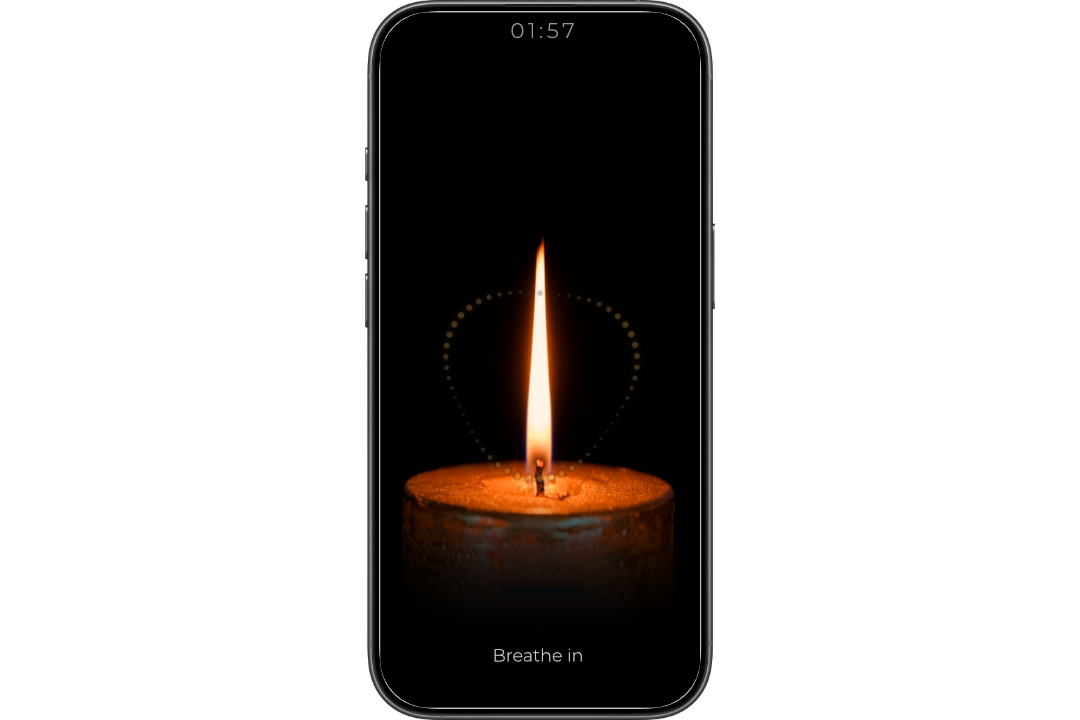
After a day spent managing other people's demands, counting your own breath can feel like one more task added to an already full mental load. QuietFlame replaces the counting with an animated flame that rises and settles at a slow 4-6 pace, so your attention has somewhere quiet to land while your body does the actual work of downshifting. There is nothing to track and nothing to get wrong - just a few minutes of following a flame between the end of work and the start of the rest of your evening.
The transition ritual: why a deliberate buffer matters
One of the most effective and most underused tools for managing post-work stress is not a technique at all, but a structural change: building a brief, deliberate transition between "work" and "home" rather than letting one collapse directly into the other.
This matters more for people who work from home, where the physical boundary between work and the rest of life has disappeared, but it is relevant for commuters too. Without some kind of buffer, the nervous system carries the activated state of the workday directly into the next phase of the evening, because nothing has signaled that the context has actually changed.
A transition ritual does not need to be elaborate. It can be as simple as:
Closing the laptop and physically leaving the workspace, even if that means just walking to another room or stepping outside for two minutes. The physical movement and change of environment give the nervous system a concrete signal that the context has shifted.
A short walk, with no phone, even five or ten minutes. Walking engages large muscle groups in a rhythmic, undemanding way that helps metabolize some of the stress hormones still circulating from the day, while the absence of a phone removes the temptation to keep checking email or news.
Changing clothes. This sounds almost too small to matter, but the physical act of changing out of "work clothes" - even if that just means a different shirt - is a well-documented psychological cue that helps mark the end of one context and the start of another.
A few minutes of the breathing pattern described above, done specifically as the bridge between work and whatever comes next, rather than waiting until much later in the evening when you are already deep into the next set of demands.
The specific content of the ritual matters less than its consistency. A short, repeatable sequence that you do at the same point every workday becomes, over time, a learned signal - your nervous system begins to associate the ritual itself with the shift out of work mode, which makes the transition faster and more reliable the more consistently you do it.
Closing the open loops
Because so much post-work tension comes from unresolved mental loops - the unfinished task, the unsent email, the decision you have not made yet - directly addressing those loops is one of the more effective ways to reduce lingering activation, separate from any breathing or physical practice.
A two- or three-minute written download of what is unresolved before you fully step away from work has real value here. This does not need to be a formal task list or a polished plan - it can be as simple as a few lines noting what is still open and what the very next step would be. The function of this practice is not to solve anything. It is to externalize the loop so your brain does not need to keep rehearsing it internally in order to "hold onto it." Once something has been written down, even briefly, the mind tends to treat it as registered rather than at risk of being forgotten, which reduces the background processing that keeps it active.
A single sentence about tomorrow's first priority serves a related but distinct function - it closes the loop of anticipatory rehearsal, the part of your mind that keeps trying to plan for what's coming, by giving it one clear, written answer instead of an open-ended question it keeps returning to.
Both of these take under five minutes and require nothing beyond a notebook or a notes app, but they directly target the cognitive half of post-work stress in a way that breathing and movement, on their own, do not.
What movement does that sitting still cannot
For many people, especially after a day spent mostly sedentary - at a desk, in meetings, in a car - the nervous system benefits from movement before it benefits from stillness. This can feel counterintuitive if your instinct after a hard day is to collapse onto the couch, but a body that has been physically still all day while under sustained mental or emotional load often has stress hormones and muscular tension that have nowhere to discharge.
Even a modest amount of physical activity - a brisk ten- or fifteen-minute walk, some light stretching, shaking out the arms and shoulders, or any movement that gets you slightly out of breath for a short period - helps metabolize circulating stress hormones and release some of the muscular tension that builds up during a day of sitting and sustained focus. This does not need to be exercise in the structured sense. The goal is not fitness; it is signaling to the body that the mobilization the day required is now complete and can be physically resolved rather than just mentally set aside.
People who go straight from a stressful day into a fully sedentary evening often report that the tension simply does not lift, no matter how much they try to relax - while a relatively brief period of movement beforehand makes the rest of the evening noticeably easier to settle into.
What tends to make it worse
Just as with the in-the-moment behaviors that worsen middle-of-the-night waking, there are a handful of common evening habits that feel reasonable in the moment but tend to prolong nervous system activation rather than resolve it. A better starting point is often the simplest evening habit for stress relief.
Scrolling the phone immediately after work. This is often reached for as a way to "switch off," but most phone use - news, social media, even passive scrolling - keeps the brain in an alert, input-processing mode that closely resembles the cognitive state of work itself, just with different content.
Venting at length without any resolution. Talking about a hard day with someone you trust can be genuinely valuable, but extended venting that keeps re-activating the stress of the events, without any movement toward acceptance or closure, can rehearse and reinforce the sympathetic state rather than helping it settle.
Jumping straight into the next set of demands. Moving directly from work stress into household tasks, caregiving responsibilities, or other obligations - without any buffer in between - gives the nervous system no opportunity to register that one demanding context has ended before another begins.
Using alcohol as the primary down-regulation tool. Alcohol can create a short-term sensation of relaxation, but it disrupts the body's natural stress-hormone regulation and sleep architecture later in the evening, often leaving the nervous system in a worse position by the next morning even though the immediate effect felt calming.
Building the full picture
As with most nervous system regulation, no single tool does all the work. The most effective approach combines a few aligned practices into a short, repeatable sequence right after work:
Create a physical and temporal boundary between work and the rest of your evening. Even two or three minutes of intentional transition - closing the laptop, changing clothes, stepping outside - gives your body a clearer signal than collapsing directly from one context into the next.
Move your body briefly before settling into stillness. A short walk or a few minutes of light movement helps discharge physical tension that has built up during a sedentary, demanding day.
Do a short written download of open loops. Two or three minutes noting what is unresolved, plus one sentence about tomorrow's first priority, reduces the background cognitive load that keeps the stress response quietly running.
Spend five to ten minutes on slow breathing. Four seconds in, six to eight seconds out, as close to the end of the workday as you can manage. This is the most direct physiological lever available and works well either on its own or layered into the transition ritual above.
Repeat the sequence consistently. As with sleep, a consistent post-work routine becomes a learned cue over time. After a few weeks of the same basic sequence, beginning the ritual itself starts to produce a sense of relief, because your nervous system has learned what reliably follows it.
None of these steps requires special equipment, a meditation background, or a significant time investment - the entire sequence above can be done in under twenty minutes. What it requires is consistency, and a willingness to treat post-work stress as a physiological state that needs an active signal to resolve, rather than something that should simply fade on its own once you stop working.
When it's more than an ordinary stressful day
Most of what is described in this article applies to the common experience of carrying tension home after a demanding workday - something nearly everyone experiences periodically, and something that responds well to the behavioral approaches above.
If you find that this activated, wired, or flattened state is present most evenings regardless of how the workday actually went, if it is affecting your sleep, your relationships, or your ability to enjoy time outside of work, or if it has been a near-constant pattern for several weeks or more without improvement from behavioral changes, it is worth speaking with a doctor or a therapist. Chronic, unresolved activation of the stress response over long periods is associated with a range of downstream effects on both physical and mental health, and a pattern this persistent is better addressed with professional support than continued self-management alone.
This is especially true if work stress is accompanied by symptoms like a racing heart at rest, frequent tension headaches, digestive disruption, or a sense of dread about work that begins well before the workday starts. These can be signs that the nervous system needs more structured support than evening rituals alone can provide.
Tonight, after work
You do not need the full sequence to start seeing a difference. A reasonable place to begin: when you finish work today, physically step away from your workspace before doing anything else, take a short walk if you can manage even ten minutes, and spend five minutes on slow breathing - four seconds in, six to eight seconds out - before you move into the rest of your evening.
If you want something to anchor your attention during those few minutes so the breathing takes care of itself, QuietFlame paces a slow session with a flame you simply watch and match, no counting required.
Your nervous system is not broken, and the tension you carry home is not a flaw in your character. It is a normal physiological response to a demanding day that has not yet been given the signal to stand down. Give it that signal, consistently, and the gap between "stressful workday" and "calm evening" gets shorter every time.
FAQ
Why do I feel wired after work?
Your sympathetic nervous system stays activated after sustained stress. Closing the laptop does not automatically tell your body the threat has passed.
How do I calm my nervous system after work?
Start with five minutes of slow breathing, then add movement, lower light, and a clear transition ritual between work and home if possible.
How long does it take to downshift after a stressful day?
A few minutes of breathing can begin the shift immediately. Fully settling may take twenty to forty minutes depending on how activated you are.
Should I breathe or exercise after work?
Both help. Breathing is the fastest first step when you are still mentally activated. Light movement afterward can complete the downshift.