 QuietFlame
Why Do I Hold My Breath While I Work?
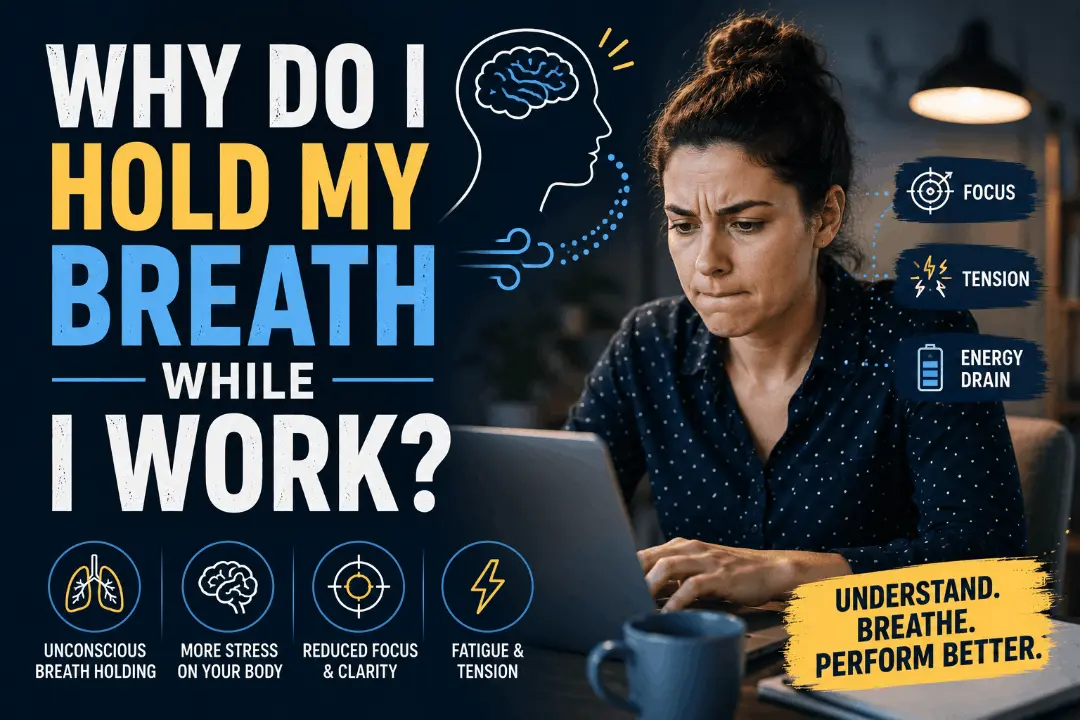
You are doing it right now and probably do not know it. Holding your breath or breathing shallowly at a screen is so common it has its own name - and its effects on your stress levels, focus, and energy are more significant than most people realize.
Stop for a second and notice your breath.
Are you breathing right now - fully, easily, without effort - or is there a slight tension somewhere, a breath that has been quietly suspended while your eyes move across the screen? If it is the latter, you are not alone, and you are not doing anything wrong. You are experiencing something so common among people who work in front of screens that it has its own clinical-sounding name: screen apnea, sometimes called email apnea.
Most people discover it in a moment of accidental noticing - a pause between emails, a brief look away from the monitor - and realize with some surprise that their breathing has been shallow or partially held for a while, without any conscious decision to do so. It feels strange to realize. It also tends to explain a lot: the low-grade tension that builds through a morning of focused work, the inexplicable tiredness that arrives before lunch, the sense of being slightly wound-up even on a quiet day - the same kind of activation that can linger after a stressful work meeting even once the call has ended.
This article explains what screen apnea is, why it happens, what it is doing to your body over the course of a workday, and - most importantly - what you can do about it. If the tension carries into the evening, see how to calm your nervous system after a stressful day at work.
What screen apnea actually is
The term was coined by Linda Stone, a former executive at Microsoft and Apple, who first noticed the phenomenon in herself in 2007. She had been practicing breathing exercises each morning and was struck by how quickly and completely that pattern dissolved the moment she opened her inbox. She would inhale in anticipation of what was coming, and then simply not exhale - held in a kind of suspended alertness while emails streamed in. She wondered if others did the same.
What followed was a period of informal but careful observation: she recruited friends and colleagues to sit at her computer and answer emails while she monitored their pulse and heart rate variability. The results were striking. Around 80 percent of the people she tested showed signs of shallow or suspended breathing while working at a screen - what she formally named "email apnea," later broadened to "screen apnea" as the behavior appeared during texting, scrolling, and other digital tasks.
The pattern she described is precise: a temporary absence or significant reduction of breathing that happens unconsciously, without the person being aware it is occurring, and that persists for as long as the screen task continues. It is not a medical condition in the clinical sense. It does not require treatment. But it does have real physiological consequences that accumulate over a workday, and it is far more common than most people realize before they start paying attention to it.
Why the body holds its breath in front of a screen
There are several overlapping reasons this happens, none of them mysterious once you understand how the nervous system responds to the modern work environment.
The threat response. When you open an inbox and see a slew of new emails, the body interprets this as a threat, and breathing is affected. This is an ancient, deeply wired response - the momentary hold that happens before a decision about what to do. The problem is that with screens, the "threats" are continuous and the freeze never quite resolves. So the breath-hold, instead of lasting a second, becomes a background pattern that runs for hours.
Posture and compression. When posture slumps or hunches over while using electronic devices, it compresses the chest, leading to shallower breathing. The body is not choosing to breathe shallowly; the position is simply not conducive to full lung expansion. Over a long session at a desk, even someone actively trying to breathe normally will find their breathing gradually becoming more restricted as posture degrades.
Cognitive absorption. Deep focus has a natural effect on breathing. When the brain is highly engaged in a task - reading something complex, composing a difficult message, solving a problem - it tends to quiet or minimize non-essential processes, and breathing is one of them. The people who did not show signs of screen apnea were those who had trained to breathe while simultaneously performing a demanding skill - athletes, dancers, singers, musicians. Most people doing desk work have no such training, and so concentration and breathing quietly compete.
What it is doing to you across a workday
A single breath-hold is trivial. An unconscious pattern of shallow or suspended breathing sustained across four, six, or eight hours of screen work is not.
The most immediate effect is on carbon dioxide regulation. Breathing is not just about getting oxygen in - it is equally about releasing carbon dioxide. When breathing is suppressed, CO2 accumulates, which triggers the body's stress response: cortisol rises, heart rate increases, the sense of alertness sharpens in the specific, uncomfortable way associated with anxiety rather than productive focus. This is one reason a morning of intense screen work can leave you feeling both exhausted and wired simultaneously - a combination that makes no intuitive sense until you understand what has been happening to your breathing.
The second major effect is on the nervous system state you carry through the day. Every hour of screen apnea is an hour in which the body's stress response has been gently, continuously activated. Cortisol that is never fully metabolized accumulates. Muscle tension that never fully releases compounds. By the afternoon, the fatigue many people attribute to "too many meetings" or "a hard day" is often partly the physiological cost of hours of shallow breathing - and if that tension follows you home, see how to calm your nervous system after a stressful day at work.
The third effect is on focus itself. Paradoxically, the deep concentration that tends to produce screen apnea is degraded by it. The root cause of email apnea is a compromised state of breathing - breath that gets shorter, shallower, and moves up from the abdomen into the chest. The focus that seems to be sharpened by the holding-breath intensity is, physiologically, being undermined by it.
How to notice it before it becomes a pattern
The single most useful first step is developing the habit of checking in on your breath periodically during the workday. Not constantly - that would itself become a distraction - but at natural transition points: when you switch between tasks, when you finish a document or close an email thread, when you pick up your phone.
The check-in takes one second: simply notice whether your breathing is full and easy or whether it has become shallow or partially suspended. If the latter, a single deliberate exhale - longer than the inhale, through the nose or mouth - is often enough to interrupt the pattern and reset to a more normal rhythm. You do not need a lengthy exercise or a significant pause. You just need to notice, and then make one different choice.
Posture is worth addressing too. A chair and desk setup that allows you to sit with a relatively upright spine - not rigid, but not collapsed forward - removes the physical compression that makes shallow breathing the path of least resistance. Even a small adjustment, like moving the screen further away so you are not instinctively leaning toward it, can make a noticeable difference in how easily the breath moves.
Why a deliberate breathing practice resets more than just the breath
Noticing and correcting screen apnea in the moment is valuable. But there is a stronger and more reliable version of this: building a deliberate breathing practice into the structure of the workday, at predictable points, rather than only responding to the pattern after it has already accumulated for an hour or two.
The reason this works better is physiological. A few minutes of slow, intentional breathing - particularly with an exhale longer than the inhale - directly engages the vagus nerve and shifts the autonomic nervous system toward parasympathetic dominance. This is not just "relaxing" - it is a measurable change in heart rate variability, cortisol levels, and the baseline tension the body carries into the next task. A deliberate five-minute breathing reset between demanding work blocks does not just undo shallow breathing; it changes the starting point for the next hour.
This is the kind of practice that is easy in principle and surprisingly hard in execution, because the middle of a workday offers almost no natural moment that feels like the right time to stop and breathe. Having a tool that removes that friction entirely - that makes a brief, guided breathing session something you can start in one tap with no setup and no decisions - changes the realistic probability that it actually happens.
QuietFlame is designed around exactly this kind of mid-day use. It organizes sessions by what you are actually trying to address - each goal like Relax, Focus, or managing frustration contains multiple guided breathing sessions, each one pairing a specific breathing pattern with a beautiful background scene and sounds chosen to match that state. There is nothing to count and nothing to configure. You choose your goal, follow the guided session, and let the environment do the work of helping your nervous system actually settle.
The sessions are organized by what you are actually trying to address. After a stretch of concentrated screen work that has left you tightly wound, the Relax goal surfaces sessions designed specifically for that kind of activation. If the morning's emails and notifications have left you scattered, the Focus goal offers a different breathing pattern oriented toward reorienting attention rather than simply slowing down. If accumulated stress has shaded into something sharper - frustration, irritability - there is a session for that state too, rather than a generic instruction to "just breathe."
Building the check-in into how you work
The most sustainable version of addressing screen apnea is not a dramatic change to how you work, but a few small additions to the rhythm of the workday that create regular opportunities for the breath to reset.
Before you open your inbox, take one full breath first. A single deliberate exhale before the flood of information begins establishes the breath rather than immediately suspending it. Done consistently, it begins to change the baseline you bring to screen work rather than just responding to it afterward.
Use transition points as check-ins. Between tasks, between calls, after sending a significant email - these are natural moments to pause for one conscious breath. The pause does not need to be long. The noticing is the thing.
Build one deliberate session into the day. Whether it is mid-morning, after lunch, or at the first sign of the afternoon energy dip, a five-minute guided breathing session at a consistent point in the workday produces compounding benefits over time. The nervous system learns the pattern, the recovery becomes faster, and the accumulated tension of a day of screen work has somewhere to discharge before it becomes the evening's problem - the same transition addressed in the simplest evening habit for stress relief.
QuietFlame tracks streaks and progress across sessions, which matters more than it sounds for a habit that is genuinely easy to skip on a busy day. A visible record of consistency makes the gap between intention and action narrower over time.
The thing you are doing right now
Stop again and check your breath.
Easier this time, probably. Awareness of the pattern tends to briefly interrupt it - and if you have read this far, you now have more of the tools to interrupt it deliberately, at the moments it would otherwise run unchecked.
Screen apnea is not a serious medical condition, and it does not require dramatic intervention. But it is a genuine, cumulative drain on focus, energy, and nervous system regulation that most people carry through their entire workday without knowing it is happening. Knowing it is happening is the first thing. Building a small, consistent practice around addressing it is the second.
The breath is available every moment of the workday. It is also the fastest physiological lever you have for changing how that workday feels. Most days, it is just a matter of remembering to use it.
FAQ
Why do I hold my breath while working?
Concentration and screen focus often trigger shallow or paused breathing, sometimes called email apnea or screen apnea, without you noticing it.
What is screen apnea?
Screen apnea is the tendency to breathe shallowly or hold your breath while reading, typing, or concentrating on a screen.
Is holding your breath while working harmful?
Occasional breath-holding is usually harmless, but doing it for hours can increase stress, reduce focus, and leave you feeling drained by afternoon.
How do I stop unconscious breath-holding?
Set brief breathing reminders, exhale fully before starting a task, and take two to three slow breaths whenever you notice tension or a held breath.