 QuietFlame
Does Breathwork Actually Lower Cortisol? Here's What the Science Says
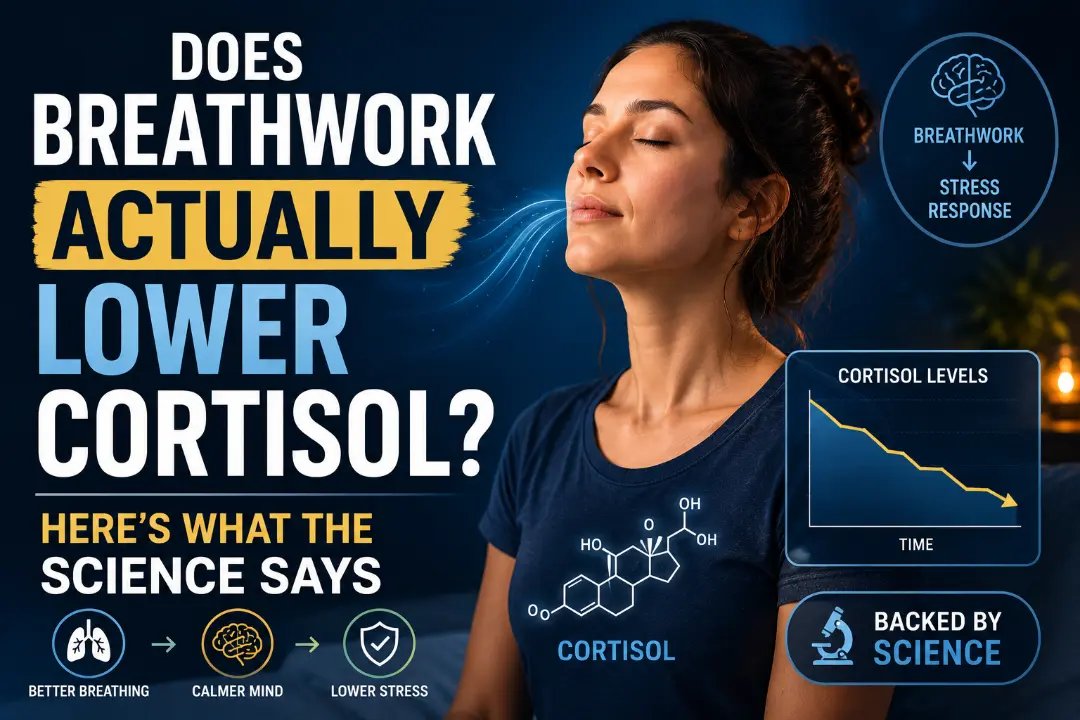
Cortisol gets blamed for everything from poor sleep to stubborn weight gain. Here is what cortisol actually does, what the research says about breathwork's effect on it, and how to use breathing realistically as part of managing it.
Cortisol has become one of those words that shows up everywhere - wellness videos, supplement ads, sleep apps, fitness content. "Lower your cortisol" is presented as a near-universal fix, often without much explanation of what cortisol actually is, why it might be elevated, or what realistically changes it.
Breathwork is frequently included in this conversation, sometimes with bold claims attached. So it is worth asking directly: does breathwork actually lower cortisol, or is this another case of a real physiological concept getting flattened into a marketing buzzword?
The honest answer sits somewhere in the middle, and it is more useful than either extreme. This article walks through what cortisol actually does, why it matters for sleep and stress, what the research on breathwork and cortisol actually shows, and how to think about breathing exercises as part of a realistic approach to managing cortisol - rather than a single switch that turns it off.
What cortisol actually is (and why it gets oversimplified)
Cortisol is a hormone produced by your adrenal glands, and it is often described as "the stress hormone" - a label that is not wrong, but is incomplete enough to cause confusion.
Cortisol's primary job is regulating energy availability and alertness. It follows a natural daily rhythm called the cortisol awakening response: levels rise sharply in the early morning, helping you wake up and feel alert, then gradually decline through the day, reaching their lowest point in the evening and overnight. This rhythm is one of the most consistent and well-studied patterns in human physiology - it is part of what allows your body to be ready for the day in the morning and to wind down toward sleep at night.
Cortisol also rises in response to stressors - physical, emotional, or psychological. This is the function most people think of when they hear "stress hormone." A demanding meeting, an argument, a near-miss in traffic, even intense exercise, all trigger a temporary cortisol increase as part of the body's response to a perceived demand.
The problem people are usually describing when they talk about "high cortisol" is not the existence of cortisol itself - you cannot and would not want to eliminate it - but rather a disrupted pattern. Specifically: cortisol that stays elevated later into the evening than it should, or a flattened daily rhythm where the morning rise is blunted and the evening decline does not happen as expected. This disrupted pattern is associated with poor sleep, increased evening alertness, and a general sense of being "wired but tired."
So the more precise and useful question is not "does breathwork lower cortisol" in some absolute sense, but "can breathwork help support the normal evening decline in cortisol when that decline has been delayed or blunted by stress?" That is a question the research can actually speak to.
How stress keeps cortisol elevated into the evening
Under normal circumstances, cortisol should be substantially lower in the evening than in the morning. But a demanding day - particularly one involving sustained psychological stress, poor sleep the night before, or stimulant use late in the day - can keep cortisol from declining as much as it should.
This happens because cortisol release is tied to activity in the hypothalamic-pituitary-adrenal axis, often shortened to the HPA axis, which is the communication system between your brain and your adrenal glands. The HPA axis responds to perceived threats or demands by triggering cortisol release. Crucially, it does not require an actual physical threat - psychological stress, anticipation of a difficult task, or even rumination about something stressful that already happened can all activate it.
This is why someone can feel physically "wired" in the evening even when nothing physically demanding has happened for hours. If the mind is still actively processing stressful content - replaying a conversation, anticipating tomorrow, problem-solving something unresolved - the HPA axis can remain more active than it would be at rest, which keeps cortisol from declining at its normal evening pace.
This connects directly to the broader pattern many people experience: feeling exhausted but unable to relax, having difficulty falling asleep despite being tired, or waking in the night with a sense of alertness that does not match the hour. An elevated or delayed cortisol decline is one of the physiological threads running through all of these experiences.
What the research on breathwork and cortisol actually shows
This is the part where it is important to be precise, because the research exists, but it does not say what some marketing claims imply.
Slow breathing reliably affects the autonomic nervous system. This part of the picture is well established. Slow, paced breathing - particularly with an extended exhale - increases parasympathetic activity, measurable through increases in heart rate variability and decreases in heart rate and blood pressure. This is one of the more consistently replicated findings in breathwork research, and it is the foundation for cortisol-related claims, because the autonomic nervous system and the HPA axis are connected. They are not the same system, but they influence each other.
Several studies show reduced cortisol following breathing interventions, particularly in people with elevated baseline stress. A number of studies measuring salivary cortisol - cortisol levels measured from a saliva sample, a common and non-invasive method - before and after a breathing session have found reductions, particularly in participants who started with higher stress levels or higher baseline cortisol. The effect tends to be more noticeable in people who have more room to come down from an elevated state, which makes physiological sense.
The effect is generally modest in single sessions and more meaningful with regular practice. A single twenty-minute breathing session is unlikely to produce a dramatic, easily-felt cortisol drop in someone with relatively normal levels to begin with. Where the research becomes more compelling is in studies involving regular practice over weeks - several weeks of consistent breathing practice showing reductions in baseline cortisol or improvements in the overall daily cortisol rhythm, rather than just an acute dip after one session.
Results are not uniform across all studies. Some studies measuring cortisol before and after breathing interventions find no significant change, particularly in healthy participants with normal baseline cortisol and low stress at the time of testing. This is not a contradiction so much as a reflection of the fact that cortisol in a healthy person under low stress does not have much room to "improve" - the rhythm is already functioning normally.
The research is strongest when breathwork is framed as supporting the existing system, not overriding it. The studies that show the most consistent positive findings frame breathwork as a tool that helps the body's existing stress-regulation systems function more effectively - particularly in the context of an evening transition, where the goal is supporting a decline that should be happening anyway, rather than forcing a change that would not occur naturally.
Put together, the honest summary is: breathwork has a real, mechanistically plausible, and reasonably well-supported effect on cortisol, particularly the evening decline in people whose stress has delayed or blunted that decline - but it is a supportive effect, observed most clearly with regular practice, not a dramatic on-demand override.
Why the framing matters more than the headline claim
The reason this distinction matters is that "does X lower cortisol" framing tends to set people up for one of two unhelpful outcomes.
Either they expect too much from a single session - doing one breathing exercise and expecting to feel a dramatic shift comparable to taking a sedative, and then concluding the practice "does not work" when that does not happen.
Or they dismiss the practice entirely because it does not produce an immediate, obvious, measurable change they can point to - missing the more realistic and more valuable effect, which is cumulative support for a system that is already trying to do its job.
A more accurate way to think about it: your body already has a cortisol rhythm that is designed to decline in the evening. Most evenings, in most modern lives, something is interfering with that decline - screens, stress, unresolved mental loops, late stimulants, bright light. Breathwork does not need to "lower cortisol" in some artificial sense. It needs to remove some of the interference so the decline your body is already trying to produce can happen more fully and on schedule.
This is a less exciting claim than "breathing exercises slash your cortisol levels," but it is the claim the evidence actually supports, and it has a practical implication: consistency matters more than intensity. A daily five-minute practice that removes a small amount of evening interference, repeated over weeks, is more aligned with what the research shows than an occasional long session.
What this looks like in practice
If the goal is supporting your evening cortisol decline through breathing, here is what the research-informed version of that looks like.
Timing matters. The evening cortisol decline is a gradual process, not a single event. Breathing exercises done as part of a consistent evening routine - rather than sporadically whenever stress feels high - are more aligned with supporting a gradual decline than interrupting an acute spike. This does not mean breathing during an acutely stressful moment is not useful - it absolutely can be, for the immediate autonomic effect - but for the cortisol-rhythm angle specifically, regularity in the evening is the more relevant factor.
The pattern matters less than the consistency of the exhale. Most of the research uses slow breathing protocols broadly in the range of four to six breaths per minute, generally with an exhale equal to or longer than the inhale. A simple 4-6 pattern - four seconds in, six seconds out - falls comfortably within this range and is accessible without any prior experience.
Five minutes is a reasonable, evidence-aligned starting point. While some studies use longer sessions, the broader pattern in habit and physiology research suggests that a shorter practice done consistently every evening produces more cumulative benefit than a longer practice done occasionally. Five minutes, done nightly as part of a wind-down routine, is consistent with both the cortisol research and what is realistic to sustain.
It works best alongside, not instead of, other evening factors. Cortisol's evening decline is influenced by light exposure, screen use, caffeine timing, and overall stress levels - not breathing alone. Breathwork is one input among several. Dimming lights, reducing late screen exposure, and avoiding stimulants close to bedtime all support the same underlying process. Breathing exercises are most effective as part of this broader picture, not as a standalone fix expected to compensate for everything else.
A simple evening practice aligned with the research
Here is a practical version, built around what the evidence actually supports rather than what sounds most dramatic.
Pick a consistent time, ideally one to two hours before you intend to sleep. This aligns with the period during which cortisol should be declining most steeply. Practicing earlier in the evening, as part of a wind-down transition, is more aligned with supporting this decline than practicing only once you are already in bed trying to fall asleep - though doing it at both times is also fine if it fits your routine.
Use a 4-6 breathing pattern - four seconds inhale, six seconds exhale. This falls within the range used in much of the supportive research and is comfortable enough to sustain without strain.
Do five minutes, every evening, regardless of how stressed you feel that day. The research supporting cortisol effects is strongest with regular practice. For what that looks like in practice, see can 5 minutes of slow breathing before bed improve your sleep quality.
Pair it with reduced light and screen exposure during the same window. Since cortisol's evening decline is influenced by multiple factors, doing the breathing practice in a dimmer environment - rather than under bright lights with a phone in hand - removes some of the competing signals and gives the breathing practice a better chance to have its supportive effect.
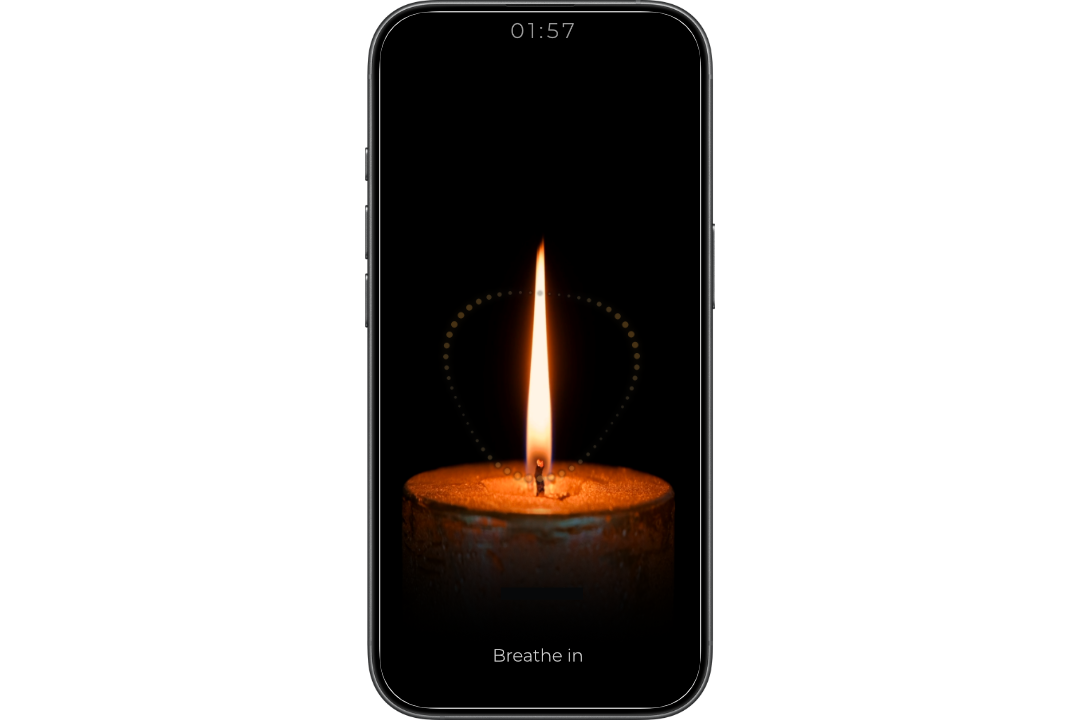
For people building this kind of consistent evening practice, having something simple to follow removes one more barrier to actually doing it every night. QuietFlame is designed around exactly this kind of five-minute evening session - a slow-moving flame paces a 4-6 breath without any counting, in a dim, distraction-free interface. The point is not that the app itself changes cortisol - breathing does that. The app's role is simply making the five minutes easy enough to repeat every single evening, which is the part of the equation the research keeps pointing back to.
What breathwork is not going to do for cortisol
It is worth being equally clear about the limits, because overpromising erodes trust in a practice that has genuine, evidence-supported value.
Breathwork is not going to "detox" cortisol or produce a dramatic before-and-after lab result after one session. If you measured your cortisol before and after a single five-minute breathing session, you might see a modest decrease, no meaningful change, or - particularly if you started in a relatively normal range - nothing measurable at all. This is normal and does not mean the practice has no value.
Breathwork cannot compensate for a fundamentally disrupted schedule. If someone is going to bed at wildly inconsistent times, consuming caffeine late into the evening, and exposed to bright screens until the moment they try to sleep, five minutes of breathing - however well done - is working against significant headwinds. The practice has the most impact when it is part of a broader evening pattern that is not actively working against it.
Chronically elevated cortisol from ongoing significant stressors - a demanding life situation, an underlying health condition, or a diagnosed HPA axis disorder - requires more than a breathing practice. Breathwork can be a genuinely helpful component of managing stress in these situations, but it is support, not treatment, and significant or persistent symptoms related to cortisol dysregulation - unexplained fatigue, significant sleep disruption, weight changes, or other symptoms - are worth discussing with a doctor rather than addressing through breathing alone.
The realistic takeaway
So: does breathwork actually lower cortisol? The evidence suggests that slow, paced breathing - particularly with an extended exhale, practiced consistently in the evening - is associated with reductions in cortisol, especially in people with elevated stress, and especially with regular practice over time rather than single sessions. The effect is real, mechanistically plausible given what is known about the connection between the autonomic nervous system and the HPA axis, and supported by a reasonable body of research - though it is a supportive, cumulative effect rather than an immediate, dramatic one.
The most useful way to think about it is not "breathing will lower my cortisol tonight" but "a consistent evening breathing practice removes some of the interference that is currently keeping my cortisol from declining the way it normally would - and over weeks, that adds up to a real difference in how the evening transition feels."
That framing is less dramatic than a headline promising a cortisol reset in five minutes. It is also the version that is actually true, and it points toward exactly the kind of practice that is realistic to sustain: short, consistent, and part of an evening that is generally working with your body's rhythm rather than against it.
Tonight
If you want to start aligning your evening with this research, the simplest entry point is five minutes of slow breathing - four seconds in, six seconds out - done at roughly the same time each evening, in a dimly lit space, away from bright screens.
If you would like something to follow so the five minutes is easy to return to night after night, QuietFlame paces a 4-6 breath with a slow-moving flame, designed to be simple enough to become part of your evening without becoming one more thing to think about.
Cortisol's evening decline is something your body is already trying to do. The role of a breathing practice is simply to get out of its way - consistently, night after night.
FAQ
Does breathwork lower cortisol?
Studies show slow breathing can reduce cortisol in some contexts, especially acute stress. Effects vary by person, dose, and how consistently you practice.
How long do cortisol effects from breathing last?
A single session may produce short-term shifts. Lasting change usually comes from regular practice as part of broader stress and sleep habits.
Is breathwork a replacement for medical treatment?
No. Breathing is a supportive tool for general wellness, not a substitute for medical care if you have a diagnosed hormonal or stress-related condition.
How often should I practice for cortisol benefits?
Five minutes most evenings is a realistic starting point. Consistency matters more than occasional longer sessions.