 QuietFlame
I Tried a 5-Minute Breathing Reset Every Day for 30 Days
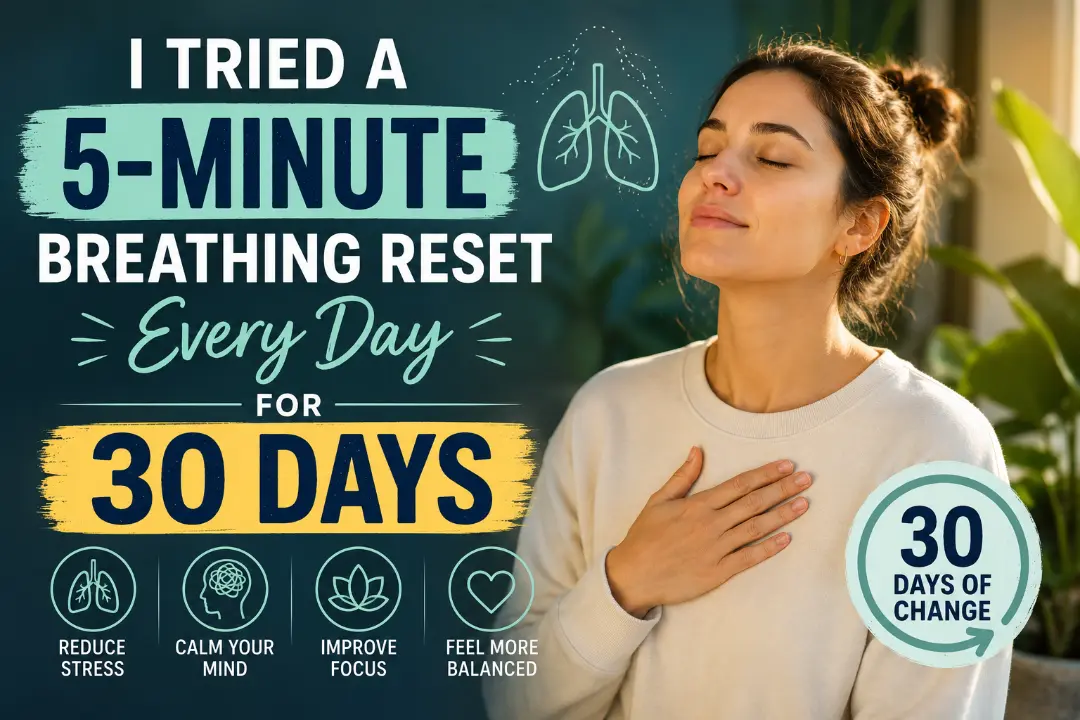
I committed to five minutes of slow breathing every evening for 30 days. Here is what actually changed, what did not, and whether it is worth doing.
I am not a meditator. I have tried meditation apps three separate times over the past few years and abandoned all three within two weeks. Not because I think meditation is useless - I believe the research behind it - but because the habit never seemed to stick in a way that felt proportionate to the effort.
So when I decided to try a daily five-minute breathing reset for thirty days, I was not approaching it as a convert. I was approaching it as someone who wanted to know whether something this small could actually do anything, or whether it was just a slightly more defensible version of the same wellness theater I had already given up on twice.
This is what happened.
The setup
The rules I set for myself were deliberately minimal. Five minutes of slow breathing every evening, before getting into bed. The pattern I used was simple: inhale for four seconds, exhale for six. No elaborate technique, no breath holds, nothing that required remembering a sequence.
The only tool I used was QuietFlame, which I had been curious about for a while. The app shows an animated flame that rises on the inhale and settles on the exhale, pacing a 4-6 breath without any counting required. I used it because I knew from previous attempts that counting breaths at the end of a tired day felt like work, and I did not want the counting to become the reason I stopped.
I sat on the edge of my bed each night, opened the app, and followed the flame for five minutes. That was the entire commitment.
I did not track sleep with a wearable or measure HRV or take any objective biometric data. This is a personal account, not a controlled study. What I tracked was simpler: how I felt during the evening transition, how long it seemed to take to fall asleep, and whether anything about my mornings changed. I made a brief note in a plain text file most evenings - one or two sentences, nothing formal.
Week one: more friction than expected
The first week was not what I expected, and not in a flattering way.
The first two nights, the five minutes felt genuinely long. Not because anything unpleasant happened, but because sitting still with no other input for five minutes is noticeably different from the rest of an evening spent doing things. My mind kept generating tasks, reminders, and random thoughts at a pace that felt almost comical - as if my brain, deprived of a screen for five minutes, decided to hold a board meeting.
I noticed something else in the first few days: I was breathing into my chest rather than my belly. I had read enough about breathing to know this is the shallow, stress-adjacent pattern, but knowing that did not automatically change it. It took a few evenings before lower belly breathing started to feel more natural than forced.
By days four and five, the friction started to ease slightly. Not dramatically - I was not suddenly loving it - but the five minutes stopped feeling quite as long. The thoughts were still there, but they were slightly easier to notice and set aside rather than follow down every rabbit hole.
The most useful thing that happened in week one had nothing to do with the breathing itself. The act of sitting down at a specific moment, with a specific intention, created a clearer line between "day" and "evening" than I had been drawing before. Even when the session felt unremarkable, the boundary it created was real.
Week two: something shifts
Week two is where the experience became more interesting and harder to explain precisely.
Around day eight or nine, I noticed that the transition into the breathing session felt different. Less like stopping something and more like arriving somewhere. That sounds vague, and it is - I am not sure I can describe it more precisely than that. The sitting down stopped feeling like an interruption to the evening and started feeling like its own thing with its own quality.
I also noticed, around the same time, that following the flame had become genuinely easy in a way it had not been in the first week. My attention still wandered - often, some nights - but the wandering felt lighter. A thought would arrive, pull me away briefly, and then I would notice the flame still moving and come back to it without any sense of having failed at something. That quality of noticing and returning - which I had read about in the context of meditation but never really experienced - started to feel like something I was actually practicing rather than just reading about.
Sleep timing was harder to evaluate. Some nights in week two I fell asleep noticeably faster than usual. Other nights I lay awake for a while regardless. I was careful not to draw conclusions from individual nights - sleep is variable enough that any single data point is almost meaningless.
What I could say by the end of week two was that the five minutes had stopped feeling like a discipline and started feeling like something I was looking forward to in a modest, quiet way. Not dramatically. Not in the way I look forward to things I actually enjoy. More like the way you look forward to sitting down after a long walk.
Week three: the compounding effect becomes visible
By week three, something had shifted clearly enough that I felt I could point to it without embarrassment.
The most concrete change was in the evenings themselves, not in the five-minute session. I noticed that I was winding down earlier and more naturally - not because I was trying to, but because the practice had apparently started to work as a genuine cue for the end of the day. Around the time I would normally do the session, I started feeling a pull toward it rather than a pull away from it. The nervous system association that the habit literature talks about - where the cue itself begins to produce the response before the behavior has fully begun - had apparently started to form.
I also noticed something I had not expected: I was reaching for my phone less in the half hour before bed. Not because I had made any rule about it. It seemed to happen as a downstream effect of the practice creating a different quality of attention in the evening - something quieter and less hungry for input that made the reflexive scroll feel less appealing than usual.
Sleep onset felt faster on most nights in week three, though there were still outliers - a stressful day, a late conversation, a night where something had clearly unsettled the baseline and the breathing practice, while still helpful, could not fully compensate. I noted these as data rather than failures.
My mornings in week three were noticeably better than they had been at the start of the month. I say noticeably with the caveat that morning quality is affected by so many variables that attributing it confidently to a single evening practice is genuinely difficult. What I can say is that the subjective sense of arriving at the morning still partially carrying the previous day - a feeling I had been aware of without naming it - was less present.
Week four: what the habit actually became
By the final week, the five minutes had become so automatic that there was nothing to report about the effort of doing it. The session happened the way brushing teeth happens - not because I remembered to do it or motivated myself to do it, but because it was the next thing in a sequence that had become established enough to run on its own.
This was the most striking thing about the full thirty days in retrospect. The change was not dramatic. There was no single night where everything shifted. There was no morning where I woke up transformed. The change was more like the gradual improvement of a baseline - the floor of the evening rising slightly, the average night becoming slightly better, the average morning carrying slightly less weight from the day before.
What the habit had become by week four was a reliable boundary. Sitting down with the app and following the flame for five minutes was the moment the day officially ended. Everything before it was still "day" - still processing, still responsive, still open. Everything after it was "night" - genuinely at rest, not performing rest while still half-engaged.
That boundary, consistent and repeatable, turned out to be more valuable than I had expected it to be when I started. I had been skeptical that five minutes could produce anything meaningful. I was not skeptical by the end of week four.
What did not change
Honesty requires including this section.
My sleep was not perfect after thirty days. I still had bad nights. I still had periods where stress overrode everything and I lay awake for longer than I wanted. The breathing practice did not make me immune to a difficult stretch of work, a stressful week, or the compounding effects of several nights of late sleep in a row.
My anxiety did not disappear. The racing thoughts before bed became more manageable, but they did not stop entirely, and on difficult nights they were still a significant presence that the practice helped with but did not resolve.
I also noticed no change in things I had half-hoped might improve - general energy levels, productivity, mood in any obvious or consistent way. Some of these things fluctuated over the month, but I could not attribute any of the fluctuation to the breathing practice with any confidence.
Five minutes is genuinely small. It is small enough to produce real cumulative effects, as I found over thirty days. It is also small enough that it cannot compensate for major disruptions to sleep, significant ongoing stress, or other factors that affect overall wellbeing. Expecting it to be a comprehensive solution would be the wrong expectation to bring to it.
The honest summary: what five minutes actually did
Reducing it to the clearest terms I can manage:
What changed clearly: the evening transition. The quality of the hour before bed improved consistently over the month - less restless, less stimulation-hungry, more naturally inclined toward rest. The boundary between day and night became more real and more repeatable.
What changed moderately: sleep onset. On most nights, not all nights, the gap between lying down and falling asleep felt shorter by the end of the month than at the beginning. This is the effect I am least certain about, because sleep onset is variable and I was not measuring it objectively.
What changed subtly: morning quality. The subjective sense of waking still carrying the previous day eased over the month. Hard to attribute confidently, but consistent enough over four weeks to register.
What did not change in any obvious way: the presence of stress, the content of anxious thoughts, overall energy, or anything that could plausibly be described as a transformation.
This is a modest report. But the more I think about it, the more I think modest is the honest and appropriate category for what a daily five-minute practice can realistically do - and the more I think that modest, consistent, and cumulative is a better outcome than dramatic and unsustainable. The physiology behind that claim is laid out in does breathwork actually lower cortisol.
Whether I continued
Yes. Without making a formal decision about it, the practice continued past day thirty without interruption.
This is perhaps the most meaningful data point of the whole experiment. Habits I have tried and eventually abandoned usually fade because they become effortful or because the return does not feel proportionate to the investment. This one did not fade, because the investment is small enough to sustain indefinitely and the return - a quieter evening transition, a more reliable boundary between day and night - is consistent enough to keep the practice feeling worthwhile.
I am not going to claim it changed my life. It changed my evenings. After thirty days of evidence, that turns out to be enough.
If you want to try it
The setup is simple enough that there is no reason to delay. Sit on the edge of your bed tonight, before getting under the covers. Breathe in for four seconds and out for six. Do that for five minutes.
If you want something to follow so the counting is handled for you, QuietFlame is what I used for the full thirty days. The animated flame paces the 4-6 breath without any input from you beyond opening the app and sitting down. On tired nights, that small reduction in friction turned out to matter more than I expected.
Start tonight. Make a note of how the first week feels. The second week will feel different, and the third week will feel different again. The change is not dramatic, and it is not fast, and it is genuinely worth doing.
FAQ
Is a 30-day breathing challenge worth it?
Yes, if you keep it short. Five minutes daily for thirty days is enough to see whether the habit lowers evening stress and improves sleep without requiring a major lifestyle overhaul.
What changed after 30 days of breathing?
Most noticeable shifts were faster downshifting in the evening, less dread at bedtime, and the routine feeling automatic rather than forced.
How many minutes per day is enough?
Five minutes every evening was sufficient. Longer sessions were easy to skip and did not clearly add benefit in the first month.
What if I miss days during the challenge?
Resume the next night. Missing a day did not reset progress. Consistency over the month mattered more than a perfect streak.