 QuietFlame
Can 5 Minutes of Slow Breathing Before Bed Improve Your Sleep Quality?
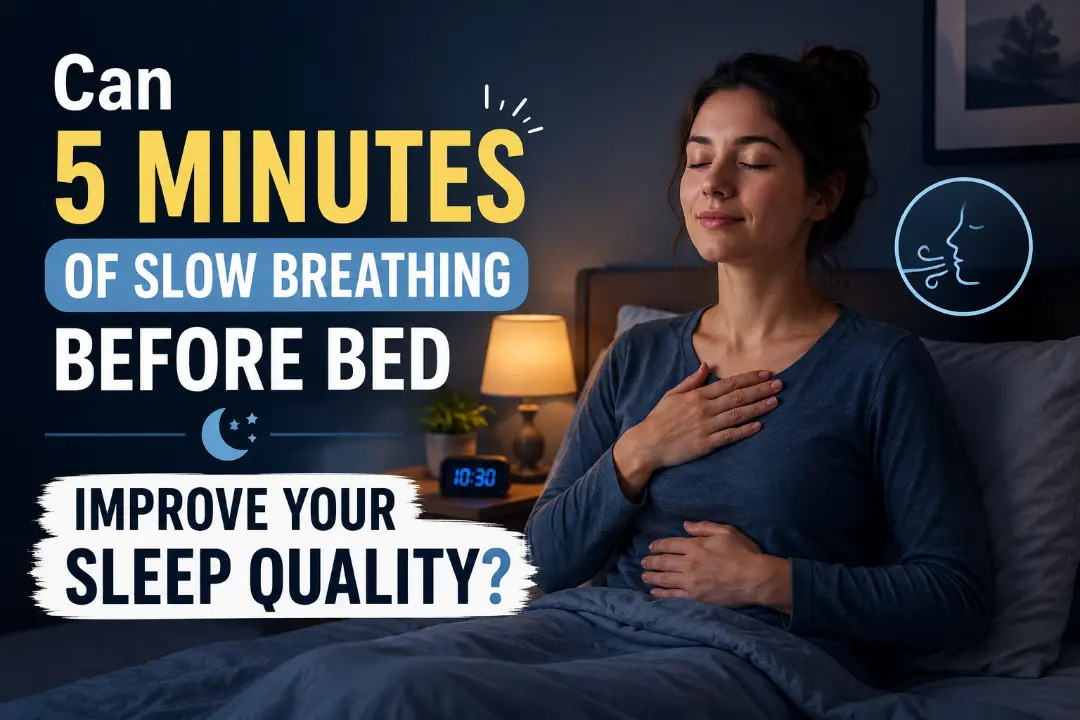
Five minutes sounds too small to matter. Here is what actually happens to your body when you breathe slowly before bed - and why the research is more convincing than you might expect.
Five minutes. That is roughly the time it takes to scroll through your phone before bed, reheat a drink you forgot about, or lie in the dark rehearsing tomorrow's to-do list. It does not sound like enough time to meaningfully change anything about your sleep.
But that assumption is worth examining. Because the question of whether five minutes of slow breathing before bed can improve your sleep quality has a more interesting answer than most people expect - one that is grounded in physiology, supported by research, and practically relevant for anyone who has ever lain awake feeling tired but unable to switch off.
This article gives you the honest version of that answer. Not a sales pitch for a single technique, not a promise of transformation in one session. Just a clear look at what slow breathing does to your body, what the evidence actually shows, and what you can realistically expect if you make it a consistent part of your evening.
The problem slow breathing is actually solving
Before getting into what five minutes can do, it helps to understand what it is working against.
Most people who struggle to fall asleep quickly, or who wake up feeling less rested than they should, are not dealing with a fundamental biological sleep problem. They are dealing with elevated pre-sleep arousal - a state in which the nervous system is still running at daytime intensity when the body is trying to transition into rest.
Pre-sleep arousal has two components. The first is physiological: elevated heart rate, muscle tension, a cortisol curve that has not finished declining, a body that is still primed to respond to demands. The second is cognitive: an active, looping mind that keeps generating thoughts, plans, worries, and replays as if the day were still ongoing.
Both components interfere with sleep onset and sleep quality. A mind racing through tomorrow's meeting keeps the brain in a light, alert state. A body still carrying the physical tension of a hard day takes longer to reach the deep, restorative sleep stages. Addressing either one tends to help the other - they are not separate problems.
Slow breathing targets both at once. It is one of the few pre-sleep tools that works on the body directly, not just the mind, which is what makes five minutes meaningfully different from five minutes of positive thinking or five minutes of listening to a podcast.
What happens in your body in those five minutes
The mechanism behind slow breathing is not mysterious. It is well documented in cardiovascular and autonomic nervous system research, and understanding it makes the practice easier to trust.
Respiratory rate and heart rate are linked. When you inhale, your heart rate rises slightly. When you exhale, it falls. This is a normal, healthy oscillation called respiratory sinus arrhythmia. When you breathe quickly and shallowly, as most people do under stress or at the end of a busy day, these fluctuations are small and fast. When you slow your breathing deliberately, you amplify the oscillation in a way that engages the vagus nerve and stimulates parasympathetic activity.
The exhale is doing most of the work. A longer exhale than inhale - the most common slow breathing pattern for sleep - means you spend more of each breath cycle in the phase that slows the heart. Breathing in for four seconds and out for six is not an arbitrary ratio. The extended out-breath is a direct physiological signal to the nervous system that it is safe to downshift.
Heart rate variability increases. HRV - the variation in time between heartbeats - is a marker of how flexibly your autonomic nervous system is operating. Higher HRV in the evening is associated with better parasympathetic tone, lower anxiety, and improved sleep quality. Slow paced breathing, particularly at around five to six breaths per minute, consistently raises HRV in both short and longer-term studies. This is one of the cleaner findings in the breathwork research literature.
Cortisol responds. Stress hormones do not clock out when your workday ends. Cortisol, which follows a natural decline through the afternoon and evening, can stay elevated longer when the day was demanding or when evening habits keep the nervous system activated. Slow breathing is one of the behavioral interventions with reasonably consistent evidence for supporting that decline. It does not work instantly, but a regular evening practice over weeks has a compounding effect on how efficiently your body manages the transition.
Muscle tension releases. Chronic tension in the shoulders, jaw, neck, and abdomen is something most people carry without fully registering it. Slow, deliberate breathing - particularly when paired with a brief body awareness check at the start of a session - creates the conditions for that tension to release. The body softens in a way that is measurable and that directly supports the physical relaxation sleep requires.
All of this begins happening within the first few minutes of slow, steady breathing. Five minutes is not a shortcut. It is genuinely enough time for the physiological shift to begin.
What the research shows
Sleep research is inherently messy. Sleep is personal, variable, and difficult to study cleanly under controlled conditions. With that caveat clearly on the table, the evidence for slow breathing as a pre-sleep tool is more robust than most wellness recommendations.
Slow breathing and HRV. Multiple controlled studies have shown that slow paced breathing at five to six breaths per minute significantly increases HRV compared to normal breathing. This effect appears in both single sessions and regular practice. Given the established relationship between higher evening HRV and better sleep quality, this is a meaningful finding rather than an indirect one. For a practical guide to the technique itself, see paced breathing for sleep.
Slow breathing and sleep onset. Research on pre-sleep arousal consistently identifies physiological activation as one of the primary barriers to falling asleep quickly. Interventions that reduce that activation - including slow breathing - show measurable effects on sleep onset latency, which is the time between lying down and falling asleep. The effects are not uniform across every study, but the direction is consistent.
Slow breathing in clinical sleep treatment. Cognitive behavioral therapy for insomnia, which is the evidence-based first-line treatment for chronic sleep difficulties, typically includes relaxation components such as slow breathing. This inclusion reflects clinical judgment that the practice is reliably helpful enough to be worth teaching. When breathing exercises appear in CBT-I protocols, it is not because they sound nice - it is because they have demonstrated enough benefit in practice to earn their place.
Short sessions and real effects. One question the research does address, at least partially, is whether short sessions produce real physiological changes or whether benefits require longer practice. The evidence suggests that even sessions of five to ten minutes produce measurable changes in HRV and self-reported relaxation. The changes from longer or more regular practice are larger and more durable, but the threshold for producing any effect is low. Five minutes is above that threshold.
What the research does not show. It is worth being honest about the limits. Most studies use small samples, short durations, and variable methodologies. The research does not establish that five minutes of breathing will add a specific number of minutes to your total sleep time or guarantee any particular outcome. Sleep is too variable and too personal for that kind of claim to be responsible. What the evidence does support is that slow breathing before bed consistently moves physiology in the direction of sleep - and that this effect is reliable enough to be practically useful.
Five minutes versus longer sessions
If five minutes produces a real effect, does thirty minutes produce six times as much benefit? The answer is no - and understanding why changes how you think about the practice.
Most of the physiological response to slow breathing happens in the early portion of a session. Heart rate responds to the first few breath cycles. Muscle tension begins releasing within two to three minutes. The nervous system shift is not linear - it is more like a curve that rises steeply at first and then levels off.
This means five minutes captures a substantial portion of the available benefit from a single session. A longer session is not without value - it deepens and extends the state, and regular long-form practice builds greater baseline parasympathetic tone over time. But the difference between five minutes and zero minutes is much larger than the difference between ten minutes and fifteen.
For the purpose of a pre-sleep habit, this matters enormously. A five-minute practice that you do every night is vastly more effective than a twenty-minute practice that you do twice a week when conditions are perfect. Habit research is consistent on this point: frequency and consistency produce more cumulative change than intensity and duration.
Five minutes is also the length that survives real life. On a hard night when you are exhausted, stressed, and lying in bed already reaching for your phone, five minutes is achievable. Twenty minutes is not. Building your practice around the length that holds on the worst nights is how you create something durable rather than something aspirational.
What "improved sleep quality" actually means in practice
The phrase sleep quality gets used loosely, so it is worth being specific about what slow breathing can realistically influence.
Sleep onset time. Many people who practice slow breathing consistently before bed notice that the gap between lying down and falling asleep shortens over weeks. Not dramatically in every case, but enough to register. This is the pre-sleep arousal mechanism working as expected - a calmer nervous system reaches the conditions for sleep onset more quickly.
Sleep architecture. Deep sleep and REM sleep - the most restorative stages - are more accessible when the body enters sleep from a calmer baseline. If you are falling asleep from a state of high tension and cortisol, the early sleep stages tend to be lighter. Arriving at sleep from a lower arousal state creates better conditions for reaching and sustaining the deeper stages.
Night waking. Some people find that consistent slow breathing practice reduces how often they wake in the night, particularly the kind of waking accompanied by a sense of alertness or a racing mind. This is not universal, and it is not guaranteed, but it aligns with what the nervous system research would predict.
Morning feeling. Sleep quality is ultimately measured by how you feel when you wake up. People who report the most consistent benefit from pre-sleep breathing often describe it not as falling asleep faster, but as waking feeling less ragged - less as if they spent the night half-processing the previous day. This is a subjective measure, but it is the one that matters most to lived experience.
The compounding effect. A single session of slow breathing before bed produces a real but modest effect. A hundred sessions produce something different - a nervous system that has been trained to associate a particular cue with downshifting, and that begins to respond to that cue before the first full breath cycle is complete. The five minutes gets easier, the transition becomes faster, and the baseline improves. This is not magic; it is how habit formation and autonomic conditioning work.
Common doubts, answered honestly
"I tried breathing before bed and it did not do much."
A single session under unfamiliar conditions, without a reliable pattern or visual guide, often does not produce a dramatic response. The practice needs to be consistent and comfortable to work well. If counting felt effortful, if you were uncertain whether you were doing it correctly, or if you stopped after two minutes when it felt awkward, you were not testing slow breathing at its best. Give a simple 4-6 pattern five minutes every night for two weeks before drawing conclusions.
"My mind is too busy for breathing to help."
A busy mind is exactly the condition slow breathing is designed for. The point is not to silence thought before you begin - it is to give attention a simple, physical focus while thoughts continue in the background. Over the course of five minutes, the intensity of those thoughts tends to decrease not because you suppressed them but because your physiological state changed enough that they feel less urgent. The busy mind is not an obstacle to the practice. It is the reason for it.
"Five minutes feels too short to matter."
This is the most common doubt, and it is the one the physiology most directly addresses. Heart rate responds to slow breathing within the first minute. Vagal tone increases within two to three minutes. Measurable HRV changes appear in sessions as short as five minutes in controlled studies. The feeling that something meaningful requires a large time investment is intuitive but not accurate here. Five minutes is not a compromise. It is the right dose for a daily pre-sleep practice.
"I fall asleep fine - it is staying asleep I struggle with."
Slow breathing is primarily studied and discussed in the context of sleep onset, but the underlying mechanism - reducing physiological arousal and improving parasympathetic tone - is relevant to sleep maintenance as well. A nervous system that is better regulated at the start of the night tends to navigate the lighter sleep stages more smoothly. If you wake in the night and struggle to return to sleep, a brief slow breathing session at that moment - two to three minutes - can serve the same function as the pre-sleep practice.
How to make five minutes work as a habit
Knowing that five minutes of slow breathing can improve sleep quality is only useful if you actually do it. The gap between knowing and doing is a design problem, not a motivation problem.
Attach it to something immovable. Brushing your teeth happens every night. The moment after you put down your toothbrush is one of the most reliable slots in your entire evening. Doing five minutes of breathing immediately after - sitting on the edge of the bed or in a chair - borrows the reliability of a habit you already have. No alarm needed, no decision to make.
Remove the counting if it feels like effort. Maintaining an accurate four-second count when you are tired is harder than it sounds. On nights when the count keeps slipping, it can make the practice feel like work rather than rest. A visual guide that moves with your breath removes that friction entirely. You follow something rather than track something, and attention can be soft rather than effortful.
Use the same position each night. Where you do the practice becomes part of the cue. Sitting in the same chair, or on the same side of the bed, in the same low-light environment, starts to become associated with the state you are trying to reach. After a few weeks, settling into that position begins the downshift before you have taken a single deliberate breath.
Track it loosely. A simple checkmark or a one-word note on your phone is enough. Not to build a streak you feel guilty breaking, but to create a small feedback loop that makes the habit visible to you. After two weeks, looking back at fourteen checkmarks is motivating in a quiet, low-pressure way. After a missed night, a single mark the following night is easy.
What to realistically expect
The honest answer to the question this article opened with - can five minutes of slow breathing before bed improve your sleep quality - is yes, with appropriate context.
It is not a cure for clinical insomnia, sleep apnea, or sleep disorders with strong physiological causes. If you have persistent, serious sleep difficulties, speak with a clinician rather than relying on a breathing practice.
For the large majority of people whose sleep suffers because they cannot transition out of the day's demands, five minutes of slow breathing before bed is one of the most accessible, evidence-supported, and side-effect-free tools available. It works on the physiology directly. It builds in effectiveness over time. It costs nothing and requires no equipment. And it is short enough to do on the nights when you most need it and least feel like doing anything.
The first night may feel subtle. The second week will feel different from the first. After a month, the five minutes will feel less like an intervention and more like a natural close to the day - something your nervous system has learned to anticipate and respond to before you have consciously done anything at all.
That is the real answer. Not transformation in one session. A trained transition that compounds quietly, night after night, until sleeping well stops being something you have to work at and starts being something your body knows how to do.
Start tonight
Set a five-minute timer or open a guided session. Sit somewhere dim and quiet. Inhale for four seconds. Exhale for six. Follow that rhythm until the time is up.
If you want a visual guide that removes the counting and makes the five minutes easier to return to each night, QuietFlame is built for exactly this. The flame moves with your breath, the session times itself, and there is nothing between you and a calmer nervous system except five minutes and a willingness to begin.
Same time tomorrow. That is all it takes.
FAQ
Can five minutes of slow breathing really improve sleep?
Research suggests slow breathing before bed can lower arousal and support sleep onset. Five minutes is enough to produce measurable physiological shifts in many people.
How soon will I notice results?
Some people feel a shift the first night. More commonly, shorter time to fall asleep and less restless evenings show up over one to three weeks of consistency.
Is slow breathing better than meditation for sleep?
For sleep specifically, slow breathing is often easier to sustain because it is shorter, more physical, and requires less mental effort than a full meditation practice.
What counts as slow breathing?
Roughly six to ten breaths per minute with a longer exhale than inhale. It should feel comfortable and unforced, not like you are trying to take the deepest breath possible.