 QuietFlame
What Is the Fastest Way to Recover After a Stressful Work Meeting?
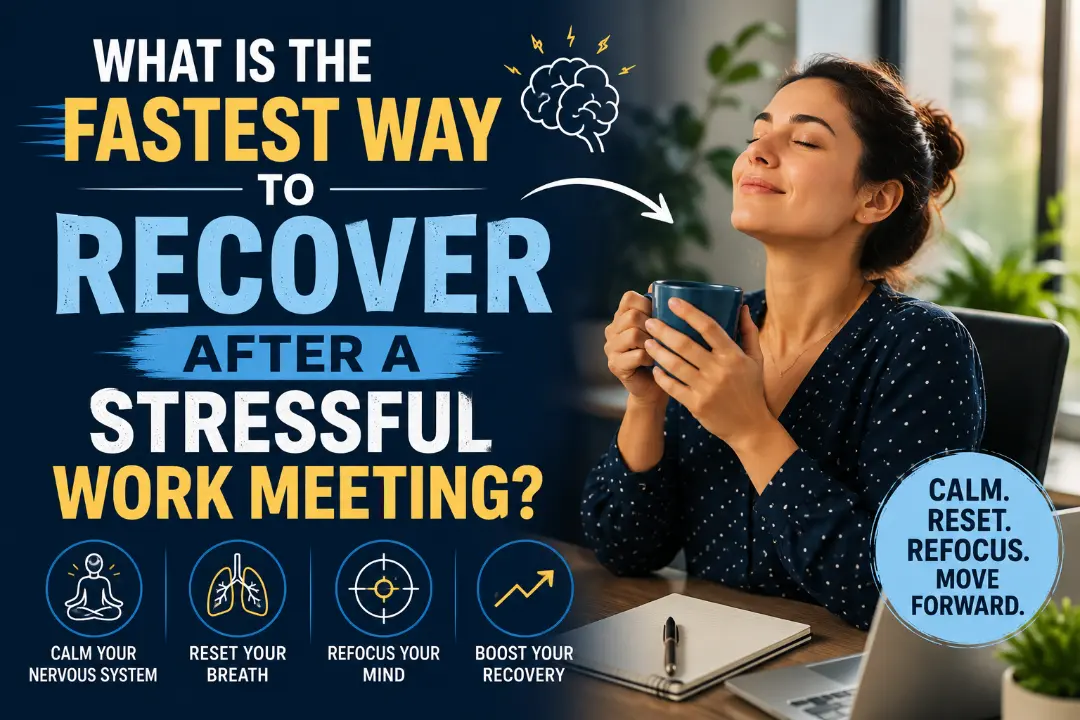
A difficult meeting does not end when the call drops or the room empties. Your body carries it forward. Here is what is happening physiologically in the minutes after a stressful meeting, and the specific steps that help you recover faster.
The meeting ends. You close the tab, or walk back to your desk, or step out of the conference room. And the stress does not end with it. Your heart is still moving a little faster than it should be. Your jaw is tight. Your thoughts are replaying what was said, running alternative versions of what you should have said instead, or sprinting ahead to the next problem the meeting just created. You are supposed to move on to the next thing, but your body has not moved on yet.
This gap - between when a stressful event ends and when your nervous system actually registers that it is over - is one of the most disruptive and least-discussed dynamics of a modern workday. If the stress carries into the evening, see how to calm your nervous system after a stressful day at work.
Sometimes it does. Often it does not - not quickly enough, and not without some help. This article explains why, and what actually works.
Why the stress from a meeting does not stop when the meeting does
When a work meeting becomes stressful - a tense exchange, a decision that went against you, a performance review that landed badly, a conflict that was never fully resolved, or simply forty-five minutes of sustained social pressure - your body responds in the same way it has always responded to perceived threat or demand: by activating the sympathetic branch of the autonomic nervous system.
This means cortisol and adrenaline enter the bloodstream. Heart rate and blood pressure rise. Breathing becomes shallower. Muscles across the shoulders, neck, and jaw contract. Blood is directed away from digestion and fine motor function toward the systems the body treats as essential for dealing with a challenge. None of this is dramatic or unusual - it is the ordinary stress response, scaled to a modern context.
The important thing to understand is that this response has a biological momentum of its own. It does not stop simply because the triggering situation has ended. Stress hormones take time to metabolize. Muscle tension persists until it is specifically released. The nervous system remains in an activated state until it receives a clear physiological signal that the demand has passed. A calendar notification that the meeting is over is not that signal. Closing a browser tab is not that signal. Walking to the kitchen to refill your water is not that signal - not unless you do something specific during that walk.
This is why you can leave a difficult meeting and still be noticeably activated twenty, thirty, or even sixty minutes later, even if you are consciously aware that it is over and that dwelling on it is counterproductive. Conscious awareness does not reset your cortisol level. Only specific physiological inputs do that.
What activated looks like in the hour after a hard meeting
Recognizing the residue of meeting stress in your own body is the first step toward addressing it - partly because many people have normalized this state to the point where they no longer notice it clearly, and partly because the activated state tends to produce behaviors that compound the problem if they go unchecked.
In the body, meeting stress residue typically shows up as: continued tension across the upper back, shoulders, and neck; a sensation of being slightly too alert or slightly too wired to focus effectively on anything requiring sustained attention; shallow or faster-than-normal breathing that you would not notice unless you checked; a mild restlessness or difficulty settling into a task.
In thinking and behavior, it often shows up as: replay of the meeting's difficult moments, including the things you said and the things you wish you had said differently; difficulty concentrating on anything unrelated; a shorter-than-usual temper in the interactions that follow; and an undercurrent of urgency or low-grade anxiety that attaches itself to whatever comes next, even if the next thing is not inherently stressful.
This is worth naming clearly: if you have three meetings in a row, and the first is difficult, the activation from the first tends to carry into the second, and the second into the third. The compounding effect of unresolved stress across a day of back-to-back meetings is one of the most common causes of end-of-day exhaustion that is out of proportion to the physical demands of the work. You are not tired because the meetings were long. You are tired because the stress from each one was never discharged before the next began.
The fastest physiological lever available: breathing
The single most direct and fastest-acting tool for recovering from a stressful meeting is controlled, slow breathing with an extended exhale. This is not a gentle wellness suggestion - it is a well-understood physiological mechanism, and the speed at which it works is faster than most people expect when they first try it deliberately.
The mechanism works through the vagus nerve, the longest nerve in the autonomic nervous system and the primary pathway of the parasympathetic branch - the "rest and digest" counterpart to the sympathetic stress response. When you breathe slowly, particularly with an exhale that is longer than the inhale, you directly stimulate the vagus nerve in a way that produces measurable, rapid reductions in heart rate, blood pressure, and the subjective sense of activation. Heart rate variability - a key marker of nervous system regulation - begins to shift within the first few minutes of slow, deliberate breathing.
The specific pattern that produces the fastest downshift is simple: inhale through the nose for four seconds, exhale slowly through the nose or mouth for six to eight seconds, and repeat for five to seven minutes. The longer exhale is doing most of the work - it is the exhalation phase that most strongly engages the parasympathetic response. You do not need large breaths or effortful technique. A calm, unforced breath at a slow pace is more effective than a dramatic deep breath done with strain.
Done immediately after a difficult meeting - even sitting at your desk before moving to the next task - this practice can produce a noticeable shift in activation within five minutes. Not a complete resolution of everything the meeting stirred up, but a measurable physical downshift: heart rate lower, breathing slower, muscle tension beginning to release, the sense of urgency beginning to loosen its grip.
Why guided breathing works better than breathing alone
Knowing the mechanics of slow breathing and actually sustaining it through five useful minutes are two different things - especially immediately after a stressful meeting, when the mind is still moving quickly and the temptation to just push through to the next task is strong.
The common experience for people who try this on their own for the first time is that the first minute or two goes reasonably well, and then the mind starts drifting - back into the meeting, forward into the day's remaining obligations, sideways into whatever the phone is offering - and the breathing quietly stops being deliberate without you quite noticing.
A guided session removes this friction. When the breathing is paced by something external - a visual cue, a sound, a rhythm you can follow rather than generate - the cognitive load of sustaining the practice drops significantly, and the five minutes are far more likely to actually happen at the pace that produces the physiological result.
This is where a focused breathing app designed around specific emotional states makes a meaningful practical difference, rather than a generic timer or a YouTube video that requires you to find and set up. QuietFlame is built around exactly this use case - it organizes sessions by what you are actually trying to address. After a difficult meeting, you choose the Relax goal, and the app surfaces guided breathing sessions designed specifically for that state: a paced visual flame that rises and falls at a slow, calming rhythm, layered with immersive background sounds and scenes that give the mind somewhere quiet to rest rather than something to process.
The difference between those five minutes with a purposeful, guided visual and sound environment versus those same five minutes staring at a blank wall while trying to count your own breath is not trivial - particularly when you are starting from an activated state and asking your mind to slow down on its own.
What to do in the first five minutes after a hard meeting
The first few minutes after a stressful meeting are where recovery either starts or gets postponed - and postponed usually means accumulated by the end of the day. Here is a specific sequence worth building into your routine:
Step away from the screen for two minutes. Even standing up and looking out a window, or walking to another room and back, gives the body a brief physical break from the posture and setting associated with the stress. The nervous system is partly context-dependent - the same physical environment that housed the stressor keeps some residue of that association alive, and a brief physical change of scene is a low-effort way to interrupt that.
Notice and release the most obvious tension. Shoulders raised toward the ears, jaw clenched, fists slightly closed - these are the most common places meeting stress is stored in the body, and they often persist without any conscious awareness. A few slow shoulder rolls, a deliberate jaw drop, and uncurling the hands are small but meaningful physical releases.
Start slow breathing before you do anything else. This is the step most people skip because it feels like lost time - but five minutes of deliberate recovery breathing after a hard meeting typically produces more than five minutes' worth of improvement in the quality of focus and equanimity that follows. The math tends to favor the brief pause.
Resist the replay. The mind's instinct after a difficult meeting is to run it back - to rehearse, re-evaluate, and revise. Some of this is useful and can be done intentionally. But the involuntary, looping version of replay that happens while you are trying to focus on something else is not useful. Breathing helps interrupt it physiologically. Naming it - "this is replay, not useful problem-solving" - can help interrupt it cognitively.
Matching the tool to what the meeting stirred up
Not every difficult meeting produces the same state. A meeting where you were criticized in front of colleagues produces something different from a meeting where an important decision was made without your input. A meeting where you had to deliver hard news to someone leaves a different residue than one in which you were on the receiving end of bad news. A meeting that felt chaotic and out of control differs from one that involved a sustained interpersonal conflict.
This matters practically because the most effective recovery tool is one that actually matches the activation pattern the meeting created, rather than a generic "calm down" instruction.
For anger or frustration - a meeting where you were dismissed, talked over, or where something genuinely unfair occurred - the body tends to need movement before stillness. A brisk five-minute walk, or even a few minutes of moving around rather than immediately sitting back down, helps metabolize the physical arousal associated with anger more effectively than going straight to a breathing session. Once the physical edge has been taken off, slow breathing works more quickly.
For anxiety or a sense of threat - a performance-related conversation, an uncertain outcome, something that felt like a risk to your standing - breathing is the most direct first tool, because the anxiety response needs a parasympathetic counter-signal more than it needs physical discharge.
For mental fog or scattered focus - a meeting that was not emotionally intense but was cognitively exhausting, full of context-switching and decisions - a session oriented toward Focus rather than just Relax can help reorient attention. The breathing pattern is similar, but the intention and framing are different, and that difference matters more than it sounds.
For a general sense of being wrung out that you can't quite name - a diffuse, low-grade version of "that was a lot" - a Relax session with sound and visual cues that are genuinely calming, rather than just a breathing count, tends to work best. The same five-minute downshift also works as the simplest evening habit for stress relief once the workday is fully over.
Streaks, consistency, and why recovery gets faster over time
One of the less obvious but more important things about building a post-meeting recovery practice is that it becomes more effective the more consistently it is practiced - not just because the technique improves, but because the nervous system literally learns the association.
When you follow the same short sequence after a stressful meeting consistently - step away, release tension, breathe deliberately - that sequence begins to function as a learned cue. After several weeks of consistency, beginning the sequence starts to produce a downshift that is faster and more complete than it was initially, because the nervous system has built an expectation of what follows the cue and begins preparing for it before you even complete the steps.
This is the same mechanism that makes a bedtime routine work better over time - not because the individual steps are more powerful, but because the pattern itself becomes a signal. Tracking this in a concrete way helps reinforce the habit during the initial weeks when the results are real but still building. Seeing a streak of days on which you completed the recovery practice - even just a visual record of consistency - makes the gap between "I should do this" and "I actually did this" smaller over time.
QuietFlame tracks both streaks and progress across sessions, so the habit has a concrete, visible shape rather than existing as a vague intention that gets crowded out by the next notification. For something as easy to skip as a five-minute breathing session in the middle of a busy workday, that small external structure turns out to matter quite a bit.
What most people do instead, and why it does not work
Because the need to recover from a stressful meeting is almost never explicitly acknowledged as a legitimate work activity, most people address it through whichever habits are already at hand - and most of those habits are not particularly effective at producing genuine nervous system recovery.
Scrolling the phone feels like a mental break but keeps the brain in an alert, input-processing mode. The content changes, but the cognitive posture does not.
Coffee or a snack treats the fatigue signal without addressing what is producing it. Caffeine added to an already-activated nervous system tends to sharpen anxiety rather than reduce it. Food is neutral at best.
Jumping straight into the next task is the most common default, and the one most likely to produce a compounding stress load across the day - particularly if the next task is another meeting.
Venting to a colleague can be genuinely useful for emotional processing in small doses, but extended complaining about the meeting keeps the stress narrative active and the nervous system engaged with it, rather than completing the stress cycle and moving past it.
None of these is the equivalent of giving the nervous system an actual downshift signal. They pass the time, or they manage the surface symptoms, but the underlying activation simply continues - often without anyone noticing because the absence of full calm has become the baseline.
Building it into the workday
The most effective version of this is not a one-off response to the worst meetings, but a brief, consistent practice built into the structure of the workday itself - a few minutes of deliberate recovery between meetings rather than moving directly from one to the next.
Even five minutes between meetings, done with intention - a brief breathing session with the phone face down and the laptop closed - produces compounding benefits across a full workday. The first meeting's activation does not compound into the second. Decision-making quality holds up later in the afternoon. The end-of-day crash is smaller. Sleep, which is directly affected by how fully the nervous system has downshifted by evening, tends to be better.
This is not a large investment. Five minutes, consistently, with a tool that makes those five minutes actually count rather than dissolving into distraction, is accessible to most people regardless of how their workday is structured. What it requires is treating post-meeting recovery as a legitimate use of time rather than a luxury to be earned only when the schedule allows it.
After your next difficult meeting
Before you reach for your phone or tab back to your inbox: step away for two minutes, release the obvious muscle tension deliberately, and spend five minutes on slow breathing - four seconds in, six to eight seconds out.
If counting the breath feels like too much to manage in the middle of a busy day, QuietFlame paces a guided session for you - a rising and settling flame set against a calming scene and sound environment, with a goal matched to what you are actually recovering from. Choose Relax when you need to come down from tension, Focus when you need to reorient your attention after an exhausting discussion, or work through whichever session fits what the meeting left behind. There is nothing to configure and nothing to count. Just a few minutes that give your nervous system the signal it needs to actually close out the meeting, rather than carrying it forward into the rest of your day.
The meeting ended. Your body just needs a little help catching up.
FAQ
How do I recover quickly after a stressful meeting?
Take two to five minutes of slow breathing with a longer exhale before opening the next task, email thread, or meeting invite.
Why do I feel bad after meetings even when they go fine?
Your body may still be in a heightened state from concentration, social evaluation, or unresolved tension even when the outcome was acceptable.
How long should recovery breathing take?
Two to five minutes is often enough to lower heart rate and clear enough mental space to move on deliberately rather than reactively.
Can I do this at my desk?
Yes. Sit back, breathe through your nose, exhale slowly, and keep your eyes soft or closed. No special equipment or privacy required.