 QuietFlame
How to Fall Asleep Faster Without Melatonin or Medication
Melatonin and sleep aids are the default answer for trouble falling asleep. Here is what actually works instead - starting with what your body is already trying to do and how to stop getting in its way.
Melatonin is everywhere. It is in every pharmacy, every grocery store, marketed as a natural and harmless solution to the problem of lying awake for too long. And for some people, in some situations - jet lag, shift work, a genuinely disrupted sleep schedule - it has a real use case.
But for most people who struggle to fall asleep on an ordinary night, the problem is not a melatonin deficiency. It is something closer to the opposite: a nervous system that is still running at daytime intensity when the body is supposed to be winding down. Adding a supplement does not fix that. It temporarily masks it, and often poorly, since many over-the-counter melatonin doses are far higher than what the body naturally produces and can leave you feeling groggy the following morning.
The good news is that there are more effective, more sustainable approaches that work by addressing the actual reason sleep is slow to arrive - and none of them require a trip to the pharmacy.
Why falling asleep feels harder than it should
Sleep onset - the transition from wakefulness into sleep - is not something the brain does suddenly when you decide to close your eyes. It is a gradual process that requires your body to meet certain physiological conditions: core body temperature needs to drop slightly, heart rate needs to slow, brain activity needs to shift from active processing toward slower, more synchronized patterns, and the nervous system needs to be operating from a parasympathetic rather than a sympathetic state.
The problem most people face is that modern evenings are full of things that prevent those conditions from developing. Bright overhead lights and screen exposure suppress melatonin production at exactly the time it should be rising. Stimulating content - news, social media, anything that produces alertness, emotion, or engagement - keeps the brain in active processing mode. Unresolved mental loops keep the stress response partially engaged. Caffeine consumed even six or eight hours earlier can still be partially active in the body.
None of this is a character flaw or a sleep disorder. It is a mismatch between what the body needs to fall asleep and what the typical evening provides. Understanding this is important because it changes the approach: instead of looking for something to take, the more effective strategy is to remove what is blocking a process the body is already trying to run - often starting with paced breathing for sleep or a simple wind-down routine.
The light problem is bigger than most people realize
Of all the factors that delay sleep onset, light exposure is the most underestimated and the most actionable. Your circadian rhythm - the roughly twenty-four-hour internal clock that governs sleep and wakefulness - is primarily set by light signals received by specialized photoreceptors in your eyes that are particularly sensitive to blue-spectrum light.
When these receptors detect bright, blue-spectrum light in the evening - the kind emitted by phones, laptops, televisions, and most modern LED overhead lighting - they send a signal to the brain's master clock that it is still daytime. This suppresses melatonin production and delays the physiological cascade that leads to sleep onset. The body is ready to be tired, but the light signal is telling it not to be yet.
The intervention here is not complicated, but it does require some deliberateness. Switching from overhead lighting to a single lamp in the evening makes a measurable difference. Dimming screens, using night mode settings, or simply putting screens down earlier than feels natural can shift the light environment enough to support the natural melatonin rise your body is trying to produce.
This matters more than most sleep advice acknowledges. You can do everything else right and still have a delayed sleep onset if your eyes are being flooded with bright, blue-spectrum light at nine or ten in the evening. Conversely, even a modest improvement in your light environment can noticeably shorten how long it takes to feel sleepy enough to actually fall asleep.
Temperature is an underused lever
Alongside light, temperature is one of the most powerful and least appreciated regulators of sleep onset. Your body's core temperature naturally begins to drop in the evening as part of the circadian process - this drop is actually one of the signals that triggers sleep onset, not a consequence of it.
When your sleeping environment is too warm, this natural drop is harder to achieve, and sleep onset is delayed. Most sleep research points to a bedroom temperature in the range of 65 to 68 degrees Fahrenheit, or 18 to 20 Celsius, as supportive of good sleep onset and sleep quality. This is noticeably cooler than most people keep their homes during waking hours.
A warm shower or bath thirty to sixty minutes before bed uses this mechanism deliberately. The warm water initially raises your skin temperature, and then the rapid drop in skin temperature that happens after you step out and the water evaporates mimics and accelerates the natural cooling process, creating a stronger and faster signal for sleep onset. This is one of the better-supported environmental interventions in the sleep research literature, and it requires nothing beyond a shower you were probably going to take anyway.
Even without a shower, sleeping with lighter bedding, opening a window slightly, or changing into lighter clothing for sleep can shift the thermal environment enough to support faster sleep onset on warmer nights.
The breathing approach: why it works and what to do
Of all the behavioral approaches to falling asleep faster, slow breathing is the one that most directly addresses the physiological state that blocks sleep onset. Not because breathing is magical, but because of a specific and well-understood mechanism.
When you breathe slowly - particularly with an exhale that is longer than the inhale - you directly stimulate the vagus nerve, which activates the parasympathetic nervous system, the branch responsible for rest and recovery. Heart rate slows. Blood pressure eases. Muscle tension releases. The subjective sense of alertness decreases. These are not metaphorical effects - they are measurable physiological changes that begin within the first few minutes of slow, deliberate breathing.
This matters for sleep onset because elevated sympathetic activity - the "stay alert" state of the nervous system - is one of the most common physiological barriers to falling asleep quickly. Addressing it through breathing is different from waiting for it to resolve on its own, because it gives the nervous system a direct input rather than asking it to settle while everything around it is still signaling wakefulness.
The specific pattern that works best for sleep onset is simple: inhale through your nose for four seconds, exhale slowly for six to eight seconds, and repeat for five minutes. The longer exhale is the active element - it is the phase of breathing that most directly engages the parasympathetic response. You do not need large breaths, perfect technique, or any prior experience. A comfortable, unforced breath at a slow pace is more effective than a dramatic deep breath done with effort.
How to use breathing in the actual moment
There are two ways to use a breathing practice in relation to sleep onset, and understanding the difference makes both more effective.
The first is as part of a consistent evening routine, done before you get into bed. This version is about building the physiological conditions for sleep onset before you even lie down - bringing heart rate and arousal down during the ten or fifteen minutes before you get under the covers, so you arrive in bed already closer to the state that sleep requires. A five-minute breathing session sitting on the edge of the bed or in a chair, as part of a regular wind-down sequence, is the most consistent and cumulative approach.
The second is as an in-the-moment tool when you are already lying awake. This is the version most people reach for first - already in bed, already frustrated with how long it is taking, starting a breathing exercise out of desperation. This version works, but it works better when the underlying practice is already somewhat familiar. If the first time you ever try slow breathing is when you are already frustrated and alert in the dark, the unfamiliarity of the technique adds a small cognitive load that can itself be mildly activating.
For people who are new to this, using both versions - the pre-sleep session and the in-bed version - in the same evening is a reasonable approach. Start with five minutes sitting up before you get under the covers, then continue the slow breathing once you are lying down until sleep arrives.
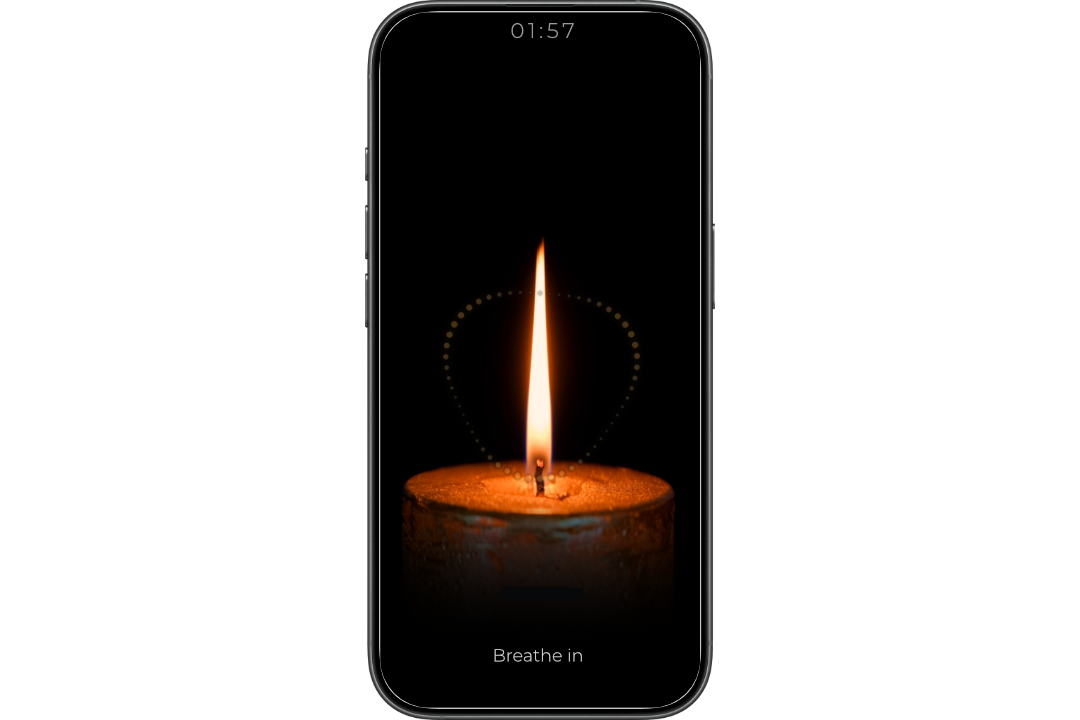
If counting the breath feels like one more task your mind has to manage at the end of a long day, a visual guide removes that friction entirely. QuietFlame uses an animated flame that rises and settles at a 4-6 pace, giving your attention somewhere quiet to rest while the breathing happens. There is no count to track, no sequence to remember - just a flame to follow for five minutes. On the nights when your mind is too busy to sustain an internal count, having something to follow externally can be what keeps the practice going long enough to actually work.
What to do about a racing mind
Slow breathing addresses the physiological component of delayed sleep onset. But many people also experience a cognitive component - a mind that generates thoughts, plans, worries, and replays the moment external stimulation stops.
It is important to understand that a racing mind at night is not separate from the physiological state - it is partly produced by it. When the nervous system is still in a sympathetic, alert state, the brain generates more active, problem-oriented thinking. As the physiological state shifts toward parasympathetic dominance through breathing, the tone of mental activity tends to shift alongside it - thoughts continue, but they become less urgent, less gripping, less capable of fully capturing attention.
This means slow breathing already addresses the racing mind indirectly, by changing the underlying state that makes thoughts feel so loud. But there are a few direct additions that help alongside it.
A brief, deliberate worry download before bed - not a formal journal, just two or three minutes of writing down whatever is unresolved on a piece of paper or in a notes app before you start your wind-down - has reasonable evidence behind it as a way of reducing the mind's need to keep rehearsing open loops during the night. Writing it down tells the brain it has been registered and does not need to be actively held in working memory while you sleep.
Intention setting for tomorrow is a related version: spending two minutes writing a single sentence about the most important thing you need to do the following day. This closes a different kind of loop - anticipatory rehearsal of tomorrow - rather than rumination about today.
Neither of these needs to be elaborate. The point is not to process everything but to give the brain a small, concrete signal that the day's unfinished business has been acknowledged and does not need to be processed during sleep onset.
Caffeine timing and what most people get wrong
Caffeine's half-life in the body is approximately five to six hours for most adults - though this varies significantly based on genetics, with some people metabolizing it much more slowly. The half-life means that after five to six hours, half of the caffeine from a given drink remains in your system. After ten to twelve hours, a quarter remains.
This has a direct implication that surprises many people: a coffee consumed at 2pm may still have a meaningful amount of caffeine active at 10pm. A coffee at 3pm almost certainly will. And because caffeine works by blocking adenosine receptors - adenosine being the molecule that accumulates during waking hours and creates sleep pressure - its presence in the evening does not just delay sleep onset. It can also reduce the restorative quality of the sleep you do get, even when you fall asleep without much difficulty.
The practical guideline that most sleep researchers converge on is a caffeine cutoff of around noon to 2pm for most people, or earlier for those who are particularly sensitive. This is earlier than feels intuitive or convenient for many people, but the downstream effect on evening adenosine signaling is real regardless of whether you subjectively feel the caffeine affecting you.
If you consume caffeine in the afternoon and regularly take a long time to fall asleep, this is worth experimenting with before any other intervention. Shifting caffeine intake earlier is free, requires no equipment, and can have a surprisingly rapid effect on evening alertness and sleep onset time.
Building the full picture
The most effective approach to falling asleep faster without melatonin or medication is not any single intervention but the combination of several aligned factors. Here is what that looks like as a practical whole:
Dim the lights an hour before bed. Switch from overhead lighting to a lamp. Put your phone or laptop on night mode or - better - put it down entirely earlier than usual.
Keep the bedroom cool. Lighter bedding, a cracked window, or a cooler thermostat setting. Aim for the 65 to 68 Fahrenheit range if possible.
Stop caffeine by early afternoon. Earlier than feels necessary, but consistent with what the half-life actually requires for minimal evening presence.
Do a brief worry download before your wind-down begins. Two or three minutes of writing down what is unresolved. Not to solve it - just to register it.
Five minutes of slow breathing as your final pre-sleep step. Sitting on the edge of the bed before lying down, or immediately after getting into your sleep position. Four seconds in, six to eight seconds out. Continue until sleep arrives or for as long as feels helpful.
Keep the sequence consistent. The same order of steps each night, at roughly the same time, builds an association between the sequence and sleep onset that compounds over weeks. Within two to three weeks, beginning the sequence will itself start to produce a sense of drowsiness, because the nervous system has learned what follows.
None of these individually is a guaranteed solution for every person on every night. Together, they address the most common physiological barriers to falling asleep quickly - light-induced melatonin suppression, thermal environment, adenosine interference, nervous system arousal, and the cognitive component of a mind that is not ready to rest - and they do so in a way that works with your body's existing sleep systems rather than attempting to override them.
A note on when to seek help
Everything in this article is relevant for the common experience of taking longer to fall asleep than you would like - the kind of sleep difficulty that most adults experience sometimes, particularly during stressful periods, and that responds well to behavioral approaches.
If you have been struggling to fall asleep most nights for an extended period - several weeks or more - and behavioral changes have not produced noticeable improvement, it is worth speaking with a doctor or a therapist who specializes in sleep. Cognitive behavioral therapy for insomnia, known as CBT-I, is the evidence-based first-line treatment for chronic insomnia and has a very strong track record. It is more effective than medication for long-term outcomes, and it works directly on the patterns of thought and behavior that sustain chronic sleep difficulty rather than masking symptoms.
Breathing exercises and the other approaches in this article can absolutely be part of managing insomnia - several of them are included in CBT-I protocols - but persistent, significant sleep difficulty is worth professional attention rather than continued self-management alone.
Tonight
You do not need to implement everything at once. A reasonable starting point for tonight: dim the lights earlier than usual, skip any caffeine after lunch today, and spend five minutes breathing slowly - four seconds in, six to eight seconds out - sitting up before you get into bed.
If you want something to follow during those five minutes so the counting takes care of itself, QuietFlame paces a slow breathing session with a visual flame you simply watch and match. No technique to learn, no sequence to remember - just a calm, quiet five minutes that gives your nervous system the transition it needs.
Sleep onset is something your body already knows how to do. Most of what delays it is something you added to your evening without realizing it. Take some of it away, give your nervous system a clear signal, and see what happens.
FAQ
Can I fall asleep faster without melatonin?
Yes. For most people, the issue is elevated nervous system arousal and evening habits that block natural sleep onset, not a melatonin deficiency.
What works better than melatonin for sleep onset?
Lowering light exposure, cooling the bedroom, and five minutes of slow breathing before bed address the physiological barriers melatonin alone often cannot fix.
How does breathing compare to sleep supplements?
Breathing directly lowers sympathetic arousal. Supplements may mask the problem temporarily without changing the state that keeps you awake.
How long before bed should I start winding down?
Begin ten to fifteen minutes before getting into bed with dim light and five minutes of slow breathing for the best results.