 QuietFlame
How to Use Breathing Exercises to Stop Overthinking at Night
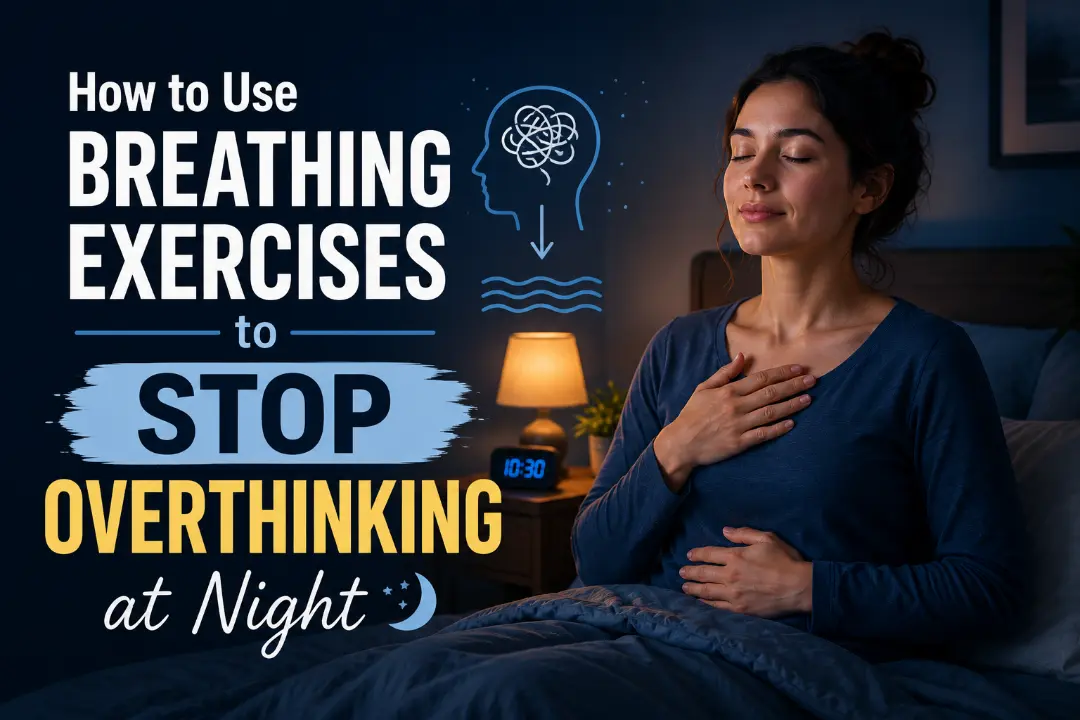
Lying awake replaying the day or rehearsing tomorrow? Here is why your mind loops at night - and how breathing exercises can interrupt the cycle in just a few minutes.
You turn off the light, settle in, and within seconds your brain opens fifteen tabs. The email you should have phrased differently. The thing you need to do tomorrow. The thing you forgot to do today. A conversation from three years ago, replaying for no reason at all.
This is one of the most common reasons people struggle with sleep, and it has very little to do with how tired they are. You can be completely exhausted and still lie awake for an hour because your mind will not stop generating material.
Breathing exercises are one of the most effective tools for this specific problem - not because they force your mind to be quiet, but because of what they do to the underlying state that makes overthinking so persistent at night. This article explains why nighttime overthinking happens, why breath-based tools work on it specifically, and how to use them practically tonight.
Why your mind gets louder at night
During the day, your attention is mostly externally directed. Meetings, conversations, tasks, screens - all of it occupies the part of your brain that would otherwise be free to wander. The moment that external input stops, usually right around the time you get into bed, your brain does not simply switch off. It shifts to internally generated content instead.
This is sometimes called the "default mode network" in neuroscience - the set of brain regions that becomes active when you are not focused on a specific external task. It is responsible for self-reflection, memory consolidation, and future planning. It is not a malfunction. It is your brain doing exactly what it is supposed to do when nothing else demands its attention.
The problem is timing. Lying in bed, in the dark, with nowhere to direct that internally generated content, is the worst possible moment for this system to become most active. There is no action you can take on most of the thoughts that arise - you cannot send the email, fix the conversation, or finish the task. The thoughts loop because there is nowhere for them to go.
Layered on top of this is physiological arousal. If your body is still carrying the day's stress - elevated heart rate, residual cortisol, muscle tension - your nervous system is primed for alertness, not rest. A mind that is already inclined to generate thoughts becomes considerably louder when the body underneath it is still signaling "stay alert."
This is why overthinking at night is rarely solved by telling yourself to stop. The thoughts are a symptom of a state, not a standalone problem. Change the state, and the thoughts tend to lose their grip on their own.
Why breathing is the right tool for this specific problem
Most advice for racing thoughts falls into one of two categories: distraction (read a book, listen to a podcast) or suppression (try not to think about it). Both can help temporarily, but neither addresses the underlying arousal that is fueling the loop.
Breathing exercises work differently because they operate on both components at once - the physiological state and the attention itself.
On the physiological side, slow, paced breathing for sleep with a longer exhale directly stimulates the vagus nerve, which is the primary channel of the parasympathetic nervous system - the branch responsible for rest and recovery. This is not a metaphorical calming effect. Heart rate measurably slows. Heart rate variability increases. Muscle tension begins to release. The body shifts from a state primed for alertness toward a state that supports sleep. As that shift happens, the intensity behind the looping thoughts tends to soften - not because the thoughts are gone, but because the urgency underneath them fades.
On the attentional side, a breathing pattern gives your mind something concrete and repetitive to do. This matters more than it sounds. The default mode network does not switch off just because you decide to think about something else - in fact, trying hard not to think about something often makes it more present. But following a simple physical rhythm - inhale, exhale, inhale, exhale - occupies attention in a low-effort, non-verbal way. It is not a battle against your thoughts. It is giving your attention somewhere to rest that is not another thought.
The combination is what makes breathing distinct from other nighttime strategies. A podcast occupies attention but does nothing for physiological arousal - you can listen to something soothing and still feel wired underneath it. A supplement might affect physiology but does nothing for an active mind. Breathing addresses both, simultaneously, using a mechanism your body already has.
The breathing pattern that works best for overthinking
For general stress relief, a 4-6 pattern - four seconds inhale, six seconds exhale - is a solid starting point. For overthinking specifically, the same pattern works well, but a few adjustments can help depending on how your mind tends to loop.
If your thoughts are urgent and anxious - the kind that feel like alarms, jumping from one worry to the next - a slightly longer exhale can help more. Try 4 in, 7 out. The longer exhale produces a stronger parasympathetic pull, which is useful when the underlying arousal is high.
If your thoughts are repetitive but not anxious - replaying the same scene or rehearsing the same conversation without obvious distress - equal counts (4-4) can be easier to settle into. The symmetry feels steady rather than effortful, which matters when your mind is already busy and a more complex pattern might feel like one more thing to manage.
If you find yourself losing track of the count entirely - which is common when overthinking is at its worst - this is a signal that counting itself has become part of the loop. In that case, a visual guide that you simply follow, without internally verbalizing numbers, removes one more layer of mental activity. You are not thinking "four... five... six." You are just watching something move and matching it.
Whichever pattern you choose, the goal is the same: a slow, steady, repeating rhythm with an exhale that is equal to or longer than the inhale. The specific numbers matter less than the consistency.
How to actually do it when your mind is racing
Here is the practical sequence, designed for the moment when you are already lying in bed and the thoughts have started.
Acknowledge where you are without trying to fix it. You do not need to solve the thought that is looping. You do not need to finish planning tomorrow or resolve the conversation from earlier. The goal of this moment is not resolution - it is a shift in state. Permission to set the thought aside, even temporarily, removes some of its urgency.
Find a position that feels settled. You do not need to sit up. Lying on your back or your side, in whatever position feels most comfortable for sleep, is fine. The breathing exercise does not require any particular posture - it requires attention on the breath.
Begin the pattern. Inhale through your nose for a slow count of four. Exhale - through your nose or mouth, whichever feels more natural - for a count of six or seven. Do not force the breath to be deep or large. A comfortable, unforced breath at a slower pace is the goal, not a dramatic lungful of air.
When a thought pulls your attention away, notice and return. This will happen. Often within the first thirty seconds. The thought arrives, you follow it for a few seconds, and then you notice you have drifted from the breath. This noticing is not a failure - it is the entire mechanism. Each time you notice and return to the exhale, you are practicing the shift from internally generated content back to a physical anchor. The number of times this happens does not matter. What matters is the returning.
Continue for at least five minutes. This is longer than it sounds when you are doing it, especially at first. Five minutes of returning to the breath, even imperfectly, is enough time for the physiological shift to begin taking hold. Do not check the time repeatedly - if you are using a guide or an app, let it track the duration so you do not have to.
Let the session end without expectation. You may feel calmer. You may feel the same. You may already be asleep before five minutes is up, which is a perfectly good outcome. The goal was never to force sleep to arrive on command - it was to interrupt the loop and shift the underlying state. Sometimes that is immediately followed by sleep, and sometimes it just makes the next twenty minutes quieter than they would have been.
Why a visual guide helps more here than almost anywhere else
Of all the situations where counting breaths becomes difficult, an overthinking mind at night is probably the hardest. The same mental machinery that is generating loops about tomorrow's meeting is also the machinery you are trying to use to count to six. It is asking the mind to do two things at once - generate thoughts and track numbers - and on a bad night, the thoughts usually win.
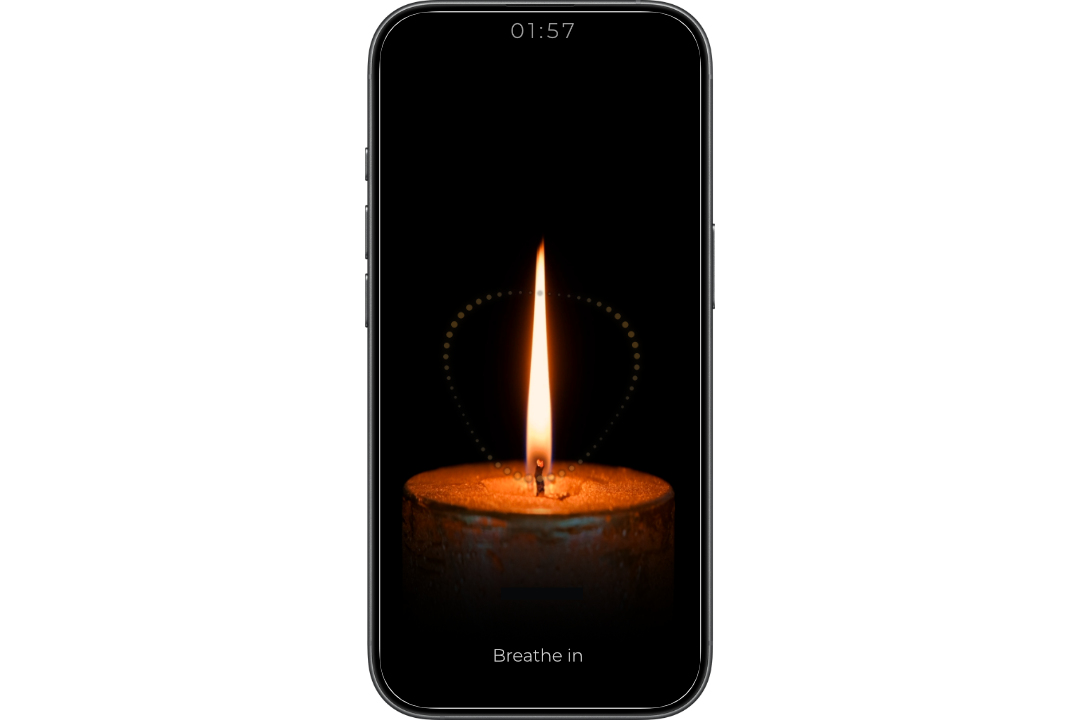
This is where a visual pacer becomes genuinely useful rather than just convenient. QuietFlame uses an animated flame that rises as you inhale and settles as you exhale, moving at a slow, steady pace without requiring you to count anything. Instead of holding "four... five... six" in your head alongside whatever your mind is already generating, you simply watch something move and let your breath follow it.
This shifts the exercise from a cognitive task to a sensory one. Watching is lower effort than counting. And because the flame continues regardless of whether your attention drifts, there is nothing to lose track of - you can drift away for a few seconds, notice the flame is still moving, and rejoin without having to figure out where you left off. For a mind that is already working overtime, removing even this small cognitive load can be the difference between a practice that helps and one that becomes one more thing to get right.
Building this into a habit, not just a rescue tool
Everything above describes what to do in the moment when overthinking has already started. But the most effective version of this practice is not a rescue tool you reach for during a bad night - it is a habit you do every night, regardless of how your mind feels at that moment.
This distinction matters because of how the nervous system learns. If breathing exercises are only something you do when overthinking is already severe, your body learns to associate the practice with crisis. The exercise becomes linked to the feeling of being overwhelmed, which can make it feel less calming - you are essentially practicing breathing while already in a heightened state.
If instead you do five minutes of slow breathing every night, regardless of how busy your mind feels - on the calm nights and the loud ones - your body learns to associate the practice with the transition into rest itself, independent of how the day went. Over time, beginning the practice becomes a cue on its own. The nervous system starts to downshift simply because the familiar sequence has begun, often before the breathing has had much chance to take effect physiologically.
The most practical way to build this is to attach the practice to something you already do every night without exception. Brushing your teeth is the most reliable anchor for most people - it happens regardless of mood, stress level, or how late it is. Doing five minutes of breathing immediately after, sitting on the edge of the bed before getting under the covers, borrows the consistency of that existing habit.
On nights when overthinking is mild, this becomes a gentle, almost unnoticed transition. On nights when it is severe, the same practice - already familiar, already part of the routine - becomes the tool you reach for, except it is not unfamiliar in the moment. You are not learning a new skill while distressed. You are using a skill you already practice every night, in a moment when you need it most.
What if the thoughts do not stop?
This is worth addressing directly, because it is the most common reason people abandon breathing exercises for overthinking after a few tries.
The thoughts are not supposed to stop entirely. This is the most important reframe. The goal of the practice is not silence - it is a change in the relationship between you and the thoughts. At the start of a session, a thought might fully capture your attention for thirty seconds before you notice you have drifted. After a few minutes, that capture time often shortens - you notice more quickly, the thought feels slightly less urgent, and the return to the breath happens with a little less effort each time.
Some nights will be harder than others. A night after a genuinely stressful day, or a night before something important, will likely involve more looping than a calm Tuesday. This does not mean the practice failed. It means the underlying arousal was higher, which is exactly the condition the practice is designed to help with - it just may take longer, or feel less dramatic, on those nights.
If five minutes is not enough, that is fine. There is nothing wrong with continuing for longer if you are not sleepy yet, or doing the practice again later if you wake up mid-night with the same loop restarting. The practice is not a one-shot intervention with a strict dose. It is a tool you can return to as many times as you need.
If overthinking is a near-nightly, severe pattern that significantly affects your life, breathing exercises are a helpful complement but not a substitute for professional support. Persistent rumination, especially when paired with anxiety or low mood, is something a therapist or doctor can help address more directly. For the common nighttime version of this pattern, see also the best breathing exercise for anxiety before bed.
What changes over time
The first night you try this, the most likely outcome is a modest shift - perhaps the loop feels slightly less intense, or you notice your shoulders have dropped without trying to drop them. That is a real result, even if it does not feel dramatic.
Over the first couple of weeks of nightly practice, most people notice that the time it takes to notice they have drifted into a thought shortens. Early on, a thought might run for a full minute before you catch it. Later, you catch it within a few seconds. This is not because the thoughts themselves are different - it is because your attention has become more practiced at the return.
Around the same time, many people notice that the practice itself starts to feel like the beginning of calm, rather than a tool deployed in response to distress. The cue - sitting down, beginning the breath - starts to carry some of the effect on its own, because the nervous system has learned what comes next.
For the specific problem of nighttime overthinking, the most meaningful change is often not that the thoughts disappear, but that they stop feeling like something you have to fight. They arise, they are noticed, attention returns to the breath, and the night continues. That shift - from struggle to a quiet, repeatable process - is usually what makes the difference between lying awake for an hour and drifting off within a more reasonable window.
Tonight
If your mind is already doing this tonight, here is the version to try right now: get into the position you sleep in, breathe in slowly through your nose for a count of four, and out for a count of six or seven. When a thought pulls you away, notice it, and come back to the next exhale. Keep going for at least five minutes.
If counting feels like one more thing your busy mind has to manage, QuietFlame is built for exactly this moment - a slow-moving flame you can simply follow, with nothing to track and nothing to get right. Open it, watch it rise and settle, and let your breath match its pace.
The thoughts may still be there. That is fine. The goal was never silence - just a quieter version of the same night, and a body that knows, a little more each time, how to let the day end.
FAQ
Why does my mind race at night?
When external stimulation stops, unresolved thoughts and an still-activated nervous system have nothing to compete with, so mental loops get louder.
Can breathing stop overthinking?
Breathing does not erase thoughts, but it lowers the arousal that makes thoughts feel urgent. Most people find loops become less gripping within a few minutes.
How long should I breathe when overthinking?
Start with five minutes. That is long enough to shift your background state without feeling like another task your tired mind has to manage.
What if thoughts keep coming during breathing?
That is normal. Let thoughts pass without engaging them and keep returning to the breath rhythm. The goal is a calmer background state, not a blank mind.