 QuietFlame
How to Do 4-7-8 Breathing Step by Step (For Sleep and Calm)
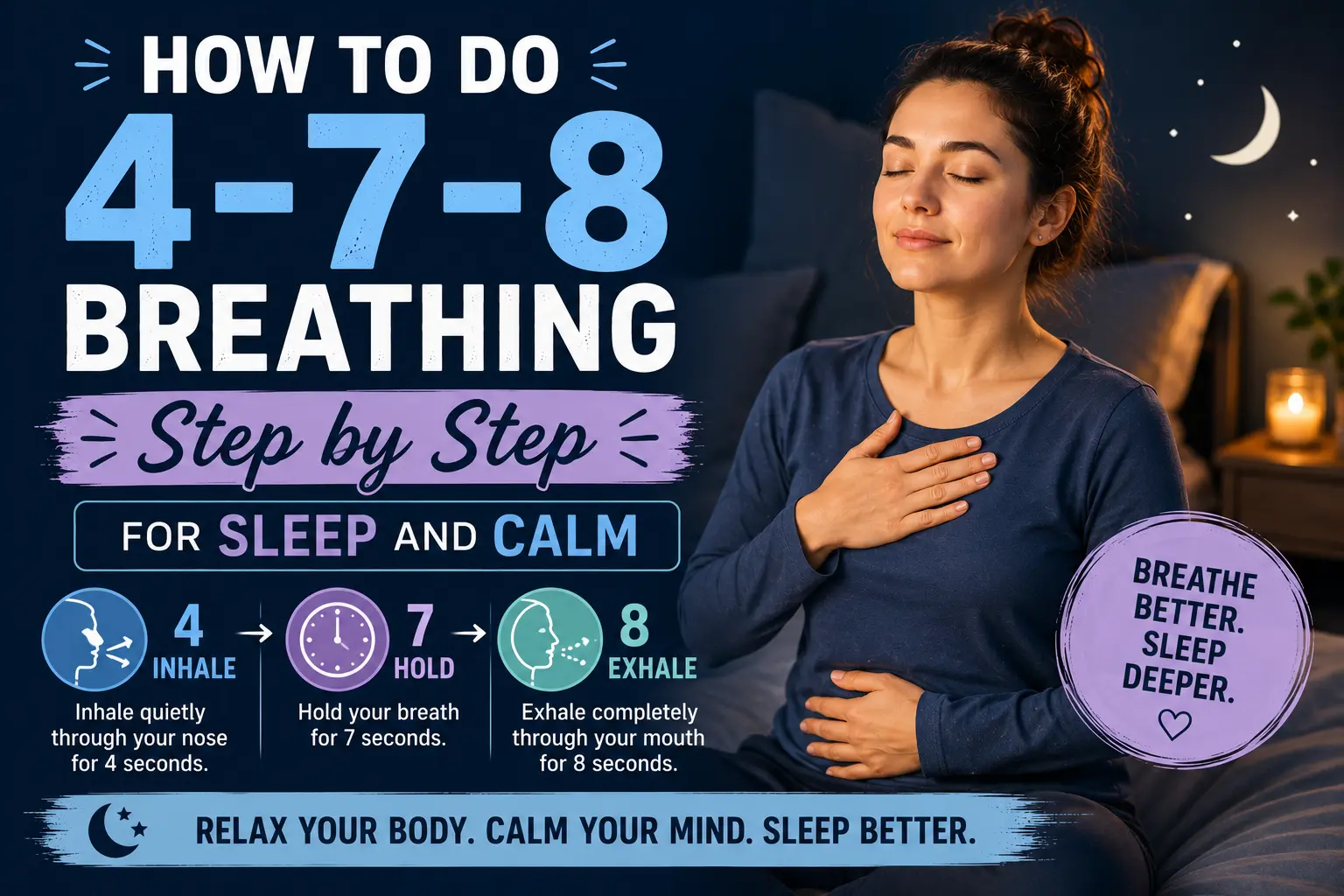
Learn the 4-7-8 breathing technique with clear steps, common modifications, and a simple way to use it before bed without forcing sleep.
4-7-8 breathing is a paced pattern: inhale for four seconds, hold for seven, exhale for eight. Done gently for a few minutes before bed, it can lower the keyed-up feeling that keeps you staring at the ceiling. You do not need experience, equipment, or a perfect count on night one. You need a longer exhale than inhale, low effort, and enough repetition for your nervous system to notice.
This guide walks through the classic method step by step, then shows safe modifications when the hold feels too long. If you are still choosing between patterns, see box breathing vs 4-7-8 for sleep first. If your main goal is sleep onset more broadly, pair this with how to fall asleep faster without melatonin.
What 4-7-8 breathing is
4-7-8 is a structured form of paced breathing for sleep. The numbers are the timing:
- 4 - inhale through the nose
- 7 - hold the breath
- 8 - exhale through the mouth
In the classic form, the exhale is twice as long as the inhale. That ratio is the point. Slow exhalation tends to support the parasympathetic side of the nervous system - the branch associated with rest and recovery. Heart rate often eases. The sense of urgency softens. You are not “making sleep happen.” You are changing the background state that blocks it.
The seven-second hold is optional in practice even though it is part of the famous name. Some people find the hold calming. Others feel pressure, dizziness, or rising anxiety. If that happens, modify the hold. The technique should feel like settling, not like a test.
Why the long exhale matters more than the brand name
Evening arousal is usually a mix of a busy mind and a body that has not finished the day. Screens, late work, caffeine, and unfinished mental loops all keep alertness high. Breathing will not erase those factors, but a longer exhale gives your body a repeated signal that it can downshift.
That is why many sleep-friendly patterns share the same core idea even when the counts differ: inhale shorter, exhale longer. Classic 4-7-8 is one popular packaging of that idea. A simpler 4-in / 6-out or 4-in / 8-out with no hold is another. Both can work. The “correct” version is the one you can repeat comfortably for several minutes.
Think of the numbers as training wheels. Once your body knows what a long exhale feels like, you will be able to recreate that state even if you forget whether you held for five seconds or seven. The skill you are building is not arithmetic. It is a reliable downshift cue.
If you treat 4-7-8 as a performance - huge breaths, rigid holds, forced eight-count exhales - you can feel worse. Forced breathing can create lightheadedness or a sense of air hunger. Gentle breathing is more effective for sleep because it does not add a new stressor at the end of an already long day.
How to do 4-7-8 breathing step by step
Use this version when you are learning or practicing before bed.
Setup
- Sit on the edge of the bed, in a chair, or lie down if that feels better.
- Dim the lights. Put the phone face-down unless you are using it only as a timer or guide.
- Soften your shoulders and jaw. You do not need a special posture - just enough ease that breathing is not cramped.
- Optionally rest the tip of your tongue behind your upper front teeth. This cue is traditional in some teachings and optional in real life. If it feels weird, ignore it. Nothing about the sleep benefit depends on tongue position.
What does matter is not fighting your body. If your ribs feel braced or your belly is locked, soften for one ordinary breath before you start the counted cycles. A tense start usually produces a tense practice.
One cycle
- Exhale fully once through your mouth to reset.
- Close your mouth and inhale quietly through your nose for four seconds.
- Hold your breath for up to seven seconds. Keep the throat soft. Do not clamp down.
- Exhale slowly through pursed lips for eight seconds, as if you are fogging a mirror.
- That is one cycle. Begin the next inhale without rushing.
How many cycles
- Night one: four cycles
- After a few comfortable nights: six to eight cycles
- Time target: about three to five minutes of easy practice
Stop early if you feel dizzy, tingly, or more anxious. Resume tomorrow with shorter counts. Comfort is part of the technique, not a failure of it.
A first-night script you can follow without overthinking
If reading steps mid-practice feels awkward, use this mental script:
- “In for four.”
- “Hold softly.”
- “Out for eight.”
- “Again.”
Whisper the counts if that helps. Or tap a finger for each second. Or ignore exact seconds and approximate: short inhale, brief pause, long slow exhale. Exact metronome perfection matters less than a calm longer release.
After four cycles, pause. Notice whether your shoulders dropped, whether your thoughts feel slightly less urgent, whether your body feels a notch warmer or heavier. Those small shifts are the win. Falling asleep may follow later - sometimes in bed, sometimes after one more quiet minute.
If your mind is still loud after four cycles, do not escalate into harder breathing. Soften instead: smaller inhale, slower exhale, fewer demands on yourself. Aggression in the technique usually mirrors the arousal you are trying to leave behind.
Common modifications (use these freely)
If seven seconds is too long
Try 4-4-8 or 4-2-8. Keep the long exhale. Shorten the hold until it feels neutral.
If eight seconds is too long
Try 4-4-6 or 4-0-6 (no hold). You still get a longer exhale than inhale.
If any hold feels activating
Drop holds completely: inhale 4, exhale 6 to 8. This is often the best bedtime version for people with anxiety or for beginners.
If mouth exhaling feels dry or forced
Exhale through the nose instead, still slowly for six to eight seconds. The pathway matters less than the pace.
If counting itself feels stressful
Use a guided session with a calming background scene and sound so you can follow the pace without tracking numbers. QuietFlame is built for that - short timed sessions organized by goals like Sleep or Relax, each with its own breathing pattern, scene, and sound.
Modifications are not “cheating.” They are how the method survives real evenings.
When to practice 4-7-8 for sleep
Timing matters almost as much as technique.
Best window: the ten to twenty minutes before you want to be asleep - after brushing your teeth, after lights are lower, before you start negotiating with your phone again.
Useful earlier in the evening: a shorter round after you close the laptop if you still feel wired, then a second round closer to bed.
Less ideal: only starting once you are already angry at the clock at 1 a.m. It can still help then, but the practice works better as a predictable cue than as an emergency brake.
When you do wake in the night, keep the same gentle rules: shorter holds or no holds, longer exhale, no forcing. A few quiet cycles in the dark are enough. Getting up to turn on bright lights or check messages usually prolongs the awakening more than a soft breathing round does.
Anchor it to something you already do every night. After teeth, before phone on the nightstand. Or sitting on the bed edge as the last deliberate action of the day. Anchors beat motivation.
What you might notice (realistic expectations)
In the first few minutes: breath slows, attention has a simple job, physical tension often eases a little.
Across the first week: the time between lying down and feeling sleepy may shorten on practice nights. Bed may feel less like a debate.
What may not happen: instant unconsciousness, zero thoughts, perfect sleep every night. Breathing lowers arousal. Sleep still needs enough sleep pressure, a reasonable schedule, and an environment that is not fighting you with bright light and heat.
If nothing changes after a week of consistent, comfortable practice, check the basics around the technique: caffeine timing, late bright screens, and whether your counts are too aggressive. Then simplify to a no-hold longer exhale for another week before deciding the method is “not for you.”
Also notice whether you are using 4-7-8 as a substitute for a wind-down. Breathing works best as one piece of a short evening transition - lower light, fewer stimulating inputs, then the breath - not as a last-second patch after an hour of bright scrolling. The technique can only downshift the body from the state you bring into the practice.
Where 4-7-8 fits with anxiety at night
Some people do not struggle with sleep as much as they struggle with the moment their head hits the pillow and the day’s unfinished thoughts arrive all at once. In that case, 4-7-8 is less about “making sleep happen” and more about giving the nervous system a simple, physical task while urgency settles.
If chest tightness or dread is the main issue, start with a no-hold longer exhale before you attempt classic seven-second holds. Anxiety and long holds are a poor first combination. Once a gentle longer exhale feels familiar, you can add a short hold if you want. For a related approach aimed specifically at bedtime anxiety, see the best breathing exercise for anxiety before bed.
4-7-8 vs simply slowing your breath
You do not have to be loyal to the brand of the technique. The useful question is: Does this help me downshift?
Classic 4-7-8 gives structure. Structure helps when your mind wants a script. A freeform slow breath with a longer exhale helps when structure feels like homework. Both belong under paced breathing. Choose based on the night you are having, not based on what sounded most impressive online.
If you already like even counts for daytime composure, keep those for daytime and save longer-exhale work for night. Different goals can use different patterns.
Common mistakes
Breathing too hard. Keep the inhale quiet and modest. Big chest heaves raise the chance of dizziness.
Turning the hold into a contest. Soft hold or no hold. Strain works against sleep.
Rushing the last seconds of the exhale. If you cannot finish eight calmly, shorten to six.
Doing one cycle and expecting a miracle. Give it a few minutes.
Practicing only when already frustrated. Make it a routine before the frustration starts.
Stacking techniques. One clear pattern for two weeks beats switching every night between box breathing, 4-7-8, and five other methods.
How to build it into a habit without guilt
Start with three nights this week, not thirty. Miss a night? Resume tomorrow. The habit is identity over streak perfection: I am someone who downshifts before bed.
Keep a tiny log if it helps: “did four cycles, felt X.” Patterns show up without turning bedtime into a spreadsheet.
If counting remains the friction point even after you know the steps, keep the same timing goal but let a guided session carry the pace. The point is the physiology and the ritual, not proving you can count to eight in the dark.
A practical minimum that survives busy weeks: four cycles, most nights, same place in your routine. You can always add more later. You cannot compound a practice you keep postponing until conditions are perfect.
Try it tonight
- Dim the light.
- Sit comfortably.
- Inhale through your nose for four.
- Hold softly for as long as feels easy - up to seven, or skip it.
- Exhale slowly for six to eight.
- Repeat four cycles.
If that felt okay, do the same tomorrow. If the hold felt wrong, drop it tomorrow and keep only the longer exhale. You still did 4-7-8 in spirit: a calm inhale, and a longer release.
Same place tomorrow night. The pattern becomes a sleep cue only after it is familiar enough that starting it feels like the day is allowed to end.
This article is educational, not medical advice. If you have a respiratory condition, cardiovascular concerns, or panic symptoms that worsen with breath holds, shorten or skip holds and check with a clinician if needed. Stop if you feel unwell. Comfort always comes first.
FAQ
How do you do 4-7-8 breathing?
Inhale through your nose for four seconds, hold for seven, then exhale slowly through your mouth for eight. Repeat four cycles to start. Keep the breath gentle and stop if you feel dizzy.
How many times should I do 4-7-8 before bed?
Start with four cycles. If that feels easy after a few nights, build toward eight. Five minutes of comfortable practice beats racing through more rounds.
Does 4-7-8 breathing help you fall asleep?
It can help by lowering arousal through a long exhale. It does not guarantee sleep, but it often shortens the wired-to-tired gap when used as part of a wind-down.
What if I cannot hold my breath for seven seconds?
Shorten or skip the hold. A pattern like inhale for four and exhale for six to eight still gives you the main sleep benefit without strain.