 QuietFlame
Box Breathing vs 4-7-8 for Sleep: Which Should You Use?
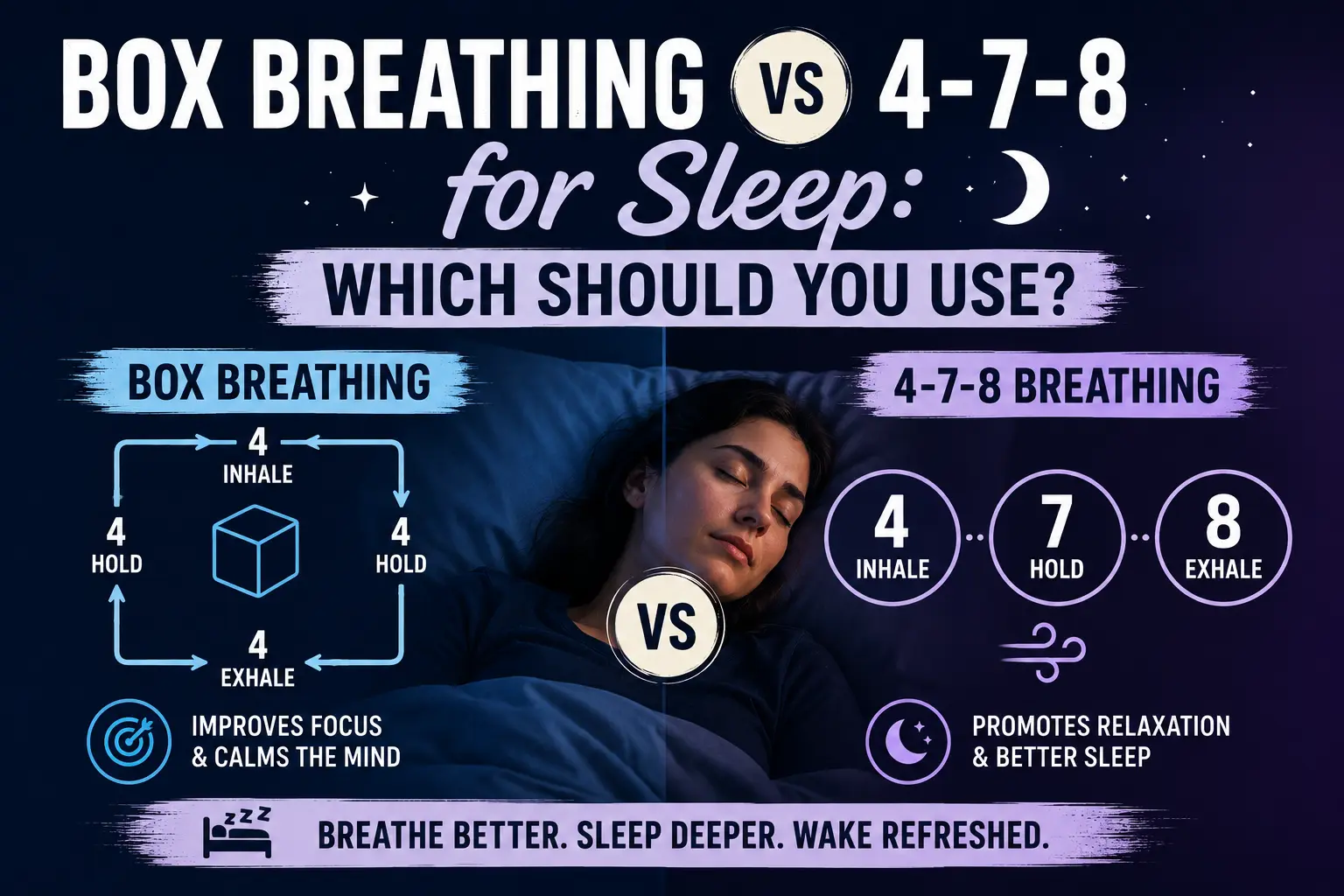
Both box breathing and 4-7-8 can calm you before bed - but they work differently. Here is how each technique works, who each suits, and which to use for sleep.
For sleep, prefer 4-7-8 or any longer-exhale pattern over classic box breathing. Box breathing (equal inhale, hold, exhale, hold) is excellent for focus and composure, but the equal breath holds can keep some people slightly alert. 4-7-8 puts the longest phase on the exhale, which is usually what a wired evening nervous system needs. If long holds make you dizzy or anxious, skip them and use a simple 4-in / 6–8-out pace instead.
Neither technique is magic. Both are tools for lowering physiological arousal so falling asleep without melatonin gets easier. The better choice is the one you will actually do - gently, consistently, for a few minutes before bed.
What box breathing is
Box breathing (also called square breathing) uses four equal sides:
- Inhale for a count of four
- Hold for a count of four
- Exhale for a count of four
- Hold empty for a count of four
Then you repeat. The “box” is the equal timing on each side. Versions exist with three- or five-second sides; four is the most common starting point.
People use box breathing in high-pressure settings - before presentations, during stressful workdays, or anytime they need a quick reset without leaving their seat. The equal structure is easy to remember and gives a busy mind something neat to track. That is also why it is not always ideal as your last action before sleep: the holds keep a bit of control and alertness in the practice.
Box breathing still slows the overall breath rate compared with shallow, hurried breathing. It can reduce the keyed-up feeling that follows a hard day. The empty hold at the end of the exhale also creates a brief pause where nothing is happening - which some people find settling, and others find slightly tense.
But if your goal is specifically sleep onset, you usually want more emphasis on the exhale than on holding. Sleep favors a longer release phase. Box breathing gives the release phase only one quarter of the cycle. That is fine for composure. It is a weaker match for “I need my body to stop running the day.”
What 4-7-8 breathing is
The 4-7-8 pattern, popularized in wellness and sleep advice, is:
- Inhale through the nose for four seconds
- Hold for seven seconds
- Exhale through the mouth for eight seconds
You typically repeat four cycles when learning, then build toward eight if it feels comfortable. The defining feature is the long exhale - twice the length of the inhale in the classic form.
That longer exhale is why 4-7-8 shows up so often in bedtime advice. Slow exhalation tends to support parasympathetic activity (the rest-and-digest side of the nervous system). Heart rate often eases. Muscle tone softens. The subjective sense of “still being on” fades. You are not forcing sleep; you are changing the background state that blocks it.
The seven-second hold is the part that trips people up. Some find it calming - a quiet gap where attention has nowhere to run. Others feel pressure in the chest, lightheaded, or more anxious - especially if they are already tense or new to breathwork. If that is you, shorten or remove the hold. The sleep benefit mostly lives in the slow exhale, not in perfect 7-second silence.
Think of classic 4-7-8 as a template, not a law. A modified version that you can sustain for five minutes is more useful than a “correct” version you abandon after two cycles.
How they compare for sleep
| Box breathing | 4-7-8 | |
|---|---|---|
| Pattern | 4 in · 4 hold · 4 out · 4 hold | 4 in · 7 hold · 8 out |
| Main effect | Even rhythm, composure, focus | Longer exhale, stronger downshift |
| Difficulty | Easy to remember | Harder if holds feel uncomfortable |
| Best for | Settling a scattered mind; daytime stress | Pre-sleep wind-down; racing body at night |
| Sleep fit | Moderate - can feel a bit “on” | Stronger for most people |
| Caution | Equal holds may keep you alert | Long hold can cause dizziness |
If you already practice paced breathing for sleep with a longer exhale and no hold, you are closer to the 4-7-8 idea than to box breathing - even if your counts are 4 and 6 instead of 4, 7, and 8.
Another practical difference: box breathing keeps your attention evenly distributed across four phases. 4-7-8 asks you to invest most of each cycle in the exhale. At night, that investment is usually the point. During the day, the even grid of box breathing can feel more natural because it matches a “stay composed” goal rather than a “power down” goal.
What actually matters physiologically
You do not need a lab to use either technique, but it helps to know why the longer exhale gets recommended for sleep.
When you breathe quickly and shallowly - common after screens, stress, or late work - your body stays closer to a sympathetic, alert state. Slowing the breath, and especially lengthening the exhale, tends to nudge the opposite direction. Heart rate often follows the breath. A longer out-breath gives the system a repeated signal that it is safe to settle.
Breath holds change the picture. A gentle hold can feel centering. A long or strained hold can raise discomfort, especially if you are already anxious. That is why two people can try the same 4-7-8 script and have opposite experiences: one feels floaty and calm; the other feels trapped mid-breath.
For sleep, the reliable ingredients are usually:
- A slower overall pace than daytime breathing
- An exhale that is longer than the inhale
- Low effort - no gasping, no big chest heaves
- Enough repetition to matter (a few minutes, not three rushed cycles)
Box breathing includes the first and last points. 4-7-8 (or a 4-in / 6–8-out variant) includes all four more cleanly.
Step-by-step: box breathing before bed
Use this if you want structure and your body is not already fighting sleep.
- Sit on the edge of the bed or in a chair. Dim the light.
- Close your mouth. Inhale gently through your nose for four seconds.
- Hold softly for four seconds - no clenched throat.
- Exhale through your nose or mouth for four seconds.
- Hold empty for four seconds.
- Repeat for five minutes, or about eight to ten full boxes.
Keep the volume of air modest. Big, forced breaths are a common reason people feel worse, not better. If the empty hold feels tense, shorten it to two seconds or skip it and only use inhale–hold–exhale with equal counts.
Box breathing can still belong in an evening wind-down routine earlier in the night - for example, right after you close the laptop - and then you switch to a longer-exhale pattern closer to lights out. Used that way, box breathing is a transition tool, not the final sleep cue.
If you try box breathing in bed and notice your mind getting sharper rather than softer - more “I am doing this correctly” than “I am drifting” - that is useful feedback. Switch to a longer exhale for the last few minutes.
Step-by-step: 4-7-8 for sleep
Use this when you want a clearer downshift before bed.
- Sit or lie down. Rest your tongue gently behind your upper front teeth if that cue helps (optional).
- Exhale fully once to reset.
- Inhale quietly through your nose for four seconds.
- Hold for up to seven seconds - or less if needed.
- Exhale slowly through pursed lips for eight seconds, as if fogging a mirror.
- Repeat four cycles. Stop if you feel dizzy. Add cycles only when the pattern feels easy.
You do not need eight perfect rounds on night one. Four calm cycles beat twelve strained ones. If seven and eight feel like too much, try 4-4-6 or 4-0-8 (no hold). You keep the sleep-relevant part - the long exhale - without the struggle.
A useful rule: if you cannot finish the exhale without rushing the last two seconds, the counts are too long for your current state. Shorten them. Technique that creates strain is working against sleep.
For nighttime anxiety that spikes the moment you lie down, see also the best breathing exercise for anxiety before bed. The same principle applies: comfort first, longer exhale second, perfect counts last.
Which one to choose (by situation)
Choose 4-7-8 (or a longer-exhale variant) if:
- Your main problem is falling asleep, not daytime focus
- Your body feels wired, hot, or restless in bed
- You already know how to slow your breath and just need a stronger downshift
- You can exhale slowly without gasping
Choose box breathing if:
- Your mind is scattered and you need a simple, even grid to follow
- You are winding down earlier in the evening, not at the final sleep moment
- Equal holds feel soothing rather than effortful for you
- You already use box breathing at work and want one familiar pattern
Choose neither classic form - use 4-in / 6–8-out with no holds - if:
- Breath holds make you anxious, dizzy, or short of breath
- You are a beginner and want the lowest-friction option
- You keep abandoning techniques that feel like a performance
That simpler longer-exhale pattern is the core of a 5-minute breathing reset before bed, and it is enough for most weeknights.
You can also combine them across the evening: box breathing after work to gather your attention, then a longer-exhale pattern in the last ten minutes before bed. What you should avoid is stacking hard techniques back-to-back until the practice itself becomes stressful.
What to expect in the first week
Night one may feel oddly uneventful. That does not mean nothing happened. Breathing often shifts physiology before it shifts your story about how “relaxed” you feel.
Across a week of consistent practice, people commonly notice:
- A shorter gap between lying down and feeling sleepy
- Less arguing with yourself about whether the technique is “working”
- An easier time stopping phone scrolling because the breathing slot has a clear start and end
- Occasional nights that still feel hard - which is normal, not failure
If after a week the classic holds still feel wrong, stop debating and switch permanently to a no-hold longer exhale. The comparison between box breathing and 4-7-8 only matters if both options are comfortable enough to repeat.
Common mistakes
Forcing huge breaths. Sleep breathing should feel small and smooth. Over-breathing can tingle, lighten your head, or raise anxiety.
Treating holds as a contest. The hold is optional for sleep. If it adds tension, drop it.
Switching techniques every night. Pick one pattern for two weeks. Consistency teaches your nervous system what the cue means.
Doing the practice only after you are already frustrated in the dark. It works better as a short session before you expect sleep - then continue gently in bed if needed.
Expecting instant unconsciousness. Breathing lowers arousal. Sleep still needs a cool room, lower light, and enough sleep pressure. Breathing is one lever, not the whole system.
Counting so loudly in your head that the count becomes the stressor. If the numbers get harsh, whisper them more softly, tap a finger for each second, or switch to a guided pace so you can stop managing the metronome yourself.
A simpler alternative if counting feels hard
Counting four, seven, and eight at 11 p.m. is still a cognitive task. On tired nights, that task is exactly what you do not want.
If you want the benefits of a slow evening pace without tracking numbers, use a guided session: pick a sleep or relax goal, follow the on-screen pacing with a calming background scene and sound, and let the timing run for a few minutes. QuietFlame is built around that idea - short guided sessions with their own breathing pattern, scene, and sound - so you can downshift without turning bedtime into homework.
You can still learn box breathing and 4-7-8 by count. Many people do both: counted practice while learning, guided sessions when they are too tired to count. Learning the pattern once makes later nights easier, whether you count or follow a guide.
Try it tonight
Skip the debate for one night. Try this:
- Dim the lights.
- Sit comfortably.
- Inhale for four. Exhale for six to eight. No hold if you prefer.
- Continue for five minutes.
If that feels good, you have your answer - you did not need a perfect box or a perfect 4-7-8. You needed a longer exhale and a few quiet minutes.
If you want more structure tomorrow, try classic 4-7-8 for four cycles, or box breathing earlier in the evening and a longer-exhale pattern at the end. Keep what feels calm. Drop what feels like work.
Same time the next night. The technique only becomes a sleep cue when it is familiar.
This article is educational, not medical advice. If you have a respiratory condition, panic disorder with hyperventilation, or feel dizzy or unwell during breath holds, ease the counts, skip the holds, and check with a clinician if needed. Comfort always comes first.
FAQ
Is box breathing or 4-7-8 better for sleep?
For most people, 4-7-8 is better for sleep because the long exhale lowers arousal more directly. Box breathing is useful when your mind needs a simple, even rhythm - but the equal hold can feel activating if you are already wired at night.
How do you do box breathing before bed?
Inhale for four seconds, hold for four, exhale for four, hold for four, and repeat for about five minutes. Keep the breath gentle - do not force big chest breaths.
How do you do 4-7-8 breathing for sleep?
Inhale through your nose for four seconds, hold for seven, and exhale slowly through your mouth for eight. Repeat for four to eight cycles, or stop earlier if you feel dizzy.
Which is better if I feel anxious at night?
Start with a longer-exhale pattern without long holds - such as inhale for four and exhale for six to eight - then try classic 4-7-8 once that feels comfortable. Box breathing with equal holds can feel too effortful when anxiety is high.