 QuietFlame
Why Counting Sheep Doesn't Work (And What to Do Instead)
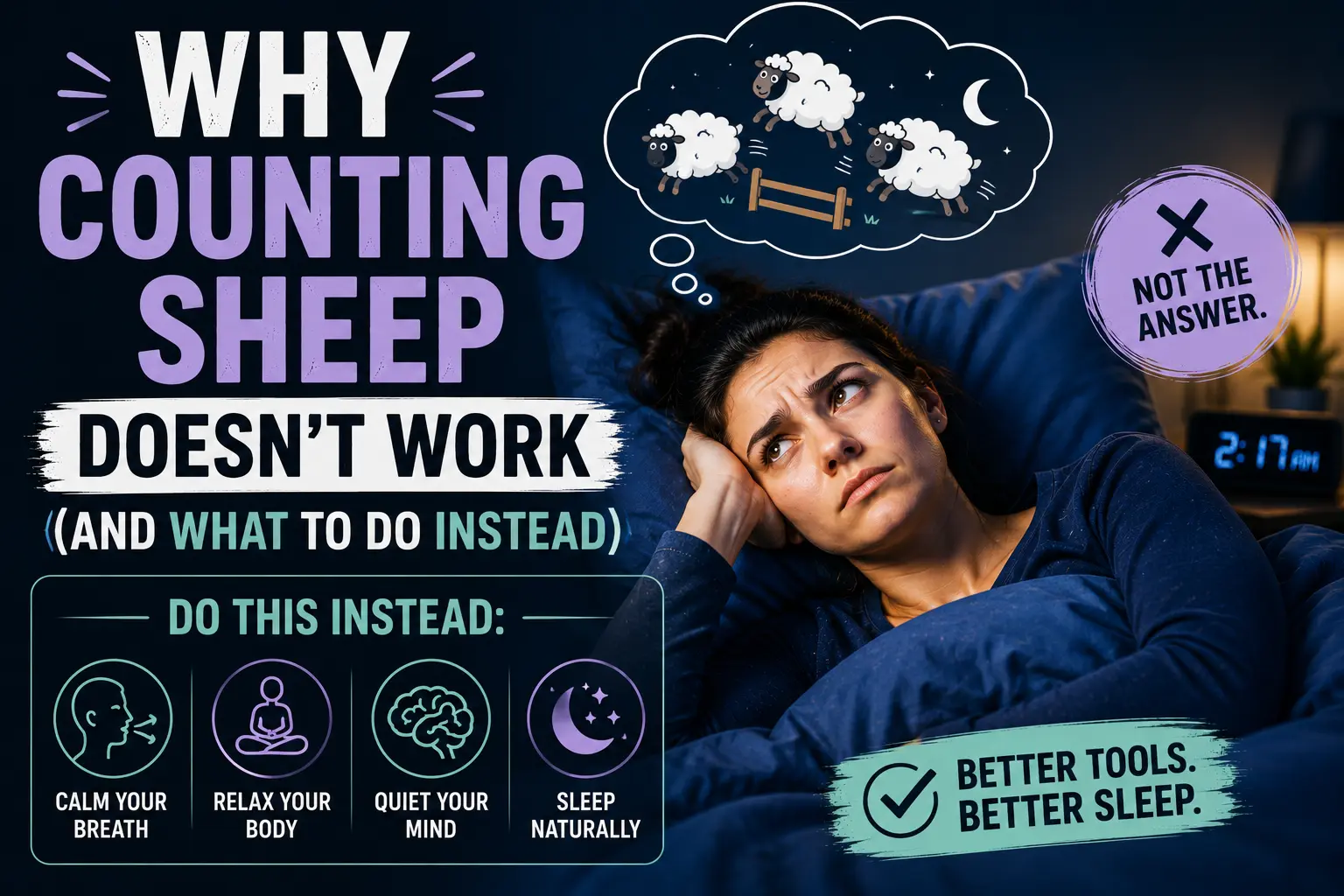
Counting sheep keeps your thinking brain online when sleep needs the opposite. Here is why the old trick fails, and what to do instead for a quieter night.
Counting sheep does not work because it asks your thinking mind to stay on duty when sleep needs that mind to step back. The classic image of fluffy animals jumping a fence is cute, but the mechanism is the problem: you are assigning your brain a continuous cognitive task at the exact moment you want cognition to quiet down. Sleep is more likely when attention softens and the body downshifts. Counting does the opposite of both.
This article explains why the habit fails, when any kind of counting can still help, and what to do instead - especially paced breathing for sleep and approaches that interrupt nighttime overthinking without forcing a blank mind.
Where the sheep myth came from
Counting sheep is old folk advice. The idea was simple: give the mind a boring, repetitive image so it stops solving problems. In theory, boredom becomes sleepiness. In practice, modern nights are different. People arrive in bed already stimulated, already behind on sleep, and already monitoring whether sleep will happen. A repetitive mental task on top of that monitoring becomes another performance to fail.
There is also a cultural reason the myth survives. It is easy to say, easy to remember, and it sounds harmless. Harmless is not the same as effective. When a method fails night after night, people often conclude they are the problem - too anxious, too broken at sleep - when the method was a poor fit from the start.
There is a kinder reading of the advice: people have always known that an occupied mind sleeps more easily than a frantic one. The error was choosing occupation that still feels like office work. The fix is not “try harder to imagine sheep.” The fix is a different kind of occupation - slower, more sensory, less evaluative.
What counting actually does in the brain
Counting is not rest. It is sequential attention. Even a simple sequence requires:
- Holding a number in working memory
- Updating that number
- Checking whether you lost the count
- Restarting when you notice a gap
- Evaluating whether this is “working”
That last step is the silent saboteur. The moment you think why am I still awake at 87 sheep, you have left the boring image and entered self-surveillance. Self-surveillance is high-arousal cognition. It is useful for deadlines. It is unhelpful at 1 a.m.
If rumination is already present - tomorrow’s meeting, a conversation that went wrong, a body sensation you cannot ignore - counting rarely replaces those loops. It competes with them. Competition is effort. Effort is activation. Activation delays sleep.
Why sheep fail specifically at night
1. The content is too weak to hold a busy mind
A fence and some sheep are not compelling enough to occupy a brain that spent the day on messages, conflict, and unfinished lists. Stronger thoughts win. The sheep become background noise, then disappear, and you are back in the original loop.
2. The task is still internal
Everything happens inside your head. There is no external rhythm to follow, no sensory anchor strong enough to pull attention out of verbal thought. When anxiety or overthinking is high, internal-only tools often collapse.
3. Mistakes become stimulation
Lose count. Restart. Feel annoyed. Try harder. That cycle looks tiny, but it is the same pattern as refreshing email: small spikes of effort that keep you online.
4. It ignores the body
Sleep is not only a mental state. Heart rate, muscle tension, breathing pace, and temperature all matter. Counting sheep does almost nothing for those inputs. You can count perfectly and still feel wired.
5. It becomes a conditioned failure cue
After enough failed nights, “time to count sheep” starts meaning “time for the thing that never works.” The method itself can raise dread. That is not superstition. It is learning.
When counting can help (and when it cannot)
Counting is not useless in every form. It helps when it is tied to a physical rhythm and kept very light - for example, silently matching a slow inhale and a longer exhale without turning the numbers into a scoreboard. In that case, the count is a temporary scaffold for pace, not the main event.
Counting fails when:
- You are already highly anxious or angry
- You are using it to force sleep on a deadline
- You keep checking progress (“how many sheep until I sleep?”)
- The count replaces a real wind-down and is your only tool
If your nights are more “racing thoughts” than “mild boredom,” skip sheep entirely. Go to a body-first method.
Children sometimes fall asleep to repetitive stories because a trusted voice carries the rhythm. Adults trying to manufacture that rhythm alone, while also grading themselves, are playing a harder game with worse tools. Prefer methods that reduce self-grading.
What to do instead
1. Longer-exhale breathing
A simple pattern that many people tolerate well in bed:
- Inhale through the nose for about four seconds - quiet, not a big gulp of air
- Exhale slowly for six to eight seconds
- Skip long holds if you feel tense
- Continue for five minutes
The longer exhale is the useful part. It gives your nervous system a downshift signal that counting sheep never provides. For a deeper walkthrough of paced approaches, see paced breathing for sleep.
If you notice yourself “performing” the breath - chasing perfect timing, judging every inhale - soften the volume and stop optimizing. Comfort beats precision.
2. Put the pace outside your head
When mental counting feels like one more task, borrow an external pace. A guided session with a calming background scene and sound lets you follow the rhythm without managing a metronome in your thoughts. That is the core idea behind QuietFlame: short sessions by goal (Sleep, Relax, and others), each with a breathing pattern, scene, and sound. The point is not entertainment. The point is offloading the count so your attention can rest on something slower than your worry.
Use it before lights-out when you can, then put the phone away. A guide that becomes a scroll session defeats the purpose.
If you prefer staying phone-free in bed, do the guided minutes while sitting on the edge of the mattress, then set the phone aside and keep the same longer-exhale pace for another minute or two with eyes closed. You get the external start without turning bed into a device station.
3. Interrupt overthinking without blanking the mind
Telling yourself to think of nothing usually fails. A better target is giving attention a simple sensory job: feel the air leave the nose, feel the belly soften, feel the weight of the sheets. If thoughts return - they will - notice them and return to the sensory cue. That is the same logic behind practices for stopping overthinking at night: interrupt the loop, do not wage war on thinking.
A two-minute open-loop dump before bed also helps. Write the unfinished items and one next step for tomorrow. Then stop analyzing. Dumping is not journaling for insight. It is moving loops out of working memory.
4. Change the demand from “sleep now” to “soften now”
Sheep counting often carries a hidden demand: produce sleep. That demand raises pressure. Replace it with a smaller goal: become 10% less activated than five minutes ago. Sleep is more likely to follow a softer body than a forced blank mind.
5. Keep the environment from fighting you
Bright screens, a hot room, a full mental review of the day, and clock-watching all make any technique harder. Dim light, cooler air if possible, and no progress checks. If you use a phone for a guided session, end when the session ends.
Also watch the “one more useful thing” trap: answering a last message, peeking at tomorrow’s calendar, or researching a worry “so you can sleep.” Those feel productive. They usually re-open the cognitive loop sheep were supposed to close.
A practical replacement routine
- Hard stop on stimulating input
- Two-minute dump of open loops
- Five minutes of longer-exhale breathing - guided if counting feels hard
- Get into bed with one sensory anchor (exhale, weight, warmth)
- If thoughts spike, return to the anchor - not to sheep, not to problem-solving
This is short enough for weeknights and specific enough to become a cue. Cues matter because sleep difficulty is partly learned. A repeated sequence teaches your system how evening ends.
If five minutes feels impossible, start with two. Consistency beats an impressive plan you abandon.
Why an external pace beats mental counting
Mental counting depends on the same resources that worry uses: verbal attention and monitoring. External pacing uses different channels - sight, sound, and a rhythm you can follow without inventing it. On easy nights, either can work. On hard nights, the external option usually fails less often because it asks less of a tired, activated mind.
That is also why some people say “I tried breathing and it didn’t work,” when what they tried was unguided counting of the breath while already spiraling. The method was still mostly cognitive. A five-minute breathing reset works better when the pace is clear and the demand is low.
Think of it this way: sheep ask your mind to generate content. A good night practice asks your body to follow a rhythm. Generation is expensive. Following is cheaper. On a tired night, cheaper wins.
What to expect when you switch
Night one: you may still wake up mental. That does not mean the new method failed. It means your system is used to the old pattern.
First week: the urge to count sheep (or check the clock) may appear out of habit. Treat that as a cue to return to the exhale or guided pace, not as proof you should go back to sheep.
Two weeks: lying down can start to feel less like a test you are failing and more like a known transition. The win is often shorter spirals, not perfect sleep every night.
Some nights will still be rough. Keep the same small plan. Nervous systems learn from repetition more than from one dramatic breakthrough.
Common mistakes when replacing sheep
Swapping sheep for a more complicated mental game. Alphabet categories, elaborate visualizations, and detailed fantasy plots can become another performance. Keep the replacement simple.
Breathing harder to “make it work.” Bigger breaths can increase lightheadedness or anxiety. Soften the inhale. Lengthen the exhale.
Starting only after peak frustration. Begin the practice earlier - ideally before you are already angry at being awake.
Using the guide as a delay tactic. One short session, then lights down. Not three sessions plus email.
Judging every night by sleep latency alone. Also notice whether dread, muscle tension, and looping intensity dropped. Those are progress.
Mixing five new techniques in one night. If sheep failed, the answer is not a chaotic toolkit. Pick one breathing pattern and one dump ritual. Repeat them long enough to learn.
If you wake at 3 a.m. and reach for sheep
Middle-of-the-night awakenings are a common place for the old habit to return. You wake, feel pressure to fall back asleep immediately, and start counting because it is familiar. Use the same replacement at lower intensity:
- Keep lights off or very low
- Skip the dump unless a single urgent loop is loud - then one line on a notepad is enough
- Do two to five minutes of longer-exhale breathing
- Avoid the phone if you can; if you need a guide, use the dimmest setting and stop when the session ends
Do not restart the whole day in your head. The job is a small downshift, not a full life review.
Counting sheep vs breathing: a quick contrast
| Approach | Main demand | Body effect | Best for |
|---|---|---|---|
| Counting sheep | Continuous mental tracking | Minimal | Mild boredom on easy nights (sometimes) |
| Unguided breath counting | Tracking + pacing | Moderate if exhale is longer | Mild restlessness |
| Longer-exhale breathing | Light attention on pace | Stronger downshift signal | Wired-but-tired nights |
| Guided scene + sound | Follow, don’t invent | Downshift with less cognitive load | Overthinking and high mental fatigue |
You do not need all four. Pick one replacement and repeat it.
If you live with a partner, agree on a simple cue so you are not whispering “are you asleep?” into the dark - another form of monitoring. A shared wind-down earlier in the evening often helps more than synchronized sheep at midnight.
Try this tonight
- Skip the sheep.
- Write three open loops on paper or notes.
- Breathe: inhale about four, exhale six to eight, for five minutes - guided if mental counting feels like work.
- Lie down with attention on the exhale.
- When thoughts return, return to the breath or scene - not to a scoreboard.
You are not trying to become a person with an empty mind. You are trying to stop assigning your brain homework at bedtime.
This article is educational, not medical advice. If you have a respiratory or cardiac condition, or if breath practices increase panic, keep the breath gentle, avoid long holds, and speak with a clinician if needed. Stop if you feel unwell. Comfort comes first.
FAQ
Why doesn't counting sheep work?
Counting is mental work. It keeps attention, evaluation, and effort online when sleep needs less cognitive load. Many people also start judging how well they are counting, which raises alertness.
What should I do instead of counting sheep?
Use a longer-exhale breathing pattern, or follow an external pace like a guided session with a calming scene and sound so you are not tracking numbers yourself.
Is counting breaths better than counting sheep?
Slightly, if the count follows a slow physical rhythm. But if counting still feels like a task, switch to a guided pace or a simple body-based cue like feeling the exhale lengthen.
How long should I try an alternative before getting up?
Give a breathing practice about five to ten minutes. If you are still highly agitated after roughly twenty minutes in bed, sit up in low light, reset briefly, then return.